Zhang Lixia, Su Yuanbo, Hsieh Evelyn, Xia Weibo, Xie Jing, Han Yang, Cao Ying, Li Yanling, Song Xiaojing, Zhu Ting, Li Taisheng, Yu Wei
BMC Musculoskelet Disord. 2013 Jul 30;14:224. doi: 10.1186/1471-2474-14-224.
Low bone mass and high bone turnover have been reported in HIV-infected individuals, both as a consequence of HIV infection itself, as well as from treatment with highly active antiretroviral therapy (HAART). The purpose of this study is to evaluate the impact of HAART on bone mineral density and bone turnover in HIV-1 infected Chinese patients.
Forty HIV-1 infected patients were enrolled in this study; all patients were followed through 48 weeks, and 17 patients completed 96 weeks. Bone mineral density (BMD), procollagen type 1 N-terminal propeptide (P1NP), collagen type 1 cross-linked C-telopeptide (β-CTX), parathyroid hormone (PTH), and 25-OH vitamin D levels were measured at baseline, 48 and 96 weeks. Baseline measurements were compared with an age-, gender-, and BMI-matched healthy control population.
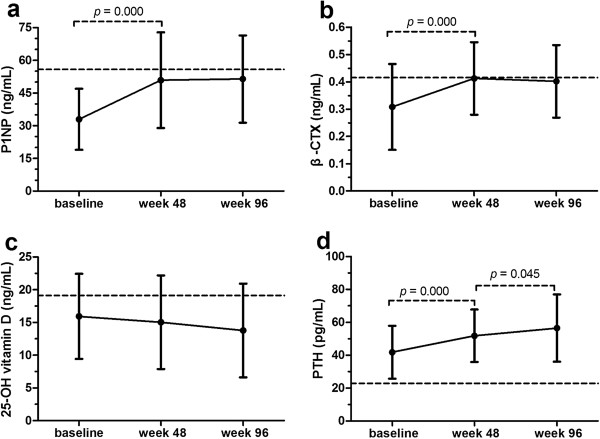
At baseline, raw BMD in the lumbar spine of HIV-1 infected patients was significantly lower than that of healthy controls (1.138 ± 0.112 g/cm2 vs. 1.195 ± 0.139 g/cm2, p = 0.047). During the first 48 weeks after initiating HAART, BMD of lumbar spine, femoral neck, and total hip decreased significantly in HIV-1 infected patients, with annual percent decline ranging from 1.78-3.28%. However, from week 48 to 96, BMD remained stable. Baseline levels of β-CTX (0.31 ± 0.16 ng/mL vs. 0.42 ± 0.19 ng/mL, p = 0.008) and P1NP (32.96 ± 14.00 ng/mL vs. 55.82 ± 26.87 ng/mL, p = 0.05) were lower in HIV-infected patients compared with controls, respectively. Both β-CTX and P1NP levels increased after onset of HAART until week 48, and remained elevated during the next 48 weeks. 25-OH vitamin D in HIV-infected patients was lower at baseline compared to healthy controls, but this difference was not statistically significant. PTH, however, was higher in HIV patients at baseline, and showed a significant increase throughout the study.
Chinese adults with HIV-1 infection have low bone turnover prior to HAART as well as lower raw BMD of the lumbar spine compared with healthy controls, with further bone loss occurring following the initiation of HAART. The long-term clinical implications of these findings remain unclear at this time.
据报道,HIV感染者存在低骨量和高骨转换情况,这既是HIV感染本身的结果,也是高效抗逆转录病毒疗法(HAART)治疗的结果。本研究的目的是评估HAART对HIV-1感染的中国患者骨矿物质密度和骨转换的影响。
本研究纳入了40例HIV-1感染患者;所有患者均随访48周,17例患者完成了96周的随访。在基线、48周和96周时测量骨矿物质密度(BMD)、1型前胶原N端前肽(P1NP)、1型胶原交联C末端肽(β-CTX)、甲状旁腺激素(PTH)和25-羟基维生素D水平。将基线测量结果与年龄、性别和BMI匹配的健康对照人群进行比较。
在基线时,HIV-1感染患者腰椎的原始BMD显著低于健康对照者(1.138±0.112g/cm²对1.195±0.139g/cm²;p=0.047)。在开始HAART后的前48周内,HIV-1感染患者腰椎、股骨颈和全髋的BMD显著下降,年下降百分比在1.78%-3.28%之间。然而,从第48周到96周,BMD保持稳定。与对照组相比,HIV感染患者的β-CTX基线水平(0.31±0.16ng/mL对0.42±0.19ng/mL;p=0.00)和P1NP基线水平(32.96±14.00ng/mL对55.82±26.87ng/mL;p=0.05)分别较低。HAART开始后直到第48周,β-CTX和P1NP水平均升高,并在接下来的48周内保持升高。HIV感染患者的25-羟基维生素D在基线时低于健康对照者,但这种差异无统计学意义。然而,HIV患者的PTH在基线时较高,并在整个研究过程中显著升高。
与健康对照者相比,HIV-1感染的中国成年人在HAART治疗前骨转换较低,腰椎原始BMD也较低,开始HAART后会出现进一步的骨质流失。目前这些发现的长期临床意义尚不清楚。