Chinnakkannan Selvakumar, Das Rashmi Ranjan, Rughmini K, Ahmed Sufath
Department of Pediatrics, Sree Balaji Medical College, Chrompet, Chennai, India.
Indian J Hum Genet. 2013 Jan;19(1):108-10. doi: 10.4103/0971-6866.112924.
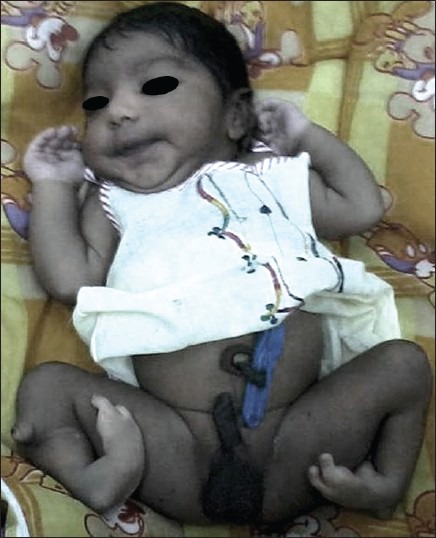
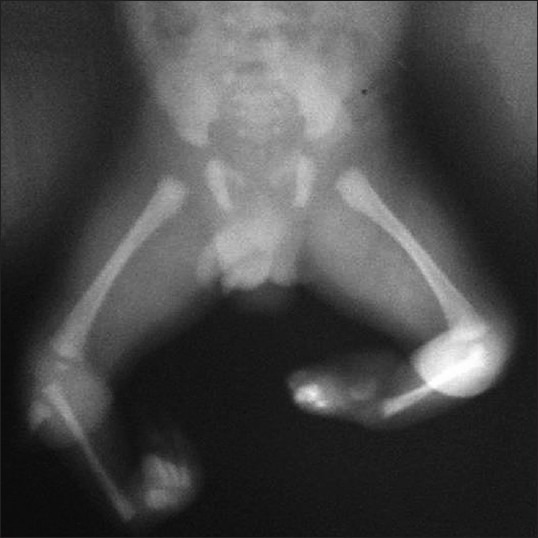
Congenital absence of tibia is a rare anomaly, and may be total or partial, unilateral or bilateral. Total absence is more frequent than partial, unilateral absence occurs more often than bilateral, with right limb more commonly affected than the left. In partial defect, almost always the distal end of the bone is affected, and of the bilateral cases, there may be total absence on both sides, or total on one side and partial on the other. Males are slightly more commonly affected than the females. Though, the family history is usually negative for congenital abnormalities and other diseases, there is a considerable chance of occurrence of congenital defect of the tibia or of other abnormalities, in near or remote relatives. We report a case of newborn having bilateral tibial hemimelia type VIIa.
先天性胫骨缺如是一种罕见的畸形,可为完全性或部分性,单侧或双侧。完全性缺比比部分性更常见,单侧缺比双侧更常见,右侧肢体比左侧更易受累。在部分缺损中,几乎总是骨的远端受累,在双侧病例中,可能两侧均为完全性缺如,或一侧为完全性而另一侧为部分性。男性受累略多于女性。虽然家族史通常无先天性异常和其他疾病,但在近亲或远亲中,发生胫骨先天性缺损或其他异常的可能性相当大。我们报告一例患有双侧VIIa型胫骨半肢畸形的新生儿病例。