Otsuji Tsuyoshi, Nagai Yoshimi, Sho Kenichiro, Tsumura Akiko, Koike Naoko, Tsuda Mei, Nishimura Tetsuya, Takahashi Kanji
Department of Ophthalmology, Kansai Medical University, Takii Hospital, Osaka, Japan.
Clin Ophthalmol. 2013;7:1487-90. doi: 10.2147/OPTH.S46317. Epub 2013 Jul 22.
Patients with exudative age-related macular degeneration (AMD) who did not respond to ranibizumab at the induction phase were assessed and referred to as initial non-responders.
We retrospectively reviewed the medical records of 215 patients (218 eyes) with exudative AMD. For the initial treatments, patients received three intravitreal injections of ranibizumab (IVR) every 4 weeks. Minimum follow-up period was 12 months. We defined patients with no improvement of best corrected logMAR visual acuity (BCVA), and with no decrease of central retinal thickness (CRT) at the end of the initial treatment, as initial non-responders. Patients who had previous treatment history prior to this investigation were included, but patients who had photodynamic therapy (PDT) with IVR were excluded.
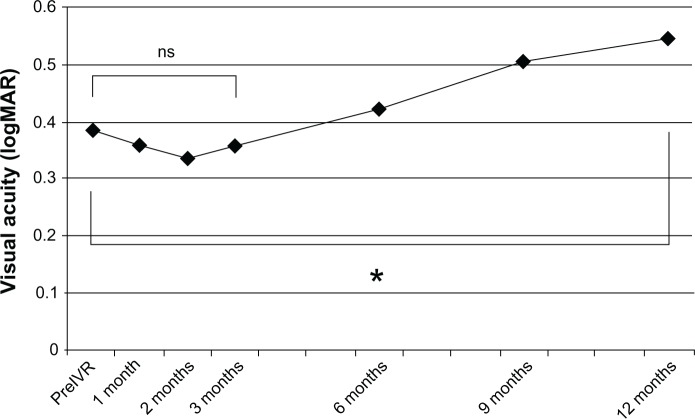
Twenty-two eyes (10.1%) were identified as initial non-responders. The mean BCVA of initial non-responders before IVR and after induction phase were 0.39 and 0.36, respectively. There was no significant difference between these values, however the mean BCVA decreased significantly to 0.55 at 12 months after the beginning of the induction phase (P = 0.021). The mean greatest linear dimension (GLD) of the lesion before IVR of initial non-responders was 4,121 μm. We found 16 eyes with typical AMD, and six eyes with polypoidal choroidal vasculopathy. One eye had predominantly classic choroidal neovascularization (CNV), and others had occult CNV of typical AMD. As additional treatments, twelve eyes received PDT, and in three of the eyes exudation remained after PDT.
Initial non-responders were more prevalent in patients with occult CNV than in patients with other CNV types. Some of the initial non-responders did not respond to PDT. This study suggested possible involvement of other factors, in addition to vascular endothelial growth factor, in the occurrence of CNV in initial non-responder patients.
对诱导期使用雷珠单抗无反应的渗出性年龄相关性黄斑变性(AMD)患者进行评估,并将其称为初始无反应者。
我们回顾性分析了215例(218只眼)渗出性AMD患者的病历。初始治疗时,患者每4周接受3次玻璃体内注射雷珠单抗(IVR)。最短随访期为12个月。我们将初始治疗结束时最佳矫正logMAR视力(BCVA)无改善且中心视网膜厚度(CRT)无降低的患者定义为初始无反应者。纳入本次研究前有过治疗史的患者,但排除曾接受光动力疗法(PDT)联合IVR治疗的患者。
22只眼(10.1%)被确定为初始无反应者。初始无反应者在IVR前和诱导期后的平均BCVA分别为0.39和0.36。这些值之间无显著差异,但诱导期开始后12个月时平均BCVA显著降至0.55(P = 0.021)。初始无反应者IVR前病变的平均最大线性尺寸(GLD)为4121μm。我们发现16只眼为典型AMD,6只眼为息肉样脉络膜血管病变。1只眼主要为典型脉络膜新生血管(CNV),其他为典型AMD的隐匿性CNV。作为额外治疗,12只眼接受了PDT,其中3只眼在PDT后仍有渗出。
隐匿性CNV患者中初始无反应者比其他CNV类型患者更常见。一些初始无反应者对PDT无反应。本研究提示,除血管内皮生长因子外,其他因素可能也参与了初始无反应者患者CNV的发生。