Department of Emergency Medicine, University of Massachusetts Medical School, Worcester, MA, USA.
Clin Epidemiol. 2013 Jul 22;5:229-36. doi: 10.2147/CLEP.S45646. Print 2013.
Limited recent data are available describing differences in long-term survival, and factors affecting prognosis, after ST-segment elevation myocardial infarction (STEMI) and non-ST-segment elevation myocardial infarction (NSTEMI), especially from the more generalizable perspective of a population-based investigation. The objectives of this study were to examine differences in post-discharge prognosis after hospitalization for STEMI and NSTEMI, with a particular focus on factors associated with reduced long-term survival.
We reviewed the medical records of residents of the Worcester, MA, USA metropolitan area hospitalized at eleven central Massachusetts medical centers for acute myocardial infarction (AMI) during 2001, 2003, 2005, and 2007.
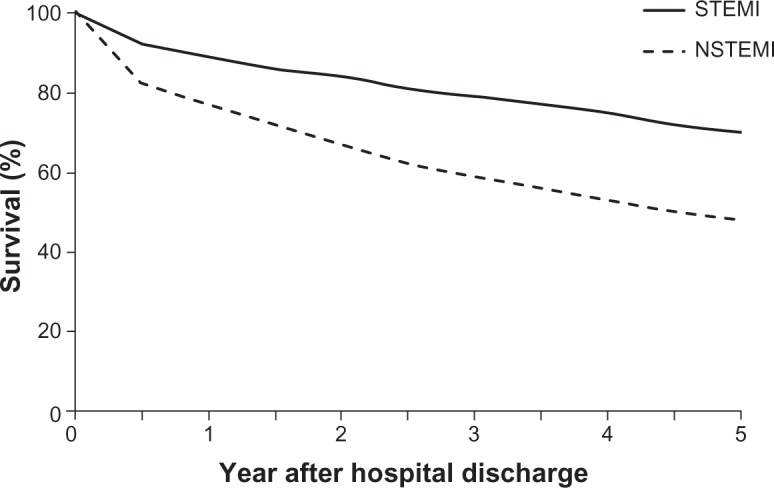
A total of 3762 persons were hospitalized with confirmed AMI; of these, 2539 patients (67.5%) were diagnosed with NSTEMI. The average age of study patients was 70.3 years and 42.9% were women. Patients with NSTEMI experienced higher post-discharge death rates with 3-month, 1-year, and 2-year death rates of 12.6%, 23.5%, and 33.2%, respectively, compared to 6.1%, 11.5%, and 16.4% for patients with STEMI. After multivariable adjustment, patients with NSTEMI were significantly more likely to have died after hospital discharge (adjusted hazards ratio 1.28; 95% confidence interval 1.14-1.44). Several demographic (eg, older age) and clinical (eg, history of stroke) factors were associated with reduced long-term survival in patients with NSTEMI and STEMI.
The results of this study in residents of central Massachusetts suggest that patients with NSTEMI are at higher risk for dying after hospital discharge, and several subgroups are at particularly increased risk.
目前关于 ST 段抬高型心肌梗死(STEMI)和非 ST 段抬高型心肌梗死(NSTEMI)患者出院后长期生存差异及其预后影响因素的资料有限,特别是从基于人群的调查更普遍的角度来看。本研究的目的是检查 STEMI 和 NSTEMI 住院患者出院后预后的差异,并特别关注与长期生存率降低相关的因素。
我们回顾了 2001 年、2003 年、2005 年和 2007 年美国马萨诸塞州伍斯特市大都市区的居民在马萨诸塞州中部 11 家医疗中心因急性心肌梗死(AMI)住院的医疗记录。
共有 3762 人因确诊 AMI 住院;其中 2539 例(67.5%)患者诊断为 NSTEMI。研究患者的平均年龄为 70.3 岁,42.9%为女性。与 STEMI 患者相比,NSTEMI 患者出院后死亡率更高,3 个月、1 年和 2 年的死亡率分别为 12.6%、23.5%和 33.2%,而 STEMI 患者的死亡率分别为 6.1%、11.5%和 16.4%。多变量调整后,NSTEMI 患者出院后死亡的风险明显更高(调整后的危险比 1.28;95%置信区间 1.14-1.44)。一些人口统计学因素(如年龄较大)和临床因素(如中风史)与 NSTEMI 和 STEMI 患者的长期生存降低有关。
这项对马萨诸塞州中部居民的研究结果表明,NSTEMI 患者出院后死亡风险较高,一些亚组的风险尤其增加。