Department of Cardiovascular Medicine, Graduate School of Medicine, Kyoto University, Kyoto, Japan.
Department of Clinical Epidemiology, Hyogo College of Medicine, Nishinomiya, Japan.
PLoS One. 2021 Nov 17;16(11):e0259268. doi: 10.1371/journal.pone.0259268. eCollection 2021.
The detailed causes of death in non-ST-segment-elevation myocardial infarction (NSTEMI) have not been adequately evaluated compared to those in ST-segment elevation myocardial infarction (STEMI).
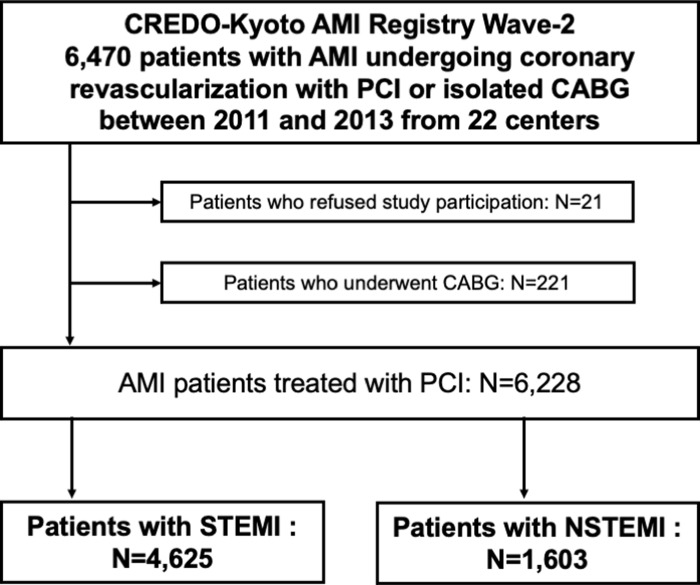
The study population was 6,228 AMI patients who underwent percutaneous coronary intervention (STEMI: 4,625 patients and NSTEMI: 1,603 patients). The primary outcome was all-cause death.
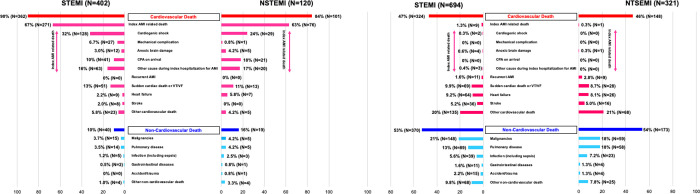
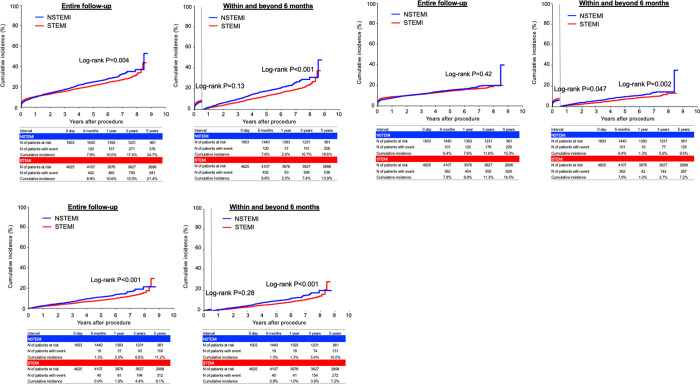
Within 6 months after AMI, the adjusted mortality risk was not significantly different between NSTEMI patients and STEMI patients (HR: 0.83, 95%CI: 0.67-1.03, P = 0.09). Regarding the causes of death within 6 months after AMI, mechanical complications more frequently occurred in STEMI patients than in NSTEMI patients, while proportions of post resuscitation status on arrival and heart failure were higher in in NSTEMI patients than in STEMI patients. Beyond 6 months after AMI, the adjusted mortality risk of NSTEMI relative to STEMI was not significantly different. (HR: 1.04, 95%CI: 0.90-1.20, P = 0.59). Regarding causes of death beyond 6 months after AMI, almost half of deaths were cardiovascular causes in both groups, and breakdown of causes of death was similar between NSTEMI and STEMI.
The mortality risk within and beyond 6 months after AMI were not significantly different between STEMI patients and NSTEMI patients after adjusting confounders. Deaths due to post resuscitation status and heart failure were more frequent in NSTEMI within 6 months after AMI.
与 ST 段抬高型心肌梗死(STEMI)相比,非 ST 段抬高型心肌梗死(NSTEMI)的详细死亡原因尚未得到充分评估。
研究人群为 6228 名接受经皮冠状动脉介入治疗(STEMI:4625 例,NSTEMI:1603 例)的急性心肌梗死(AMI)患者。主要结局为全因死亡。
在 AMI 后 6 个月内,NSTEMI 患者与 STEMI 患者的调整后死亡风险无显著差异(HR:0.83,95%CI:0.67-1.03,P=0.09)。关于 AMI 后 6 个月内的死亡原因,机械并发症在 STEMI 患者中比在 NSTEMI 患者中更常见,而复苏后状态到达时和心力衰竭的比例在 NSTEMI 患者中高于 STEMI 患者。在 AMI 后 6 个月以上,NSTEMI 相对于 STEMI 的调整后死亡风险无显著差异(HR:1.04,95%CI:0.90-1.20,P=0.59)。关于 AMI 后 6 个月以上的死亡原因,两组近一半的死亡原因是心血管原因,NSTEMI 和 STEMI 之间的死亡原因分布相似。
在调整混杂因素后,STEMI 患者和 NSTEMI 患者在 AMI 后 6 个月内和 6 个月以上的死亡风险无显著差异。在 AMI 后 6 个月内,由于复苏后状态和心力衰竭导致的死亡在 NSTEMI 中更为常见。