Division of Cancer Studies, Cancer Epidemiology Group, School of Medicine, King's College London, London, UK.
BJU Int. 2013 Dec;112(8):1113-20. doi: 10.1111/bju.12239. Epub 2013 Jul 26.
To evaluate the risk of different in-hospital complications for patients undergoing a radical cystectomy (RC), as limited nationwide population data on short- and long-term complications after RC is available, despite it being the standard treatment for localised muscle-invasive urinary bladder cancer (UBC).
In all, 7608 persons underwent a RC after UBC diagnosis, as registered in the Swedish National Patient Register between 1964 and 2008. We estimated the frequency and incidences and calculated hazard ratios (HR) and 95% confidence intervals (CI) using multivariate Cox proportional hazards models.
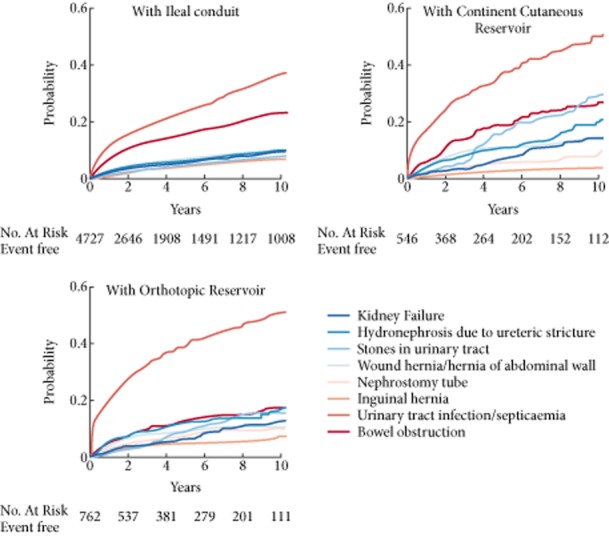
Urinary tract infection/septicaemia was the most common complication following radical cystectomy, with an incidence of 90.4 per 1,000 person years. There was a higher risk of urinary tract infection among patients who had a continent cutaneous reservoir (HR: 1.11 (0.94-1.30) or orthotopic neobladder 1.21 (1.05-1.39) than among those with ileal conduit. Similarly, continent cutaneous reservoir and orthotopic neobladder were associated with increased risks for wound and abdominal wall hernias, stones in the urinary tract, hydronephrosis and nephrostomy tube treatment, and kidney failure. In contrast, risk of bowel obstruction was lower among those with orthotopic neobladder than those with ileal conduit (HR: 0.64 (0.50-0.81)) and those with continent cutaneous reservoir (HR: 0.92 (0.73-1.16).
In-hospital complications after RC are numerous and continue to accumulate for many years after surgery, indicating the need for life-long follow-up of these patients. Comparison between different types of diversion should, however, be made with care because of potential confounding by indication.
评估接受根治性膀胱切除术(RC)的患者出现不同院内并发症的风险,尽管 RC 是局部肌层浸润性膀胱癌(UBC)的标准治疗方法,但有关其术后短期和长期并发症的全国范围内人群数据有限。
在 1964 年至 2008 年间,共有 7608 例 UBC 患者在瑞典国家患者登记处登记接受 RC。我们估计了频率和发生率,并使用多变量 Cox 比例风险模型计算了危险比(HR)和 95%置信区间(CI)。
尿路感染/败血症是 RC 后最常见的并发症,发病率为每 1000 人年 90.4 例。与回肠造口术相比,有间位皮管储尿器(HR:1.11(0.94-1.30)或原位新膀胱 1.21(1.05-1.39)的患者发生尿路感染的风险更高。同样,间位皮管储尿器和原位新膀胱与增加的伤口和腹壁疝、尿路结石、肾盂积水和肾造口管治疗以及肾衰竭风险相关。相比之下,与回肠造口术相比,原位新膀胱的肠梗阻风险较低(HR:0.64(0.50-0.81)),间位皮管储尿器的肠梗阻风险较低(HR:0.92(0.73-1.16))。
RC 后的院内并发症很多,并且在手术后多年仍在不断累积,这表明这些患者需要终身随访。然而,由于存在潜在的混杂因素,不同类型的转流之间的比较应谨慎进行。