New York University School of Medicine, 645 Translational Research Building, 227 East 30th St, New York, NY 10016, USA.
Prev Chronic Dis. 2013 Aug 1;10:E129. doi: 10.5888/PCD10.130028.
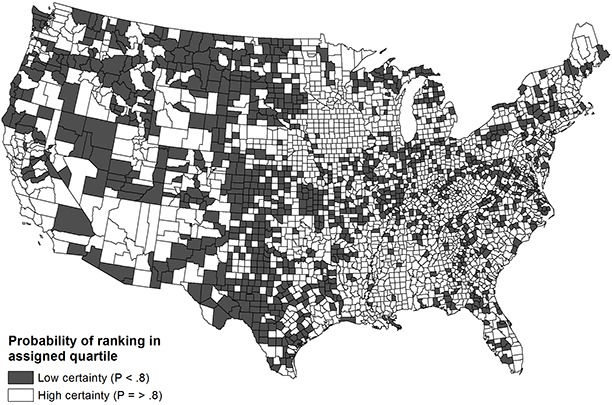
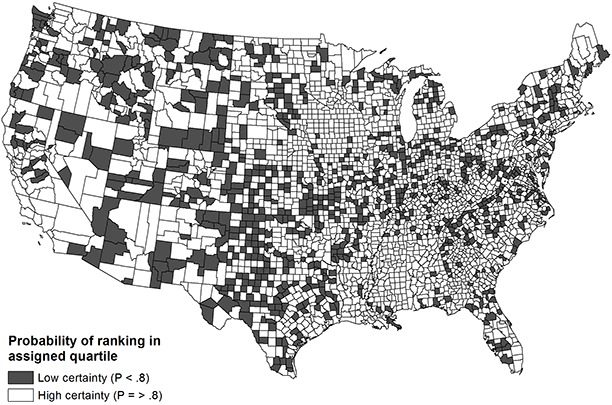
University of Wisconsin Population Health Institute has published County Health Rankings (The Rankings) since 2010. These rankings use population-based data to highlight variation in health and encourage health assessment for all US counties. However, the uncertainty of estimates remains a limitation. We sought to quantify the precision of The Rankings for selected measures. We developed hierarchical models for 5 health outcome measures and applied empirical Bayes methods to obtain county rank estimates for a composite health outcome measure. We compared results using models with and without demographic fixed effects to determine whether covariates improved rank precision. Counties whose rank had wide confidence intervals had smaller populations or ranked in the middle of all counties for health outcomes. Incorporating covariates in the models produced narrower intervals, but rank estimates remained imprecise for many counties. Local health officials, especially in smaller population and mid-performing communities, should consider these limitations when interpreting the results of The Rankings.
威斯康星大学人口健康研究所自 2010 年以来发布了县健康排名(排名)。这些排名使用基于人口的数据来突出健康方面的差异,并鼓励对美国所有县进行健康评估。然而,估计的不确定性仍然是一个限制。我们试图量化排名中选定指标的精度。我们为 5 个健康结果指标开发了层次模型,并应用经验贝叶斯方法为综合健康结果指标获得县排名估计。我们比较了使用具有和不具有人口统计固定效应的模型的结果,以确定协变量是否可以提高排名精度。排名置信区间较宽的县人口较少,或者在所有县中排名居中。在模型中纳入协变量会产生更窄的区间,但许多县的排名估计仍然不够精确。当地卫生官员,尤其是在人口较少和表现中等的社区,在解释排名结果时应考虑到这些限制。