Program in Neuroscience, Harvard Medical School, 220 Longwood Avenue, Boston, MA 02115, USA.
Curr Biol. 2013 Aug 19;23(16):1566-73. doi: 10.1016/j.cub.2013.06.044. Epub 2013 Aug 1.
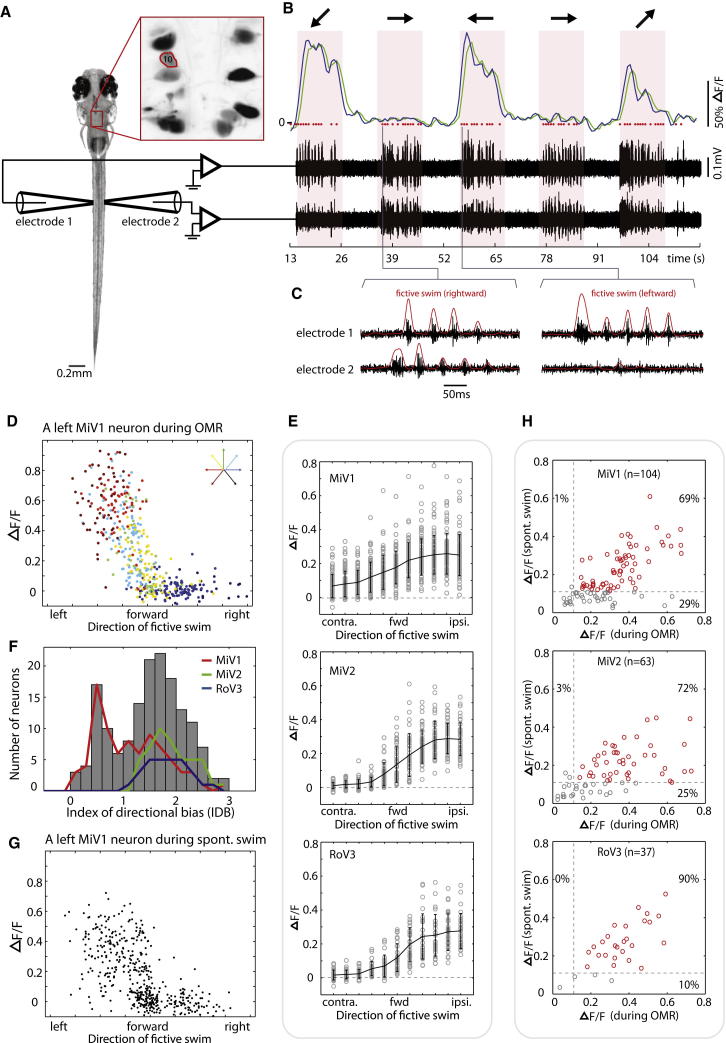
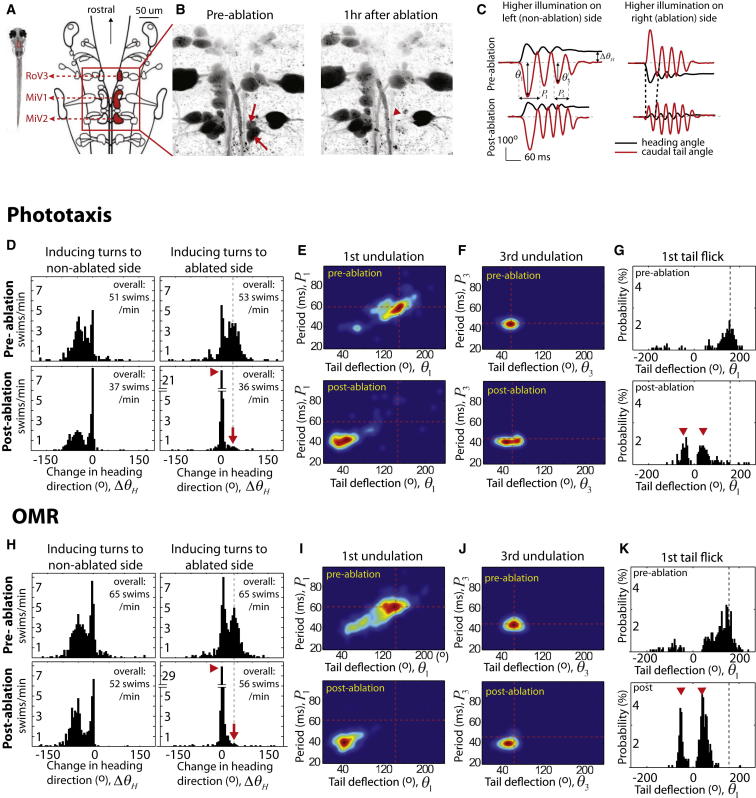
Discrete populations of brainstem spinal projection neurons (SPNs) have been shown to exhibit behavior-specific responses during locomotion [1-9], suggesting that separate descending pathways, each dedicated to a specific behavior, control locomotion. In an alternative model, a large variety of motor outputs could be generated from different combinations of a small number of basic motor pathways. We examined this possibility by studying the precise role of ventromedially located hindbrain SPNs (vSPNs) in generating turning behaviors. We found that unilateral laser ablation of vSPNs reduces the tail deflection and cycle period specifically during the first undulation cycle of a swim bout, whereas later tail movements are unaffected. This holds true during phototaxic [10], optomotor [11], dark-flash-induced [12], and spontaneous turns [13], suggesting a universal role of these neurons in controlling turning behaviors. Importantly, we found that the ablation not only abolishes turns but also results in a dramatic increase in the number of forward swims, suggesting that these neurons transform forward swims into turns by introducing turning kinematics into a basic motor pattern of symmetric tail undulations. Finally, we show that vSPN activity is direction specific and graded by turning angle. Together, these results provide a clear example of how a specific motor pattern can be transformed into different behavioral events by the graded activation of a small set of SPNs.
已显示脑桥脊髓投射神经元 (SPN) 的离散群体在运动过程中表现出行为特异性反应[1-9],这表明单独的下行途径,每个途径都专门用于特定的行为,控制运动。在另一种模型中,大量的运动输出可以由少数基本运动途径的不同组合产生。我们通过研究位于腹侧中脑的 SPN(vSPN)在产生转弯行为中的精确作用来检验这种可能性。我们发现,单侧激光消融 vSPN 会特异性地减少游泳时的尾巴偏转和周期,特别是在第一个波动周期,但随后的尾巴运动不受影响。这在光趋性[10]、光运动性[11]、暗闪光诱导[12]和自发转弯[13]中都是如此,这表明这些神经元在控制转弯行为中具有普遍作用。重要的是,我们发现消融不仅会导致转弯消失,还会导致向前游动的次数急剧增加,这表明这些神经元通过将转弯运动学引入对称尾巴波动的基本运动模式来将向前游动转变为转弯。最后,我们表明 vSPN 活动具有方向特异性,并由转弯角度分级。总之,这些结果提供了一个明确的例子,说明如何通过一组小 SPN 的分级激活将特定的运动模式转化为不同的行为事件。