Laboratório de Imunopatologia, Núcleo de Pesquisas em Ciências Biológicas/NUPEB, Universidade Federal de Ouro Preto, Ouro Preto, Minas Gerais, Brazil.
Mol Immunol. 2013 Dec;56(4):540-8. doi: 10.1016/j.molimm.2013.05.231. Epub 2013 Aug 1.
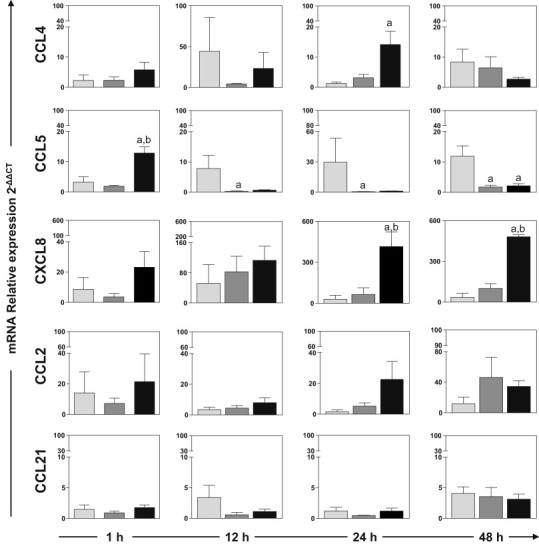
The complex interplay between cytokines and chemokines regulates innate and adaptive immune responses against pathogens; specifically, cytokine and chemokine expression drives activation of immune effector cells and their recruitment to tissue infection sites. Herein, we inoculated dogs with Leishmania braziliensis antigens plus saponin (the LBSap vaccine), as well as with the vaccine components, and then used real-time PCR to evaluate the kinetics of dermal expression of mRNAs of cytokines (IL-12, IFN-γ, TNF-α, IL-4, IL-13, TGF-β and IL-10) and chemokines (CCL2, CCL4, CCL5, CCL21 and CXCL8) 1, 12, 24 and 48 h after inoculation. We also evaluated the correlation between cytokine and chemokine expression and dermal cellularity. The LBSap vaccine induced high levels of IL-12 and IL-10 expression at 12 and 24 h, respectively. Furthermore, we observed positive correlations between IL-12 and IL-13 expression, IFN-γ and IL-13 expression, and IL-13 and TGF-β expression, suggesting that a mixed cytokine microenvironment developed after immunization with the vaccine. Inoculation with the saponin adjuvant alone induced a chemokine and cytokine expression profile similar to that observed in the LBSap group. CCL4 and CXCL8 chemokine expression was up regulated by the LBSap vaccine. CCL5 expression was initially highest in the LBSap group, but at 48 h, expression was highest in the LB group. Information about the kinetics of the immune response to this vaccine gained using this dog model will help to elucidate the mechanisms of and factors involved in a protective response against Leishmania infection and will aid in establishing rational approaches for the development of vaccines against canine visceral leishmaniasis.
细胞因子和趋化因子之间的复杂相互作用调节了针对病原体的先天和适应性免疫反应;具体而言,细胞因子和趋化因子的表达驱动免疫效应细胞的激活及其向组织感染部位的募集。在此,我们用巴西利什曼原虫抗原加皂素(LBSap 疫苗)以及疫苗成分对狗进行接种,然后使用实时 PCR 评估接种后 1、12、24 和 48 小时皮肤细胞因子(IL-12、IFN-γ、TNF-α、IL-4、IL-13、TGF-β 和 IL-10)和趋化因子(CCL2、CCL4、CCL5、CCL21 和 CXCL8)mRNA 的表达动力学。我们还评估了细胞因子和趋化因子表达与皮肤细胞密度之间的相关性。LBSap 疫苗分别在 12 和 24 小时诱导高水平的 IL-12 和 IL-10 表达。此外,我们观察到 IL-12 与 IL-13 表达、IFN-γ与 IL-13 表达以及 IL-13 与 TGF-β 表达之间呈正相关,这表明接种疫苗后形成了混合细胞因子微环境。单独接种皂素佐剂诱导了与 LBSap 组观察到的相似的趋化因子和细胞因子表达谱。LBSap 疫苗上调了 CCL4 和 CXCL8 趋化因子的表达。CCL5 表达在 LBSap 组最初最高,但在 48 小时时,LB 组表达最高。使用这种狗模型获得的关于对这种疫苗的免疫反应的动力学信息将有助于阐明对利什曼原虫感染的保护性反应的机制和涉及的因素,并有助于为开发针对犬内脏利什曼病的疫苗建立合理的方法。