Center for Autism Research, The Children's Hospital of Philadelphia, PA, USA; Child Neuropsychology Section, Department of Child and Adolescent Psychiatry and Psychotherapy, RWTH Aachen University, Aachen, Germany.
Neuropsychologia. 2013 Sep;51(11):2062-9. doi: 10.1016/j.neuropsychologia.2013.07.020. Epub 2013 Aug 1.
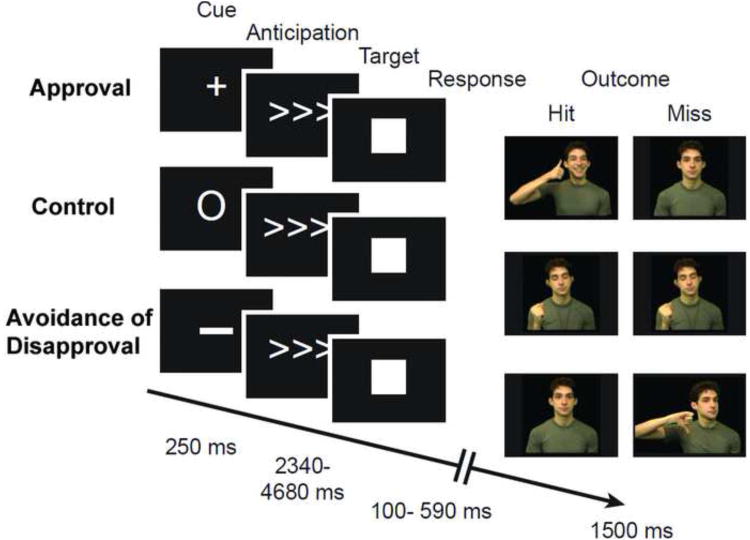
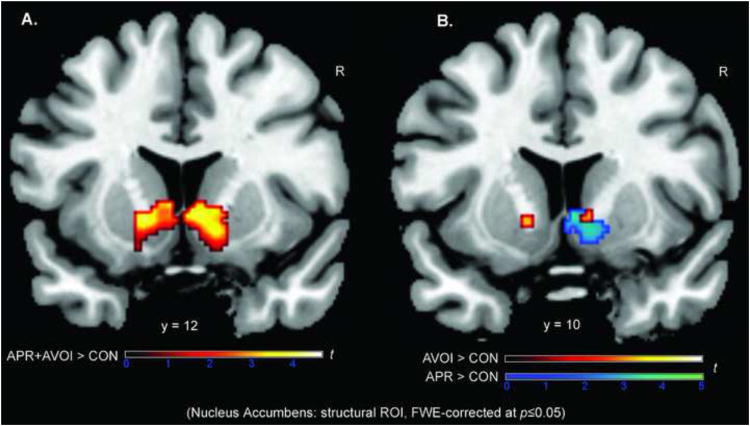
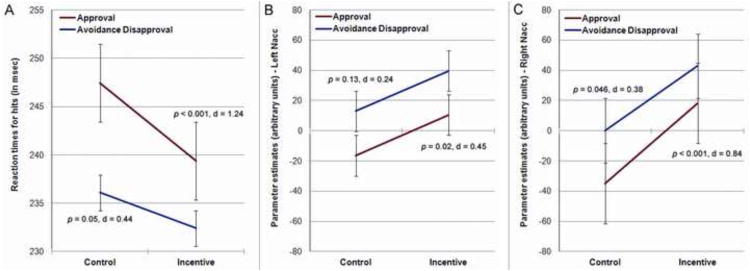
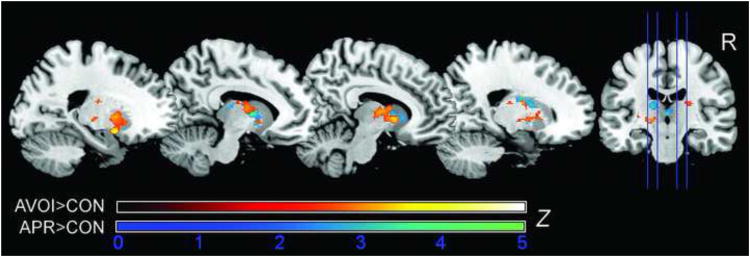
Human social motivation is characterized by the pursuit of social reward and the avoidance of social punishment. The ventral striatum/nucleus accumbens (VS/Nacc), in particular, has been implicated in the reward component of social motivation, i.e., the 'wanting' of social incentives like approval. However, it is unclear to what extent the VS/Nacc is involved in avoiding social punishment like disapproval, an intrinsically pleasant outcome. Thus, we conducted an event-related functional magnetic resonance imaging (fMRI) study using a social incentive delay task with dynamic video stimuli instead of static pictures as social incentives in order to examine participants' motivation for social reward gain and social punishment avoidance. As predicted, the anticipation of avoidable social punishment (i.e., disapproval) recruited the VS/Nacc in a manner that was similar to VS/Nacc activation observed during the anticipation of social reward gain (i.e., approval). Stronger VS/Nacc activity was accompanied by faster reaction times of the participants to obtain those desired outcomes. This data support the assumption that dynamic social incentives elicit robust VS/Nacc activity, which likely reflects motivation to obtain social reward and to avoid social punishment. Clinical implications regarding the involvement of the VS/Nacc in social motivation dysfunction in autism and social phobia are discussed.
人类的社会动机的特点是追求社会奖励和避免社会惩罚。腹侧纹状体/伏隔核(VS/Nacc)尤其与社会动机的奖励成分有关,即对诸如认可等社会激励的“渴望”。然而,尚不清楚 VS/Nacc 在多大程度上参与避免社会惩罚,如不赞成,这是一种内在愉悦的结果。因此,我们进行了一项与社会奖励延迟任务相关的事件相关功能磁共振成像(fMRI)研究,该任务使用动态视频刺激代替静态图片作为社会奖励,以检验参与者对社会奖励获得和社会惩罚回避的动机。正如所预测的,可避免的社会惩罚(即不赞成)的预期会以类似于观察到的社会奖励获得(即赞成)时的 VS/Nacc 激活方式来招募 VS/Nacc。VS/Nacc 活动越强,参与者获得这些期望结果的反应时间就越快。这些数据支持了这样一种假设,即动态社会奖励会引起强烈的 VS/Nacc 活动,这可能反映了获得社会奖励和避免社会惩罚的动机。讨论了 VS/Nacc 在自闭症和社交恐惧症中的社会动机功能障碍中的作用的临床意义。