The Vivan L. Smith Department of Neurosurgery, The University of Texas Medical School at Houston, Houston, TX 77030, USA.
Int J Mol Sci. 2013 Jul 31;14(8):15959-76. doi: 10.3390/ijms140815959.
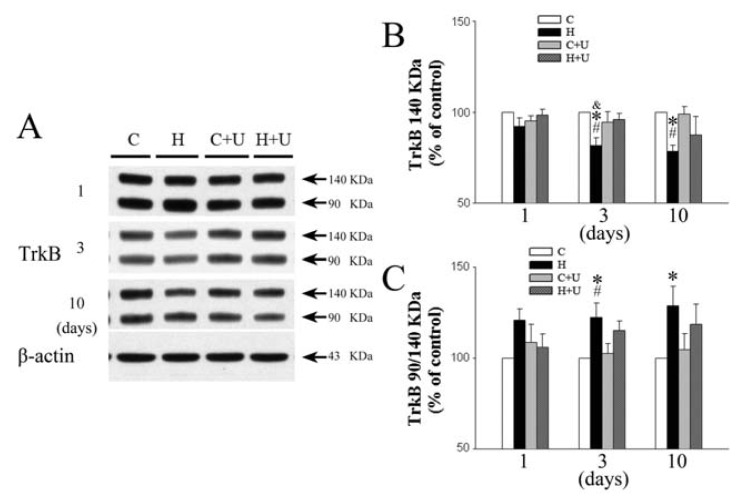
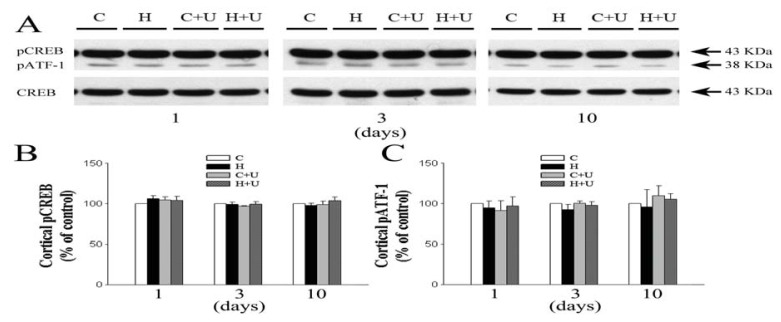
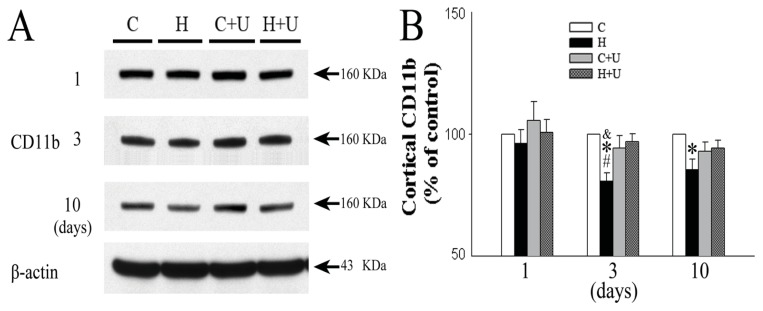
We investigated whether δ-opioid receptor (DOR)-induced neuroprotection involves the brain-derived neurotrophic factor (BDNF) pathway. We studied the effect of DOR activation on the expression of BDNF and other proteins in the cortex of C57BL/6 mice exposed to hypoxia (10% of oxygen) for 1-10 days. The results showed that: (1) 1-day hypoxia had no appreciable effect on BDNF expression, while 3- and 10-day hypoxia progressively decreased BDNF expression, resulting in 37.3% reduction (p < 0.05) after 10-day exposure; (2) DOR activation with UFP-512 (1 mg/kg, i.p., daily) partially reversed the hypoxia-induced reduction of BDNF expression in the 3- or 10-day exposed cortex; (3) DOR activation partially reversed the hypoxia-induced reduction in functional TrkB (140-kDa) and attenuated hypoxia-induced increase in truncated TrkB (90-kDa) in the 3- or 10-day hypoxic cortex; and (4) prolonged hypoxia (10 days) significantly increased TNF-α level and decreased CD11b expression in the cortex, which was completely reversed following DOR activation; and (5) there was no significant change in pCREB and pATF-1 levels in the hypoxic cortex. We conclude that prolonged hypoxia down-regulates BDNF-TrkB signaling leading to an increase in TNF-α in the cortex, while DOR activation up-regulates BDNF-TrkB signaling thereby decreasing TNF-α levels in the hypoxic cortex.
我们研究了 δ-阿片受体 (DOR) 诱导的神经保护是否涉及脑源性神经营养因子 (BDNF) 通路。我们研究了 DOR 激活对暴露于缺氧 (10%氧气) 1-10 天的 C57BL/6 小鼠皮层中 BDNF 和其他蛋白表达的影响。结果表明:(1) 1 天缺氧对 BDNF 表达没有明显影响,而 3 天和 10 天缺氧逐渐降低 BDNF 表达,10 天暴露后降低 37.3%(p<0.05);(2) UFP-512(1mg/kg,腹腔注射,每日)激活 DOR 部分逆转了 3 天或 10 天暴露皮层中缺氧诱导的 BDNF 表达减少;(3) DOR 激活部分逆转了缺氧诱导的 3 天或 10 天缺氧皮层中功能性 TrkB(140kDa)减少,并减弱了缺氧诱导的 TrkB(90kDa)截断增加;(4) 延长缺氧(10 天)显著增加了皮层中的 TNF-α水平和 CD11b 表达,而 DOR 激活完全逆转了这一现象;(5) 缺氧皮层中的 pCREB 和 pATF-1 水平没有明显变化。我们得出结论,延长缺氧下调 BDNF-TrkB 信号导致皮层中 TNF-α增加,而 DOR 激活上调 BDNF-TrkB 信号从而降低缺氧皮层中的 TNF-α水平。