Olin Neuropsychiatry Research Center, Hartford Hospital, Hartford, CT, USA,
Neuroinformatics. 2013 Oct;11(4):495-505. doi: 10.1007/s12021-013-9194-1.
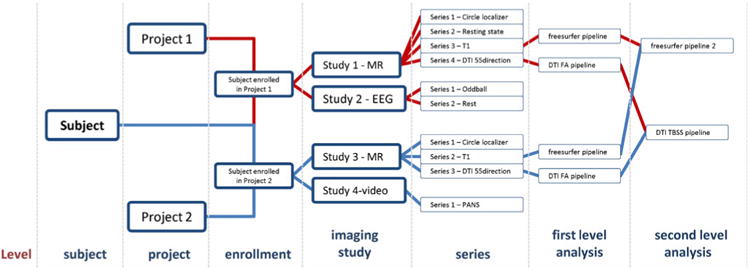
We present a modular, high performance, open-source database system that incorporates popular neuroimaging database features with novel peer-to-peer sharing, and a simple installation. An increasing number of imaging centers have created a massive amount of neuroimaging data since fMRI became popular more than 20 years ago, with much of that data unshared. The Neuroinformatics Database (NiDB) provides a stable platform to store and manipulate neuroimaging data and addresses several of the impediments to data sharing presented by the INCF Task Force on Neuroimaging Datasharing, including 1) motivation to share data, 2) technical issues, and 3) standards development. NiDB solves these problems by 1) minimizing PHI use, providing a cost effective simple locally stored platform, 2) storing and associating all data (including genome) with a subject and creating a peer-to-peer sharing model, and 3) defining a sample, normalized definition of a data storage structure that is used in NiDB. NiDB not only simplifies the local storage and analysis of neuroimaging data, but also enables simple sharing of raw data and analysis methods, which may encourage further sharing.
我们提出了一个模块化、高性能、开源的数据库系统,该系统将流行的神经影像学数据库功能与新颖的点对点共享和简单的安装相结合。自 20 多年前 fMRI 流行以来,越来越多的成像中心创建了大量的神经影像学数据,但其中很多数据都没有被共享。神经信息学数据库(NiDB)提供了一个稳定的平台来存储和操作神经影像学数据,并解决了神经影像学数据共享 INCF 工作组提出的几个数据共享障碍,包括 1)分享数据的动机,2)技术问题,和 3)标准制定。NiDB 通过以下方式解决这些问题:1)最小化 PHI 的使用,提供经济高效的简单本地存储平台,2)存储和关联所有数据(包括基因组)与主体,并创建一个点对点共享模型,和 3)定义一个样本,NiDB 中使用的标准化数据存储结构的定义。NiDB 不仅简化了神经影像学数据的本地存储和分析,还能够简单地共享原始数据和分析方法,这可能会鼓励进一步的共享。