Neurospin, Commissariat à l'Energie Atomique et aux Energies Alternatives Gif-sur-Yvette, France.
Front Neuroinform. 2012 Apr 5;6:9. doi: 10.3389/fninf.2012.00009. eCollection 2012.
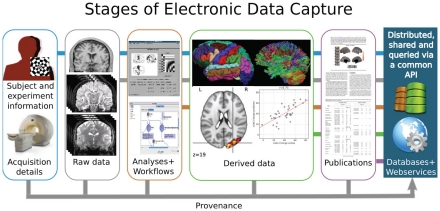
Significant resources around the world have been invested in neuroimaging studies of brain function and disease. Easier access to this large body of work should have profound impact on research in cognitive neuroscience and psychiatry, leading to advances in the diagnosis and treatment of psychiatric and neurological disease. A trend toward increased sharing of neuroimaging data has emerged in recent years. Nevertheless, a number of barriers continue to impede momentum. Many researchers and institutions remain uncertain about how to share data or lack the tools and expertise to participate in data sharing. The use of electronic data capture (EDC) methods for neuroimaging greatly simplifies the task of data collection and has the potential to help standardize many aspects of data sharing. We review here the motivations for sharing neuroimaging data, the current data sharing landscape, and the sociological or technical barriers that still need to be addressed. The INCF Task Force on Neuroimaging Datasharing, in conjunction with several collaborative groups around the world, has started work on several tools to ease and eventually automate the practice of data sharing. It is hoped that such tools will allow researchers to easily share raw, processed, and derived neuroimaging data, with appropriate metadata and provenance records, and will improve the reproducibility of neuroimaging studies. By providing seamless integration of data sharing and analysis tools within a commodity research environment, the Task Force seeks to identify and minimize barriers to data sharing in the field of neuroimaging.
全球投入了大量资源来研究大脑功能和疾病的神经影像学。更容易获得这大量的工作,应该会对认知神经科学和精神病学的研究产生深远的影响,从而促进精神疾病和神经疾病的诊断和治疗。近年来,神经影像学数据共享的趋势有所增加。然而,仍有一些障碍在阻碍这一趋势。许多研究人员和机构仍然不确定如何共享数据,或者缺乏参与数据共享的工具和专业知识。电子数据采集 (EDC) 方法在神经影像学中的应用极大地简化了数据收集任务,并有可能有助于标准化数据共享的许多方面。我们在这里回顾了共享神经影像学数据的动机、当前的数据共享现状,以及仍需要解决的社会学或技术障碍。INCF 神经影像学数据共享工作组与世界各地的几个合作团体一起,已经开始开发一些工具,以简化并最终实现数据共享的自动化。希望这些工具能使研究人员能够轻松地共享原始、处理后和衍生的神经影像学数据,以及适当的元数据和出处记录,并能提高神经影像学研究的可重复性。通过在商品研究环境中无缝集成数据共享和分析工具,工作组旨在确定和最小化神经影像学领域的数据共享障碍。