Department of Oncology, Royal Hospital for Sick Children, Edinburgh, UK.
BMJ Open. 2013 Aug 2;3(8):e002451. doi: 10.1136/bmjopen-2012-002451.
To determine the feasibility of therapy-based, risk-stratified follow-up guidelines for childhood and teenage cancer survivors by evaluating adverse health outcomes in a survivor cohort retrospectively assigned a risk category.
Retrospective cohort study.
Tertiary level, single centre, paediatric cancer unit in South East Scotland.
All children and teenagers diagnosed with cancer (<19 years) between 1 January 1971 and 31 July 2004, who were alive more than 5 years from diagnosis formed the study cohort. Each survivor was retrospectively assigned a level of follow-up, based on their predicted risk of developing treatment-related late effects (LEs; levels 1, 2 and 3 for low, medium and high risk, respectively). Adverse health outcomes were determined from review of medical records and postal questionnaires. LEs were graded using the Common Terminology Criteria for Adverse Event, V.3.
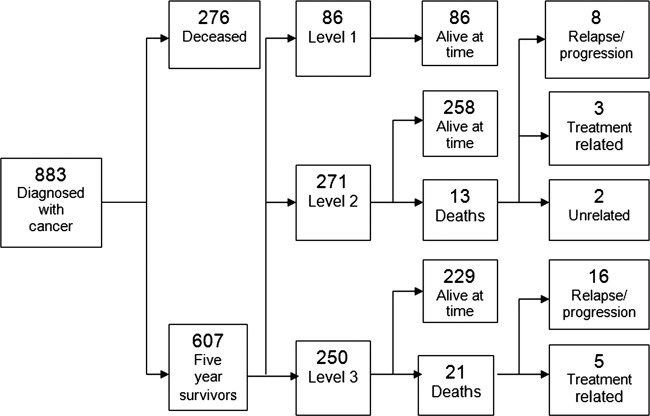
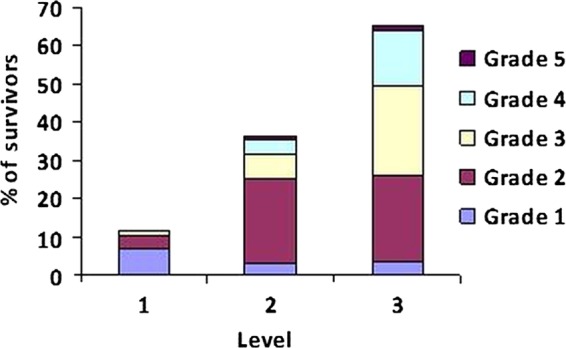
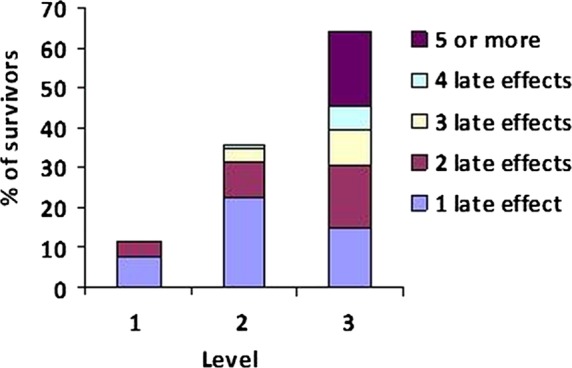
607 5-year survivors were identified. Risk stratification identified 86 (14.2%), 271 (44.6%) and 250 (41.2%) as levels 1, 2 and 3 survivors, respectively. The prevalence of LEs for level 1 survivors was 11.6% with only one patient with grade 3 or above toxicity. 35.8% of level 2 survivors had an LE, of whom 9.3%, 58.8%, 18.5%, 10.3% and 3% had grades 1, 2, 3, 4 and 5 toxicity, respectively. 65.2% of level 3 survivors had LE, of whom 5.5% (n=9), 34.4% (n=56), 36.2% (n=59), 22.1% (n=36) and 1.8% (n=3) had grades 1, 2, 3, 4 and 5 toxicity, respectively.
Therapy-based risk stratification of survivors can predict which patients are at significant risk of developing moderate-to-severe LEs and require high-intensity long-term follow-up. Our findings will need confirmation in a prospective cohort study that has the power to adjust for all potentially confounding variables.
通过评估回顾性分配风险类别的幸存者队列中的不良健康结局,确定基于治疗的儿童和青少年癌症幸存者的风险分层随访指南的可行性。
回顾性队列研究。
苏格兰东南部三级、单中心儿科癌症单位。
所有于 1971 年 1 月 1 日至 2004 年 7 月 31 日期间诊断为癌症(<19 岁)且生存时间超过诊断后 5 年的儿童和青少年均构成研究队列。每位幸存者均根据其发生治疗相关晚期效应(LE)的预测风险(低、中、高风险分别为 1、2 和 3 级),回顾性地分配随访级别。通过审查病历和邮寄问卷确定不良健康结局。使用通用不良事件术语标准,V.3 对 LE 进行分级。
确定了 607 名 5 年幸存者。风险分层确定了 86 名(14.2%)、271 名(44.6%)和 250 名(41.2%)为 1 级、2 级和 3 级幸存者。1 级幸存者的 LE 患病率为 11.6%,仅有 1 例患者发生 3 级以上毒性。2 级幸存者中有 35.8%发生了 LE,其中 9.3%、58.8%、18.5%、10.3%和 3%分别发生了 1、2、3、4 和 5 级毒性。3 级幸存者中有 65.2%发生了 LE,其中 5.5%(n=9)、34.4%(n=56)、36.2%(n=59)、22.1%(n=36)和 1.8%(n=3)分别发生了 1、2、3、4 和 5 级毒性。
基于治疗的幸存者风险分层可以预测哪些患者存在发生中重度 LE 的显著风险,需要高强度的长期随访。我们的研究结果需要在具有调整所有潜在混杂变量能力的前瞻性队列研究中得到证实。