Loyola University Chicago Health Sciences, Maywood, IL, USA.
Fred Hutchinson Cancer Research Center, Seattle, WA, USA.
Lancet Oncol. 2020 Mar;21(3):421-435. doi: 10.1016/S1470-2045(19)30800-9. Epub 2020 Feb 14.
Treatment outcomes among survivors of cancer diagnosed during adolescence and early young adulthood have not been characterised independently of survivors of cancers diagnosed during childhood. We aimed to describe chronic health conditions and all-cause and cause-specific mortality among survivors of early-adolescent and young adult cancer.
The Childhood Cancer Survivor Study (CCSS) is a retrospective cohort study with longitudinal follow-up of 5-year survivors diagnosed with cancer before the age of 21 years at 27 academic institutions in the USA and Canada between 1970 and 1999. We evaluated outcomes among survivors of early-adolescent and young adult cancer (aged 15-20 years at diagnosis) and survivors diagnosed at age younger than 15 years (matched on primary cancer diagnosis, including leukaemia, lymphoma, CNS tumours, neuroblastoma, Wilms tumour, soft-tissue sarcomas, and bone cancer) by comparing both groups to siblings of the same age. Mortality was ascertained with the National Death Index. Chronic health conditions were classified with the Common Terminology Criteria for Adverse Events. Standardised mortality ratios (SMRs) were estimated with age-specific, sex-specific, and calendar year-specific US rates. Cox proportional hazard models estimated hazard ratios (HRs) for chronic health conditions and 95% CIs.
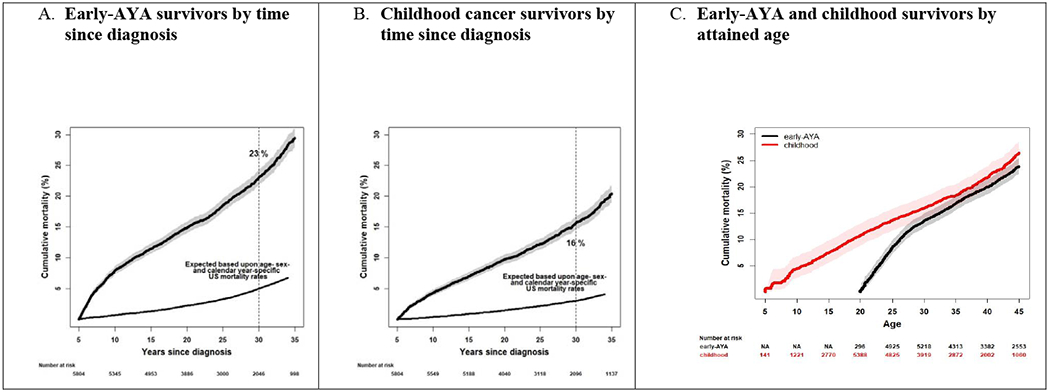
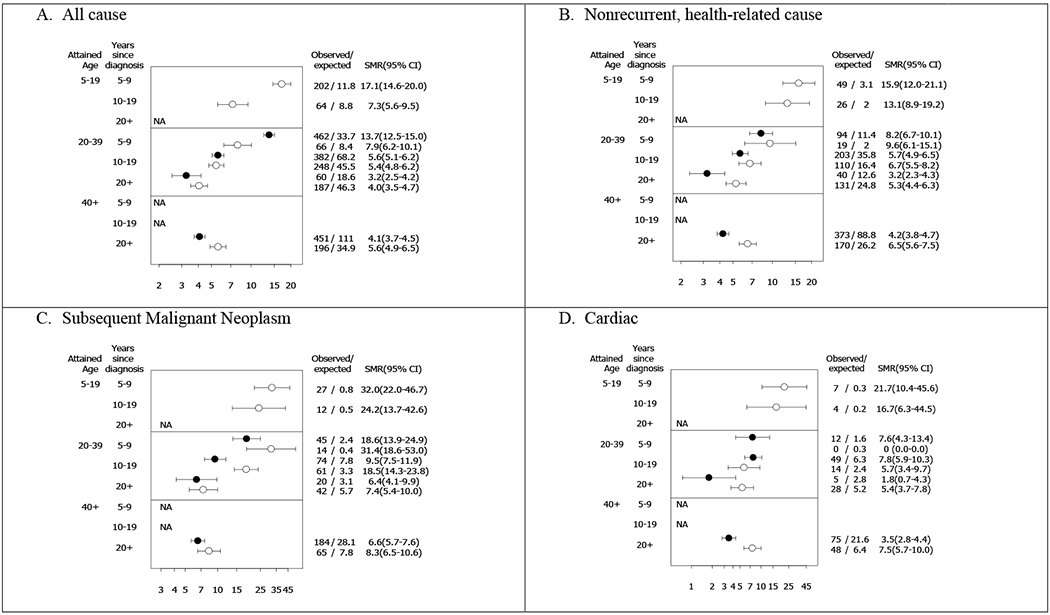
Among 5804 early-adolescent and young adult survivors (median age 42 years, IQR 34-50) the SMR compared to the general population for all-cause mortality was 5·9 (95% CI 5·5-6·2) and among 5804 childhood cancer survivors (median age 34 years; 27-42), it was 6·2 (5·8-6·6). Early-adolescent and young adult survivors had lower SMRs for death from health-related causes (ie, conditions that exclude recurrence or progression of the primary cancer and external causes, but include the late effects of cancer therapy) than did childhood cancer survivors (SMR 4·8 [95% CI 4·4-5·1] vs 6·8 [6·2-7·4]), which was primarily evident more than 20 years after cancer diagnosis. Early-adolescent and young adult cancer survivors and childhood cancer survivors were both at greater risk of developing severe and disabling, life-threatening, or fatal (grade 3-5) health conditions than siblings of the same age (HR 4·2 [95% CI 3·7-4·8] for early adolescent and young adult cancer survivors and 5·6 [4·9-6·3] for childhood cancer survivors), and at increased risk of developing grade 3-5 cardiac (4·3 [3·5-5·4] and 5·6 [4·5-7·1]), endocrine (3·9 [2·9-5·1] and 6·4 [5·1-8·0]), and musculoskeletal conditions (6·5 [3·9-11·1] and 8·0 [4·6-14·0]) when compared with siblings of the same age, although all these risks were lower for early-adolescent and young adult survivors than for childhood cancer survivors.
Early-adolescent and young adult cancer survivors had higher risks of mortality and severe and life threatening chronic health conditions than the general population. However, early-adolescent and young adult cancer survivors had lower non-recurrent, health-related SMRs and relative risks of developing grade 3-5 chronic health conditions than childhood cancer survivors, by comparison with siblings of the same age, which were most notable more than 20 years after their original cancer. These results highlight the need for long-term screening of both childhood and early-adolescent and young adult cancer survivors.
National Cancer Institute and American Lebanese-Syrian Associated Charities.
青少年和青年早期诊断的癌症幸存者的治疗结果尚未与儿童期诊断的癌症幸存者的结果分开描述。我们旨在描述青少年早期和青年期癌症幸存者的慢性健康状况以及全因和病因特异性死亡率。
儿童癌症幸存者研究(CCSS)是一项回顾性队列研究,对在美国和加拿大的 27 个学术机构中诊断为 1970 年至 1999 年间 21 岁以下癌症的 5 年幸存者进行纵向随访。我们通过将幸存者的诊断年龄与年龄匹配(包括白血病、淋巴瘤、中枢神经系统肿瘤、神经母细胞瘤、威尔姆斯瘤、软组织肉瘤和骨癌),比较了青少年早期和青年期癌症(诊断时年龄为 15-20 岁)和年龄小于 15 岁诊断的幸存者,以评估两组患者的结局。通过国家死亡索引确定死亡率。慢性健康状况通过常见不良事件术语标准进行分类。使用特定年龄、性别和日历年的美国比率估计标准化死亡率比(SMR)。使用 Cox 比例风险模型估计慢性健康状况和 95%置信区间的危险比(HR)。
在 5804 名青少年和青年期幸存者(中位年龄 42 岁,IQR 34-50)中,与普通人群相比,全因死亡率的 SMR 为 5.9(95%CI 5.5-6.2),在 5804 名儿童癌症幸存者(中位年龄 34 岁;27-42)中,SMR 为 6.2(5.8-6.6)。与儿童癌症幸存者相比,青少年和青年期幸存者的健康相关原因导致的死亡率(即排除原发性癌症的复发或进展以及外部原因,但包括癌症治疗的晚期效应的疾病)的 SMR 较低(SMR 4.8 [95%CI 4.4-5.1] 与 6.8 [6.2-7.4]),这主要在癌症诊断后 20 多年才明显。青少年和青年期癌症幸存者和儿童癌症幸存者发生严重和致残、危及生命或致命(3-5 级)健康状况的风险均高于同龄兄弟姐妹(青少年和青年期癌症幸存者的 HR 为 4.2 [95%CI 3.7-4.8],儿童癌症幸存者的 HR 为 5.6 [4.9-6.3]),并且发生 3-5 级心脏(3.9 [2.9-5.4] 和 5.6 [4.5-7.1])、内分泌(3.9 [2.9-5.1] 和 6.4 [5.1-8.0])和肌肉骨骼疾病(6.5 [3.9-11.1] 和 8.0 [4.6-14.0])的风险也更高与同龄兄弟姐妹相比,尽管与儿童癌症幸存者相比,这些风险在青少年和青年期幸存者中均较低。
青少年和青年期癌症幸存者的死亡率和严重危及生命的慢性健康状况风险高于普通人群。然而,与儿童癌症幸存者相比,青少年和青年期癌症幸存者的非复发性、健康相关 SMR 和发展 3-5 级慢性健康状况的相对风险较低,与同龄兄弟姐妹相比,这在癌症诊断后 20 多年最为明显。这些结果强调了需要对儿童和青少年期癌症幸存者进行长期筛查。
美国国立癌症研究所和美国黎巴嫩-叙利亚联合慈善协会。