Section for General Medical Practice, Aarhus University, Aarhus C, Denmark.
BMJ Open. 2013 Aug 2;3(8):e003045. doi: 10.1136/bmjopen-2013-003045.
To examine the association between mental health status after first-time myocardial infarction (MI) and new cardiovascular events or death, taking into account depression and anxiety as well as clinical, sociodemographic and behavioural risk factors.
Population-based cohort study based on questionnaires and nationwide registries. Mental health status was assessed 3 months after MI using the Mental Component Summary score from the Short-Form 12 V.2.
Central Denmark Region.
All patients hospitalised with first-time MI from 1 January 2009 through 31 December 2009 (n=880). The participants were categorised in quartiles according to the level of mental health status (first quartile=lowest mental health status).
Composite endpoint of new cardiovascular events (MI, heart failure, stroke/transient ischaemic attack) and all-cause mortality.
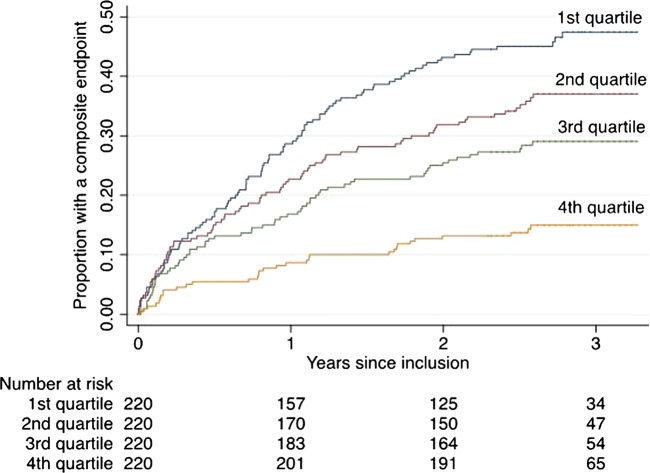
During 1940 person-years of follow-up, 277 persons experienced a new cardiovascular event or died. The cumulative incidence following 3 years after MI increased consistently with decreasing mental health status and was 15% (95% CI 10.8% to 20.5%) for persons in the fourth quartile, 29.1% (23.5% to 35.6%) in the third quartile, 37.0% (30.9% to 43.9%) in the second quartile, and 47.5% (40.9% to 54.5%) in the first quartile. The HRs were high, even after adjustments for age, sociodemographic characteristics, cardiac disease severity, comorbidity, secondary prophylactic medication, smoking status, physical activity, depression and anxiety (HR3rd quartile 1.90 (95% CI 1.23 to 2.93), HR2nd quartile 2.14 (1.37 to 3.33), HR1st quartile 2.23 (1.35 to 3.68) when using the fourth quartile as reference).
Low mental health status following first-time MI was independently associated with an increased risk of new cardiovascular events or death. Further research is needed to disentangle the pathways that link mental health status following MI to prognosis and to identify interventions that can improve mental health status and prognosis.
探讨首次心肌梗死(MI)后心理健康状况与新发心血管事件或死亡的关系,同时考虑抑郁和焦虑以及临床、社会人口学和行为危险因素。
基于问卷和全国登记处的基于人群的队列研究。使用短式 12 第 2 版的心理成分综合评分,在 MI 后 3 个月评估心理健康状况。
丹麦中部地区。
2009 年 1 月 1 日至 12 月 31 日期间首次因 MI 住院的所有患者(n=880)。根据心理健康状况水平将参与者分为四个四分位组(第一四分位组=心理健康状况最低)。
新发心血管事件(MI、心力衰竭、中风/短暂性脑缺血发作)和全因死亡率的复合终点。
在 1940 人年的随访期间,有 277 人发生新发心血管事件或死亡。MI 后 3 年的累积发病率随着心理健康状况的降低而持续增加,第四四分位数组为 15%(95%CI 10.8%至 20.5%),第三四分位数组为 29.1%(23.5%至 35.6%),第二四分位数组为 37.0%(30.9%至 43.9%),第一四分位数组为 47.5%(40.9%至 54.5%)。即使在调整了年龄、社会人口学特征、心脏疾病严重程度、合并症、二级预防药物、吸烟状况、身体活动、抑郁和焦虑后,HR 仍然较高(第三四分位数 HR=1.90(95%CI 1.23 至 2.93),第二四分位数 HR=2.14(1.37 至 3.33),第一四分位数 HR=2.23(1.35 至 3.68),以第四四分位数为参考)。
首次 MI 后心理健康状况较低与新发心血管事件或死亡风险增加独立相关。需要进一步研究以阐明 MI 后心理健康状况与预后之间的关联途径,并确定可以改善心理健康状况和预后的干预措施。