National Institutes of Health-International Center for Excellence in Research, Chennai 600031, India.
J Immunol. 2013 Sep 1;191(5):2466-73. doi: 10.4049/jimmunol.1300911. Epub 2013 Aug 2.
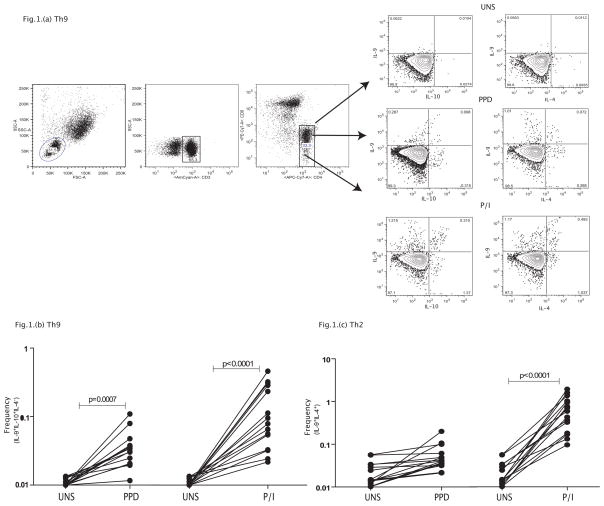
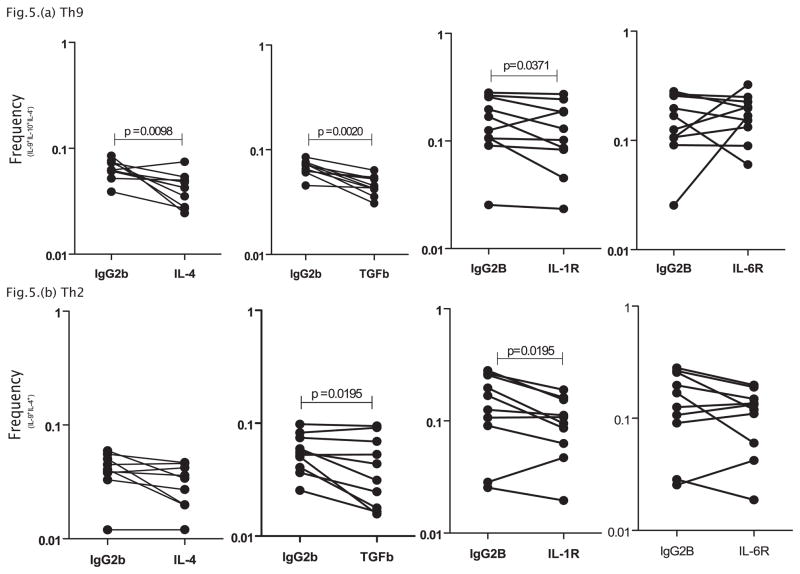
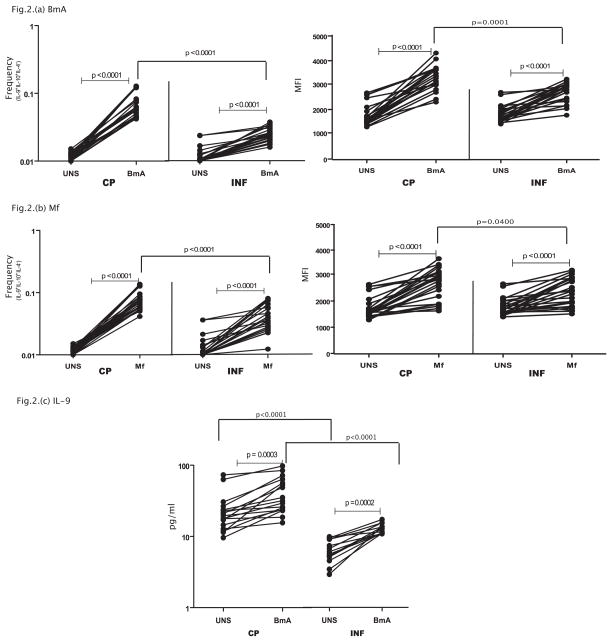
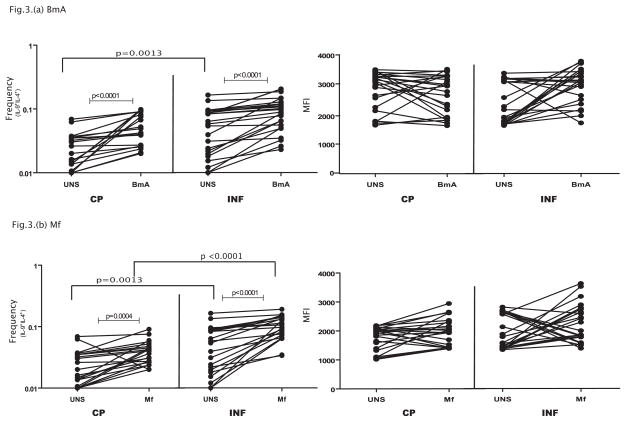
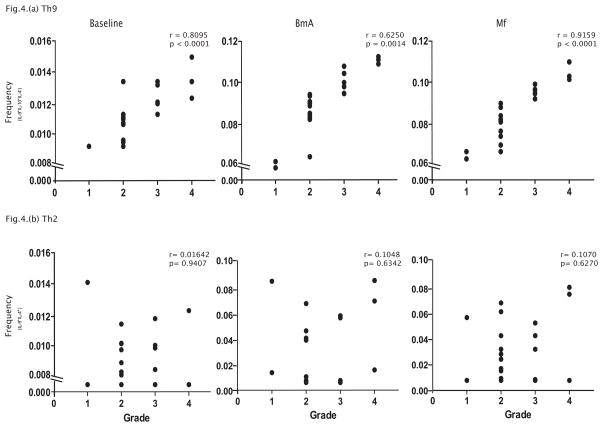
Th9 cells are a subset of CD4(+) T cells, shown to be important in allergy, autoimmunity, and antitumor responses; however, their role in human infectious diseases has not been explored in detail. We identified a population of IL-9 and IL-10 coexpressing cells (lacking IL-4 expression) in normal individuals. These cells respond to antigenic and mitogenic stimulation, but are distinct from IL-9(+) Th2 cells. We also demonstrate that these Th9 cells exhibit Ag-specific expansion in a chronic helminth infection (lymphatic filariasis). Comparison of Th9 responses reveals that individuals with pathology associated with filarial infection exhibit significantly expanded frequencies of filarial Ag-induced Th9 cells, but not of IL9(+)Th2 cells in comparison with filarial-infected individuals without associated disease. Moreover, the per cell production of IL-9 is significantly higher in Th9 cells compared with IL9(+)Th2 cells, indicating that the Th9 cells are the predominant CD4(+) T cell subset producing IL-9 in the context of human infection. This expansion was reflected in elevated Ag-stimulated IL-9 cytokine levels in whole blood culture supernatants. Finally, the frequencies of Th9 cells correlated positively with the severity of lymphedema (and presumed inflammation) in filarial-diseased individuals. This expansion of Th9 cells was dependent on IL-4, TGF-β, and IL-1 in vitro. We have therefore identified an important human CD4(+) T cell subpopulation coexpressing IL-9 and IL-10, but not IL-4, the expansion of which is associated with disease in chronic lymphatic filariasis and could potentially have an important role in the pathogenesis of other inflammatory disorders.
Th9 细胞是 CD4(+)T 细胞的一个亚群,已被证明在过敏、自身免疫和抗肿瘤反应中很重要;然而,它们在人类感染性疾病中的作用尚未详细探讨。我们在正常个体中鉴定出一群共表达 IL-9 和 IL-10(缺乏 IL-4 表达)的细胞。这些细胞对抗原和有丝分裂原刺激有反应,但与 IL-9(+)Th2 细胞不同。我们还证明,这些 Th9 细胞在慢性寄生虫感染(淋巴丝虫病)中表现出抗原特异性扩增。比较 Th9 反应发现,与丝虫感染相关的病理个体中,与寄生虫相关的 Th9 细胞的扩增频率显著增加,而与无相关疾病的寄生虫感染个体相比,IL9(+)Th2 细胞的扩增频率没有增加。此外,与 IL9(+)Th2 细胞相比,Th9 细胞中 IL-9 的每细胞产生量显著更高,表明在人类感染的情况下,Th9 细胞是产生 IL-9 的主要 CD4(+)T 细胞亚群。这种扩增反映在全血培养上清液中 Ag 刺激的 IL-9 细胞因子水平升高。最后,Th9 细胞的频率与丝虫病个体的淋巴水肿(和推测的炎症)严重程度呈正相关。这种 Th9 细胞的扩增依赖于体外的 IL-4、TGF-β 和 IL-1。因此,我们鉴定出一种重要的人类 CD4(+)T 细胞亚群,该亚群共表达 IL-9 和 IL-10,但不表达 IL-4,其扩增与慢性淋巴丝虫病中的疾病相关,并且可能在其他炎症性疾病的发病机制中具有重要作用。