Kogler Christoph, Kühberger Anton, Gilhofer Rainer
Faculty of Psychology, University of Vienna, Austria.
J Econ Psychol. 2013 Aug;37(100):42-53. doi: 10.1016/j.joep.2013.05.001.
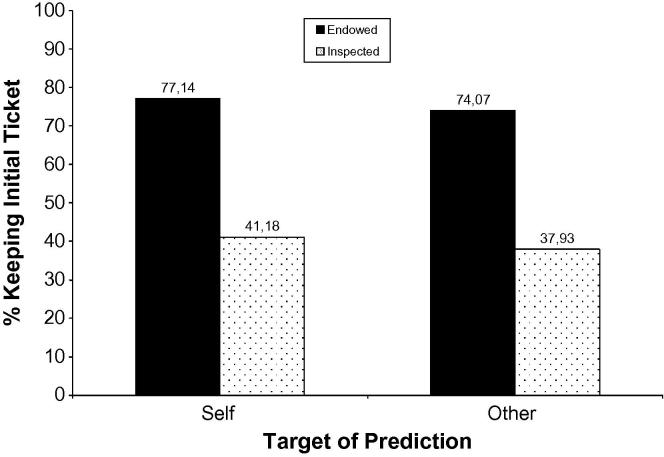
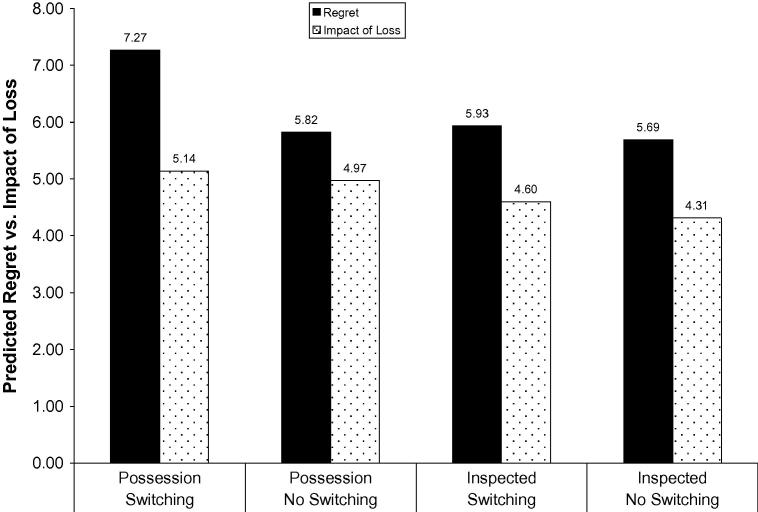
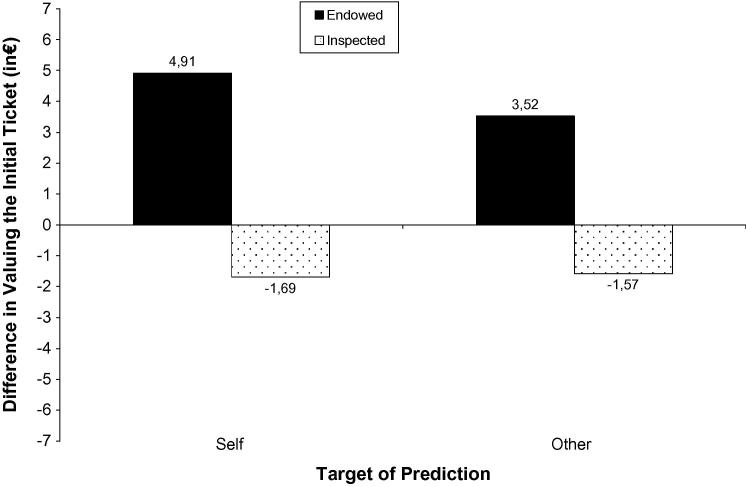
The endowment effect is the finding that possession of an item adds to its value. We introduce a new procedure for testing this effect: participants are divided into two groups. Possession group participants inspect a numbered lottery ticket and know it is theirs, while inspection group participants only inspect a lottery ticket without being endowed with it. Subsequently participants choose between playing the lottery with this (possessed or inspected) ticket, or exchanging it for another one. Our procedure tests for the effect of endowment while controlling for the influence of transaction costs as well as for inspection effects and the influence of bargaining roles (buyer vs. seller), which often afflict experimentation with the endowment effect. In a real setting, tickets in possession were valued significantly higher than inspected tickets. Contrary to some findings in the literature participants also correctly predicted these valuation differences in a hypothetical situation, both for themselves as well as for others. Furthermore, our results suggest that regret rather than loss aversion may be the source of the endowment effect in an experimental setting using lottery tickets. Applying our procedure to a setting employing riskless objects in form of mugs revealed rather ambiguous results, thus emphasizing that the role of regret might be less prominent in non-lottery settings.
禀赋效应是指拥有某一物品会增加其价值的发现。我们引入了一种新的程序来测试这种效应:将参与者分为两组。拥有组的参与者检查一张编号的彩票并知道这是他们自己的,而检查组的参与者只检查一张彩票但并未被赋予所有权。随后,参与者要在使用这张(拥有或检查过的)彩票抽奖,或者用它交换另一张彩票之间做出选择。我们的程序在控制交易成本影响以及检查效应和讨价还价角色(买方与卖方)影响的同时测试禀赋效应,而这些因素常常困扰着禀赋效应的实验。在实际情境中,拥有的彩票比检查过的彩票估值显著更高。与文献中的一些发现相反,参与者在假设情境中也能正确预测这些估值差异,无论是对自己还是对他人。此外,我们的结果表明,在使用彩票的实验情境中,懊悔而非损失厌恶可能是禀赋效应的根源。将我们的程序应用于以杯子形式使用无风险物品的情境中,结果相当模糊,从而强调了懊悔在非彩票情境中的作用可能不那么突出。