Kato Chie, Kato Atsuhiko, Adachi Kenji, Fujii Etsuko, Isobe Kaori, Watanabe Takeshi, Ito Tsuneo, Suzuki Masami
Research Division, Chugai Pharmaceutical Co., Ltd., 200 Kajiwara, Kamakura, Kanagawa 247-8530, Japan.
J Toxicol Pathol. 2013 Jun;26(2):223-6. doi: 10.1293/tox.26.223. Epub 2013 Jul 10.
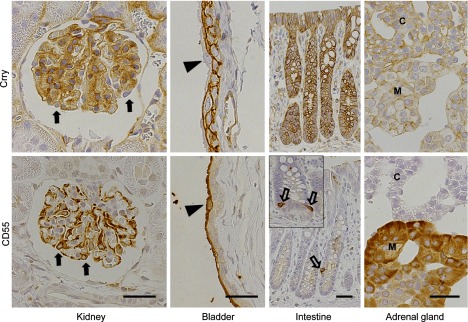
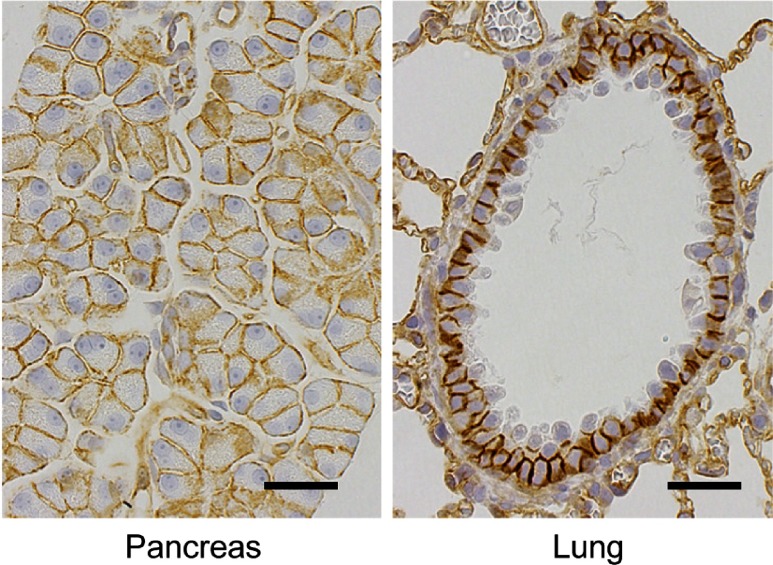
Some anticancer therapeutic antibodies are designed to act through complement-dependent cytotoxicity (CDC). It has been reported that there are many membrane complement regulatory proteins (mCRPs) that inhibit CDC. In the present study, we examined the expression of two mCRPs, the complement receptor 1-related gene/protein Y (Crry) and the decay-accelerating factor CD55, in three normal rats by immunohistochemistry. Crry and CD55 were detected widely in rat organs and tissues. Crry was found mainly in the urinary, digestive, respiratory, immunohematopoietic, circulatory and neuroendocrine systems. CD55 was found in the urinary, digestive and neuroendocrine systems. However, the two molecules were expressed in separate cells within the same organ. These results suggest that the distribution of mCRPs is related to the strict regulation of CDC activation in these organs and tissues and that the two molecules have a nonoverlapping expression pattern, a fact indicating specific roles in CDC regulation.
一些抗癌治疗性抗体被设计为通过补体依赖性细胞毒性(CDC)发挥作用。据报道,有许多膜补体调节蛋白(mCRP)可抑制CDC。在本研究中,我们通过免疫组织化学检测了三种正常大鼠中两种mCRP,即补体受体1相关基因/蛋白Y(Crry)和衰变加速因子CD55的表达。在大鼠的器官和组织中广泛检测到Crry和CD55。Crry主要存在于泌尿、消化、呼吸、免疫造血、循环和神经内分泌系统中。CD55存在于泌尿、消化和神经内分泌系统中。然而这两种分子在同一器官的不同细胞中表达。这些结果表明,mCRP的分布与这些器官和组织中CDC激活的严格调节有关,并且这两种分子具有不重叠的表达模式,这一事实表明它们在CDC调节中具有特定作用。