RIKEN , Saitama , Japan.
Front Immunol. 2013 Aug 1;4:224. doi: 10.3389/fimmu.2013.00224. eCollection 2013.
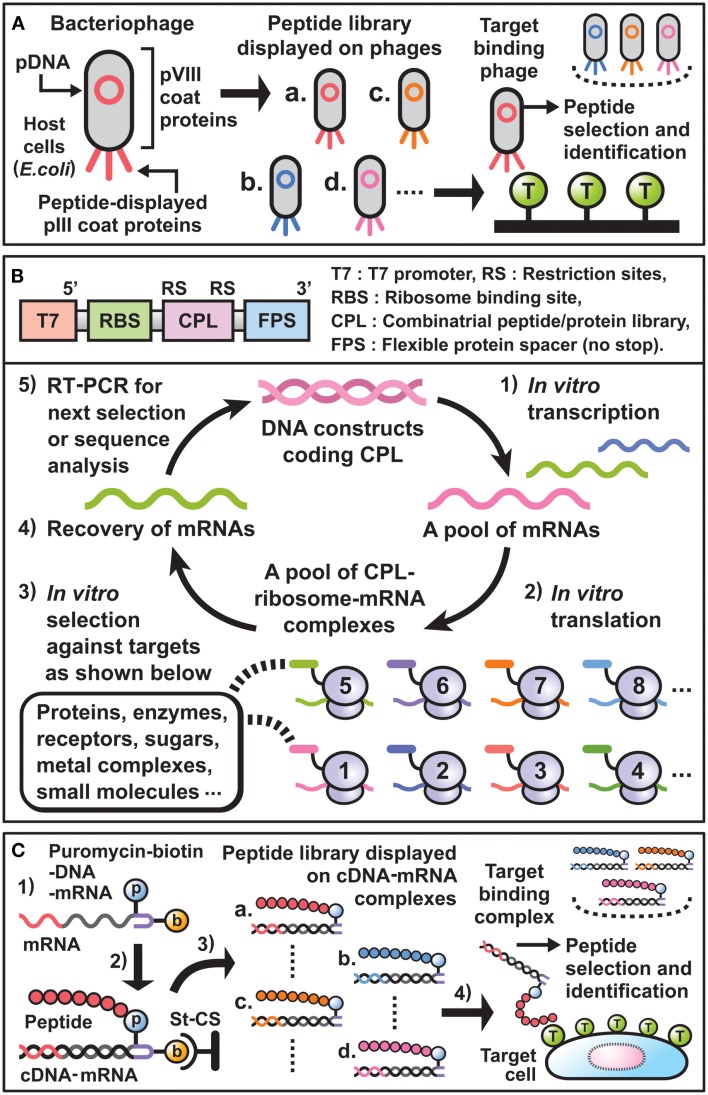
During the last decade, a variety of monoclonal antibodies have been developed and used as molecular targeting drugs in medical therapies. Although antibody drugs tend to have intense pharmacological activities and negligible side effects, several issues in their development and prescription remain to be resolved. Synthetic peptides with affinities and specificities for a desired target have received significant attention as alternatives to antibodies. In vitro display technologies are powerful methods for the selection of such peptides from combinatorial peptide libraries. Various types of peptide binders are being selected with such technologies for use in a wide range of fields from bioscience to medicine. This mini review article focuses on the current state of in vitro display selection of synthetic peptide binders and compares the selected peptides with natural peptides/proteins to provide a better understanding of the target affinities and inhibitory activities derived from their amino acid sequences and structural frameworks. The potential of synthetic peptide binders as alternatives to antibody drugs in therapeutic applications is also reviewed.
在过去的十年中,已经开发出了多种单克隆抗体,并将其作为医学治疗中的分子靶向药物。尽管抗体药物往往具有强烈的药理活性和可以忽略不计的副作用,但在其开发和处方方面仍存在一些问题需要解决。具有所需靶标亲和力和特异性的合成肽已作为抗体的替代品受到了广泛关注。体外展示技术是从组合肽文库中筛选此类肽的强大方法。正在使用各种类型的肽结合物选择技术在从生物科学到医学的广泛领域中使用。本文综述主要关注目前体外展示技术选择合成肽结合物的现状,并将所选肽与天然肽/蛋白质进行比较,以更好地了解源自其氨基酸序列和结构框架的靶标亲和力和抑制活性。还回顾了合成肽结合物作为治疗应用中抗体药物替代品的潜力。