Iqbal F, Khattak Rm, Ozubek S, Khattak Mnk, Rasul A, Aktas M
Zoology Division, Institute of Pure and Applied Biology, Bahauddin Zakariya University Multan 60800, Pakistan.
Iran J Parasitol. 2013 Apr;8(2):289-95.
The present study was designed to detect the presence of tick-borne parasites (Theileria and Babesia spp.) in 196 blood samples collected from apparently healthy sheep and goats from two provinces, Punjab and Khyber Pukhtoon Khwa, in Pakistan.
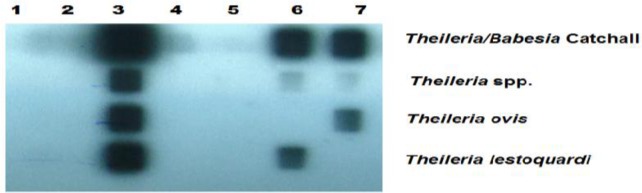
Reverse line blot (RLB) assay was applied for the parasitic detection by the amplification of hypervariable V4 region of the 18S ribosomal RNA (rRNA) gene. A membrane with covalently linked generic and species specific oligonucleotide probes was used for the hybridization of amplified PCR products.
Parasites were detected in 16% of the ruminant blood samples under study. Two Theileria species, T. lestoquardi and T. ovis, were identified in samples. 25, of the total 32, infected animals were from Khyber Pukhtoon Khwa.
Sheep were more prone to tick borne haemoprotozans as 81% infected samples were sheep as compared to 19% goats (P > 0.001). Risk factor analysis revealed that male (P = 0.03), animals infested by ticks (P = 0.03) and herd composed of sheep only (P = 0.001) were more infected by blood parasites.
本研究旨在检测从巴基斯坦旁遮普省和开伯尔-普赫图赫瓦省的貌似健康的绵羊和山羊采集的196份血液样本中蜱传播寄生虫(泰勒虫属和巴贝斯虫属)的存在情况。
应用反向线印迹(RLB)分析法,通过扩增18S核糖体RNA(rRNA)基因的高变V4区域来进行寄生虫检测。使用带有共价连接的通用和种特异性寡核苷酸探针的膜对扩增的PCR产物进行杂交。
在所研究的反刍动物血液样本中,16%检测到寄生虫。在样本中鉴定出两种泰勒虫,即莱氏泰勒虫和绵羊泰勒虫。在总共32只受感染动物中,有25只来自开伯尔-普赫图赫瓦省。
绵羊更容易感染蜱传播的血原虫,因为81%的受感染样本是绵羊,而山羊为19%(P>0.001)。风险因素分析显示,雄性动物(P=0.03)、受蜱虫侵袭的动物(P=0.03)和仅由绵羊组成的畜群(P=0.001)更容易感染血液寄生虫。