Women's Health and Exercise Laboratory, 104 Noll Laboratory, Department of Kinesiology, Penn State University, University Park, PA 16802, USA.
Toronto General Hospital, University Health Network, Toronto, ON M5G 2C4, Canada.
J Int Soc Sports Nutr. 2013 Aug 2;10:34. doi: 10.1186/1550-2783-10-34. eCollection 2013.
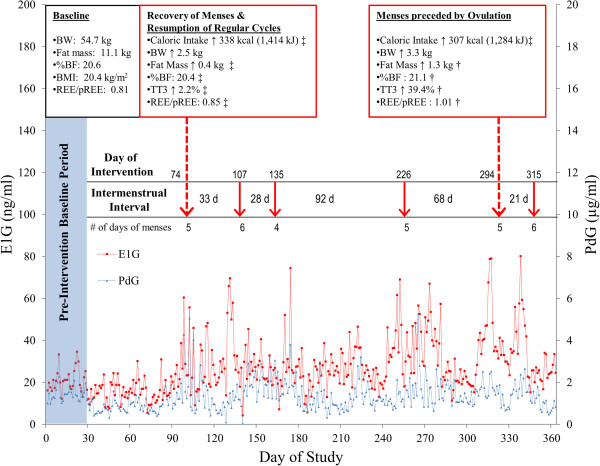
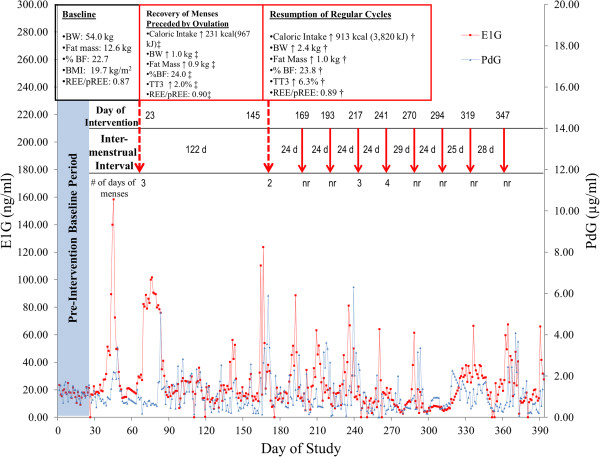
Increasing caloric intake is a promising treatment for exercise-associated amenorrhea, but strategies have not been fully explored. The purpose of this case report was to compare and contrast the responses of two exercising women with amenorrhea of varying duration to an intervention of increased energy intake. Two exercising women with amenorrhea of short (3 months) and long (11 months) duration were chosen to demonstrate the impact of increased caloric intake on recovery of menstrual function and bone health. Repeated measures of dietary intake, eating behavior, body weight, body composition, bone mineral density, resting energy expenditure, exercise volume, serum metabolic hormones and markers of bone turnover, and daily urinary metabolites were obtained. Participant 1 was 19 years old and had a body mass index (BMI) of 20.4 kg/m(2) at baseline. She increased caloric intake by 276 kcal/day (1,155 kJ/day, 13%), on average, during the intervention, and her body mass increased by 4.2 kg (8%). Participant 2 was 24 years old and had a BMI of 19.7 kg/m(2). She increased caloric intake by 1,881 kcal/day (7,870 kJ/day, 27%) and increased body mass by 2.8 kg (5%). Resting energy expenditure, triiodothyronine, and leptin increased; whereas, ghrelin decreased in both women. Resumption of menses occurred 23 and 74 days into the intervention for the women with short-term and long-term amenorrhea, respectively. The onset of ovulation and regular cycles corresponded with changes in body weight. Recovery of menses coincided closely with increases in caloric intake, weight gain, and improvements in the metabolic environment; however, the nature of restoration of menstrual function differed between the women with short-term versus long-term amenorrhea.
增加热量摄入是治疗运动相关性闭经的一种有前途的方法,但该策略尚未得到充分探索。本病例报告的目的是比较和对比两名闭经时间长短不同的运动女性对增加能量摄入干预的反应。选择两名闭经时间短(3 个月)和长(11 个月)的运动女性,以展示增加热量摄入对恢复月经功能和骨骼健康的影响。对饮食摄入、饮食行为、体重、身体成分、骨密度、静息能量消耗、运动量、血清代谢激素和骨转换标志物以及每日尿代谢产物进行了重复测量。参与者 1 年龄为 19 岁,基线时的体重指数(BMI)为 20.4kg/m2。她在干预期间平均每天增加 276 卡路里(1,155kJ/day,13%)的热量摄入,体重增加了 4.2kg(8%)。参与者 2 年龄为 24 岁,BMI 为 19.7kg/m2。她每天增加 1,881 卡路里(7,870kJ/day,27%)的热量摄入,体重增加了 2.8kg(5%)。静息能量消耗、三碘甲状腺原氨酸和瘦素增加,而生长激素释放肽减少。两名女性均出现闭经。短期和长期闭经的女性分别在干预的第 23 天和第 74 天恢复月经。排卵和正常周期的出现与体重变化相对应。月经恢复与热量摄入增加、体重增加和代谢环境改善密切相关;然而,短期和长期闭经女性的月经功能恢复性质不同。