College of Veterinary Medicine, Animal resources and Biosecurity, Makerere University, P.O. BOX 7062, Kampala, Uganda.
Virol J. 2013 Aug 1;10:247. doi: 10.1186/1743-422X-10-247.
African swine fever (ASF) is a highly lethal and economically significant disease of domestic pigs in Eastern Africa particularly in Uganda where outbreaks regularly occur. Sequence analysis of variable genome regions have been extensively used for molecular epidemiological studies of African swine fever virus (ASFV) isolates. By combining p72, P54 and pB602L (CVR), a high level resolution approach is achieved for viral discrimination. The major aim of this study therefore, was to investigate the genetic relatedness of ASF outbreaks that occurred between 2010 and 2013 in Uganda to contribute to the clarification of the epidemiological situation over a four year period.
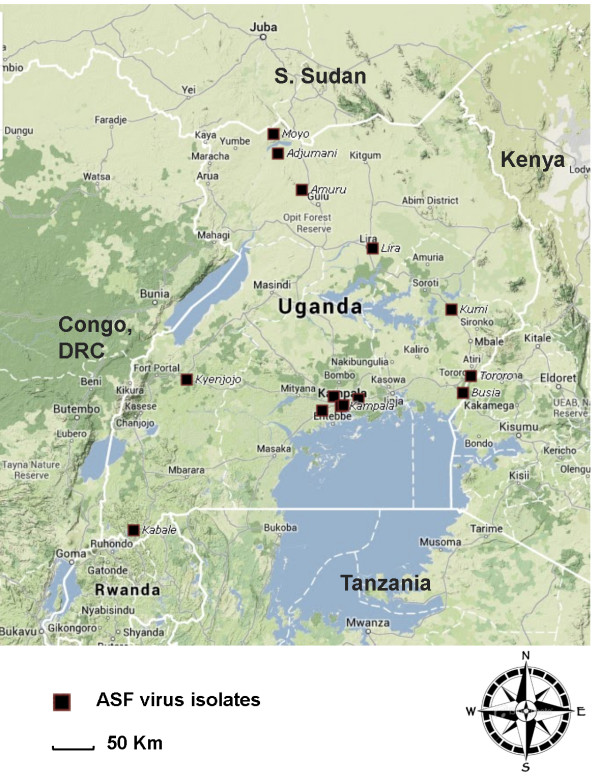
Tissue samples from infected domestic pigs associated with an ASF outbreak from 15 districts in Uganda were confirmed as being infected with ASFV using a p72 gene-based polymerase chain reaction amplification (PCR) assay recommended by OIE. The analysis was conducted by genotyping based on sequence data from three single copy ASFV genes. The E183L gene encoding the structural protein P54 and part of the gene encoding the p72 protein was used to delineate genotypes. Intra-genotypic resolution of viral relationships was achieved by analysis of tetramer amino acid repeats within the hypervariable CVR of the B602L gene.
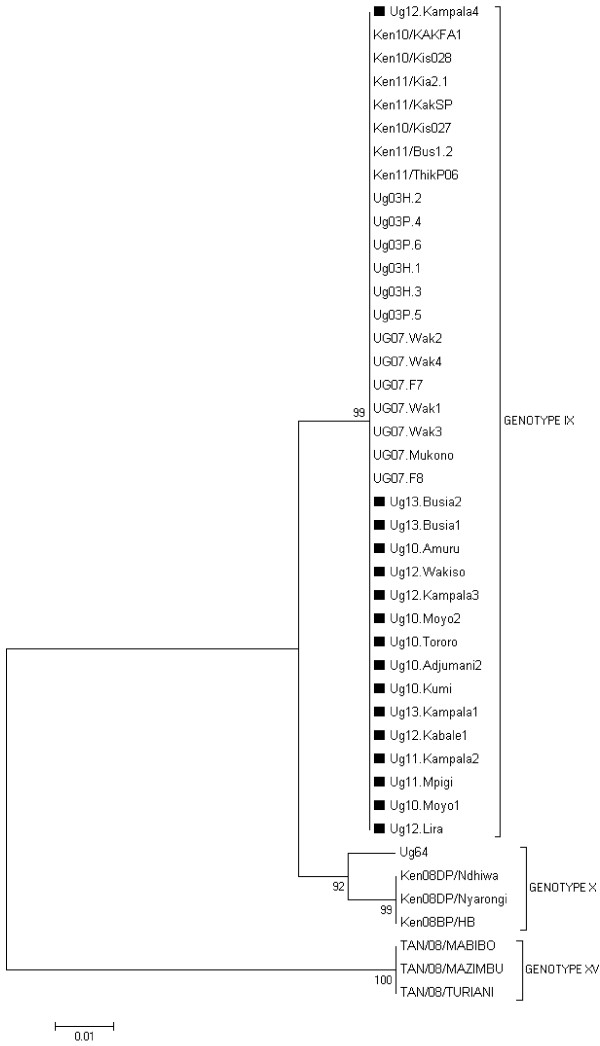
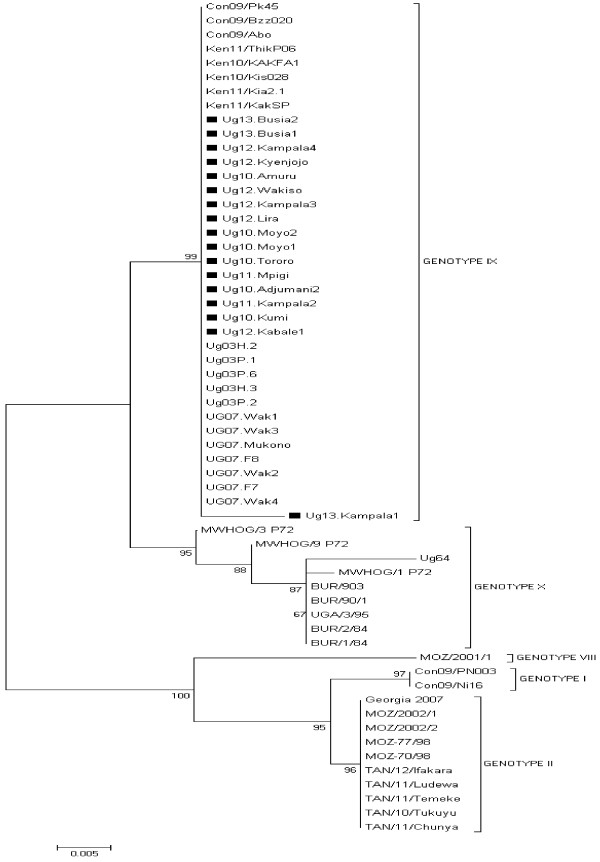
Twenty one (21) ASF outbreaks were confirmed by the p72 ASF diagnostic PCR, however; only 17 isolates were successfully aligned after sequencing. Our entire isolates cluster with previous ASF viruses in genotype IX isolated in Uganda and Kenya using p72 and P54 genes. Analysis of the CVR gene generated three sub-groups one with 23 tetrameric amino acid repeats (TRS) with an additional CAST sequence, the second with 22 TRS while one isolate Ug13. Kampala1 had 13 TRS.
We identified two new CVR subgroups different from previous studies. This study constitutes the first detailed assessment of the molecular epidemiology of ASFV in domestic pigs in the different regions of Uganda.
非洲猪瘟(ASF)是一种对东非特别是乌干达国内猪具有高度致命性和经济重要性的疾病,那里经常爆发疫情。对可变基因组区域的序列分析已被广泛用于非洲猪瘟病毒(ASFV)分离株的分子流行病学研究。通过结合 p72、P54 和 pB602L(CVR),可以实现对病毒的高分辨率区分。因此,本研究的主要目的是调查 2010 年至 2013 年期间在乌干达发生的 ASF 疫情的遗传相关性,以有助于澄清四年期间的流行病学情况。
使用 OIE 推荐的基于 p72 基因的聚合酶链反应(PCR)扩增检测方法,对来自乌干达 15 个地区的与 ASF 疫情相关的受感染家猪的组织样本进行确认,这些样本被确认为感染了 ASFV。通过基于三个单拷贝 ASFV 基因的序列数据进行基因分型来进行分析。E183L 基因编码结构蛋白 P54 和部分 p72 蛋白基因用于划定基因型。通过分析 B602L 基因的高变区 CVR 中的四聚体氨基酸重复来实现病毒关系的种内分辨率。
通过 p72 ASF 诊断 PCR 确认了 21 次 ASF 疫情,但只有 17 个分离株在测序后成功对齐。我们的所有分离株与使用 p72 和 P54 基因在乌干达和肯尼亚分离的先前的 IX 基因型 ASF 病毒聚集在一起。CVR 基因分析产生了三个亚群,一个具有 23 个四聚体氨基酸重复(TRS)和一个附加的 CAST 序列,第二个具有 22 个 TRS,而一个分离株 Ug13. Kampala1 具有 13 个 TRS。
我们确定了两个与先前研究不同的新 CVR 亚群。本研究构成了对乌干达不同地区家猪中 ASFV 分子流行病学的首次详细评估。