Centro de Genética Médica Dr, Jacinto Magalhães, CHP, Praça Pedro Nunes 88, 4099-028, Porto, Portugal.
BMC Med Genet. 2013 Aug 5;14:80. doi: 10.1186/1471-2350-14-80.
X-linked intellectual disability is a common cause of inherited cognitive deficit affecting mostly males. There are several genetic causes implicated in this condition, which has hampered the establishment of an accurate diagnosis. We developed a multiplex-PCR assay for the mutational hotspot regions of the FMR1, AFF2 and ARX genes.
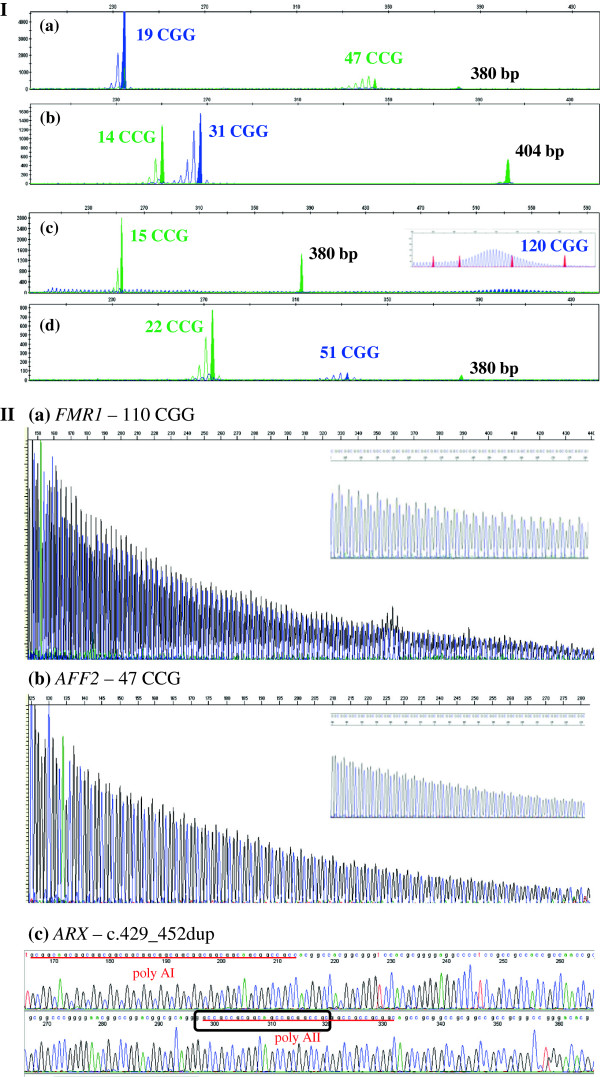
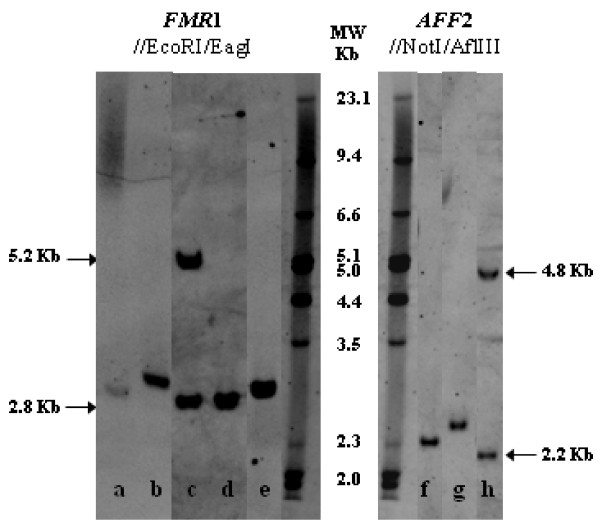
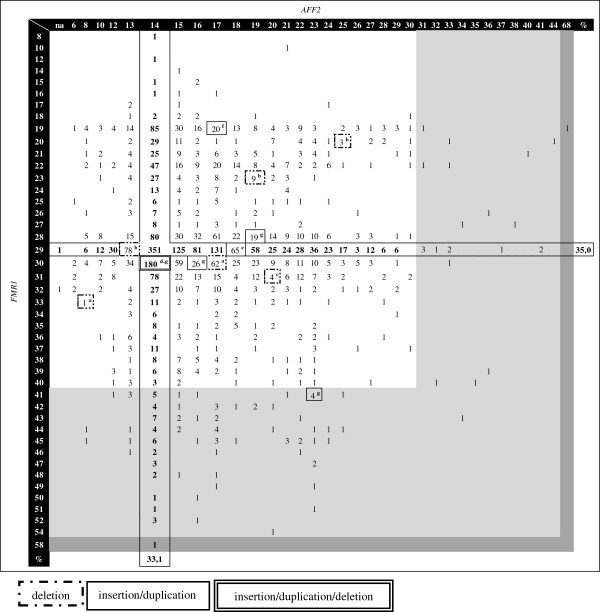
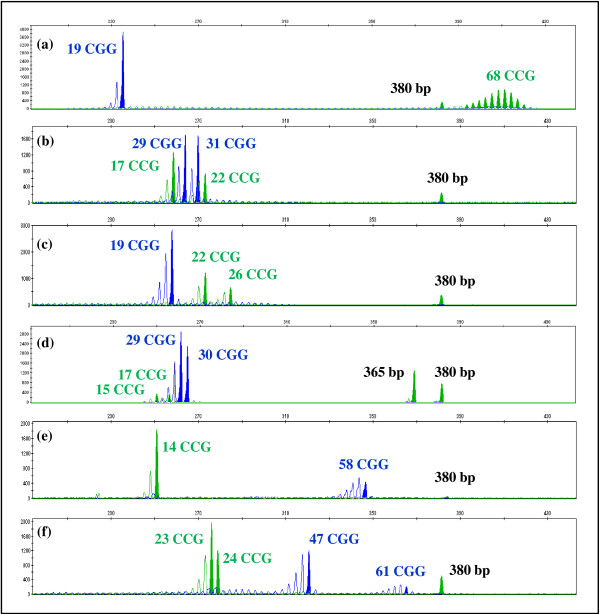
The multiplex-PCR was validated in a cohort of 100 males selected to include known alleles for the FMR1 repetitive region: five full mutations (250-650 CGGs), ten premutations (70-165 CGGs) and eighty-five in the normal range (19-42 CGGs). Sequencing or Southern blotting was used to confirm the results, depending on the allele class. In this cohort, with the exception of one sample showing an AFF2 intermediate-sized allele, all other samples were normal (8-34 CCGs). No ARX variant was found besides the c.429_452dup. The validated assay was applied to 5000 samples (64.4% males and 35.6% females).
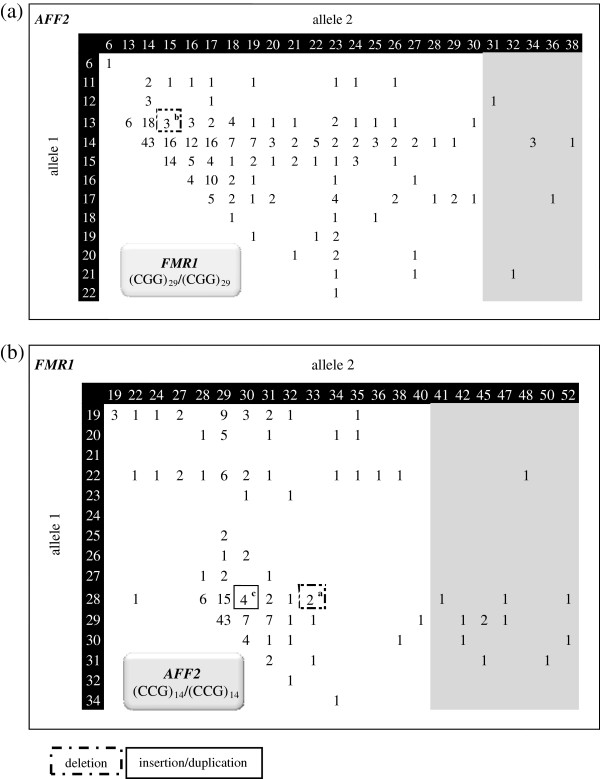
The normal-allelic range of both FMR1 and AFF2 genes as well as the nature of ARX variants identified was similar in both genders. The rate of homozygosity observed in female samples, 27.5% for FMR1 and 17.8% for AFF2 alleles, is comparable to that published by others. Two FMR1 premutations were identified, in a male (58 CGGs) and a female case [(CGG)(47)/(CGG)(61)], as well as several FMR1 or AFF2 intermediate-sized alleles. One AFF2 premutation (68 CCGs) and two putative full expansions were picked up in male subjects, which seems relevant considering the rarity of reported AFF2 mutations found in the absence of a family history.
We developed a robust multiplex-PCR that can be used to screen the mutational hotspot regions of FMR1, AFF2 and ARX genes. Moreover, this strategy led to the identification of variants in all three genes, representing not only an improvement in allele-sizing but also in achieving a differential diagnosis. Although the distinction between females who are truly homozygous and those with a second pre- or full mutation sized allele, as well as a definitive diagnosis, requires a specific downstream technique, the use of this multiplex-PCR for initial screening is a cost-effective approach which widens the scope of detection.
X 连锁智力障碍是一种常见的遗传性认知缺陷疾病,主要影响男性。有几个遗传原因与这种疾病有关,这使得准确诊断变得困难。我们开发了一种用于 FMR1、AFF2 和 ARX 基因突变热点区域的多重 PCR 检测方法。
我们在 100 名男性中验证了该多重 PCR 方法,这些男性的选择包括已知的 FMR1 重复区域等位基因:五个完全突变(250-650 CGGs),十个前突变(70-165 CGGs)和八十五个正常范围(19-42 CGGs)。根据等位基因类别,使用测序或 Southern 印迹法确认结果。在这个队列中,除了一个样本显示 AFF2 中等大小等位基因外,所有其他样本均正常(8-34 CCGs)。除了 c.429_452dup 外,没有发现 ARX 变异。该验证后的方法应用于 5000 个样本(64.4%为男性,35.6%为女性)。
FMR1 和 AFF2 基因的正常等位基因范围以及 ARX 变异的性质在两性中相似。在女性样本中观察到的同型合子率为 27.5%(FMR1)和 17.8%(AFF2 等位基因),与其他人发表的结果相当。在一个男性(58 CGGs)和一个女性病例中(CGG)(47)/(CGG)(61),发现了两个 FMR1 前突变,以及几个 FMR1 或 AFF2 中等大小等位基因。在男性中发现了一个 AFF2 前突变(68 CCGs)和两个疑似完全扩展,这似乎与在没有家族史的情况下发现罕见的 AFF2 突变有关。
我们开发了一种稳健的多重 PCR 方法,可用于筛选 FMR1、AFF2 和 ARX 基因突变热点区域。此外,这种策略导致了三个基因中所有变异的鉴定,不仅提高了等位基因大小的准确性,还实现了鉴别诊断。尽管需要特定的下游技术来区分真正同型合子的女性和具有第二个前突变或完全突变大小等位基因的女性,以及明确的诊断,但使用这种多重 PCR 进行初始筛查是一种具有成本效益的方法,可以扩大检测范围。