Center for Sensory-Motor Interaction (SMI), Department of Health Science and Technology, Aalborg University, Fredrik Bajers 7D, Aalborg, 9220, Denmark.
BMC Musculoskelet Disord. 2013 Aug 1;14:226. doi: 10.1186/1471-2474-14-226.
Computer users often report musculoskeletal complaints and pain in the upper extremities and the neck-shoulder region. However, recent epidemiological studies do not report a relationship between the extent of computer use and work-related musculoskeletal disorders (WMSD).The aim of this study was to conduct an explorative analysis on short and long-term pain complaints and work-related variables in a cohort of Danish computer users.
A structured web-based questionnaire including questions related to musculoskeletal pain, anthropometrics, work-related variables, work ability, productivity, health-related parameters, lifestyle variables as well as physical activity during leisure time was designed. Six hundred and ninety office workers completed the questionnaire responding to an announcement posted in a union magazine. The questionnaire outcomes, i.e., pain intensity, duration and locations as well as anthropometrics, work-related variables, work ability, productivity, and level of physical activity, were stratified by gender and correlations were obtained.
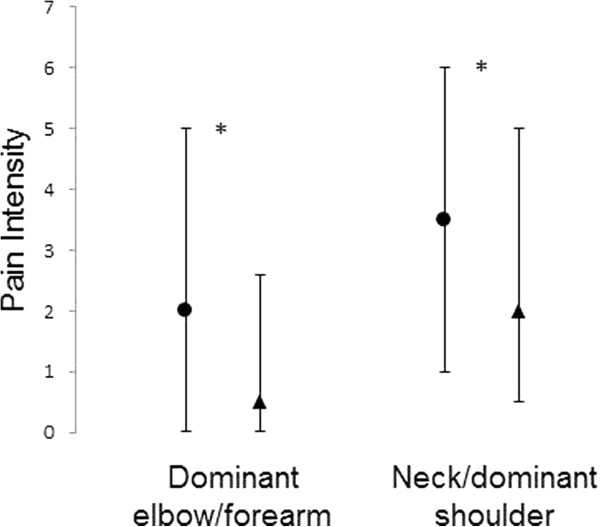
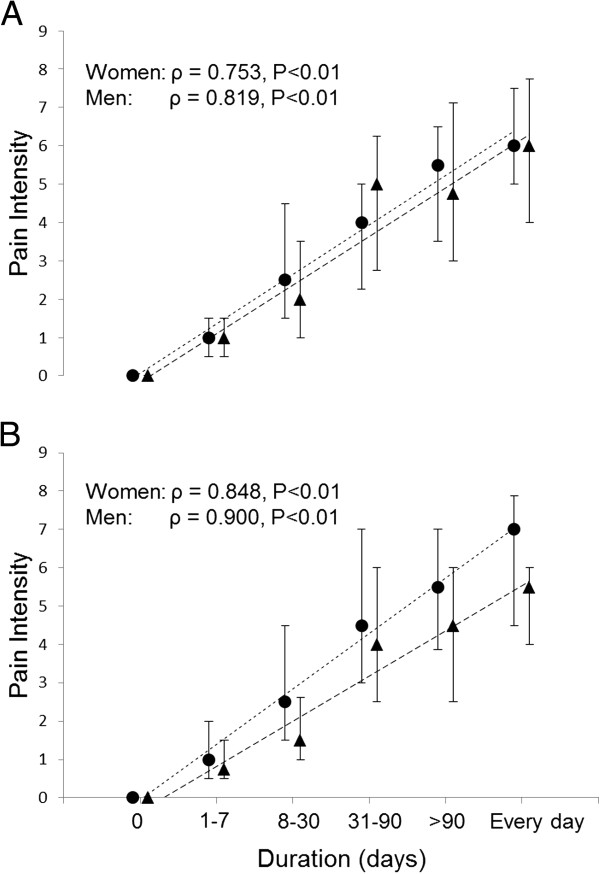
Women reported higher pain intensity, longer pain duration as well as more locations with pain than men (P < 0.05). In parallel, women scored poorer work ability and ability to fulfil the requirements on productivity than men (P < 0.05). Strong positive correlations were found between pain intensity and pain duration for the forearm, elbow, neck and shoulder (P < 0.001). Moderate negative correlations were seen between pain intensity and work ability/productivity (P < 0.001).
The present results provide new key information on pain characteristics in office workers. The differences in pain characteristics, i.e., higher intensity, longer duration and more pain locations as well as poorer work ability reported by women workers relate to their higher risk of contracting WMSD. Overall, this investigation confirmed the complex interplay between anthropometrics, work ability, productivity, and pain perception among computer users.
计算机用户经常报告上肢和颈部肩部的肌肉骨骼投诉和疼痛。然而,最近的流行病学研究并未报告计算机使用程度与工作相关肌肉骨骼疾病(WMSD)之间的关系。本研究的目的是对丹麦计算机用户队列中的短期和长期疼痛投诉以及与工作相关的变量进行探索性分析。
设计了一个基于网络的结构化问卷,其中包括与肌肉骨骼疼痛、人体测量学、与工作相关的变量、工作能力、生产力、健康相关参数、生活方式变量以及休闲时间的体力活动相关的问题。690 名办公室工作人员完成了问卷调查,他们对工会杂志上发布的公告做出了回应。根据性别对问卷结果(即疼痛强度、持续时间和位置以及人体测量学、与工作相关的变量、工作能力、生产力和体力活动水平)进行分层,并获得相关性。
与男性相比,女性报告的疼痛强度更高、疼痛持续时间更长、疼痛部位更多(P < 0.05)。与此同时,女性的工作能力和完成生产力要求的能力评分也低于男性(P < 0.05)。前臂、肘部、颈部和肩部的疼痛强度和疼痛持续时间之间存在强烈的正相关(P < 0.001)。疼痛强度与工作能力/生产力之间存在中度负相关(P < 0.001)。
目前的结果提供了有关办公室工作人员疼痛特征的新关键信息。女性工人报告的疼痛特征差异,即更高的强度、更长的持续时间和更多的疼痛部位以及较差的工作能力,与她们患 WMSD 的风险增加有关。总体而言,这项调查证实了人体测量学、工作能力、生产力和疼痛感知之间复杂的相互作用。