Espinel Eugenia, Joven Jorge, Gil Iván, Suñé Pilar, Renedo Berta, Fort Joan, Serón Daniel
BMC Res Notes. 2013 Aug 1;6:306. doi: 10.1186/1756-0500-6-306.
Angiotensin-converting enzyme inhibitors and angiotensin II receptor blockers are renoprotective but both may increase serum potassium concentrations in patients with chronic kidney disease (CKD). The proportion of affected patients, the optimum follow-up period and whether there are differences between drugs in the development of this complication remain to be ascertained.
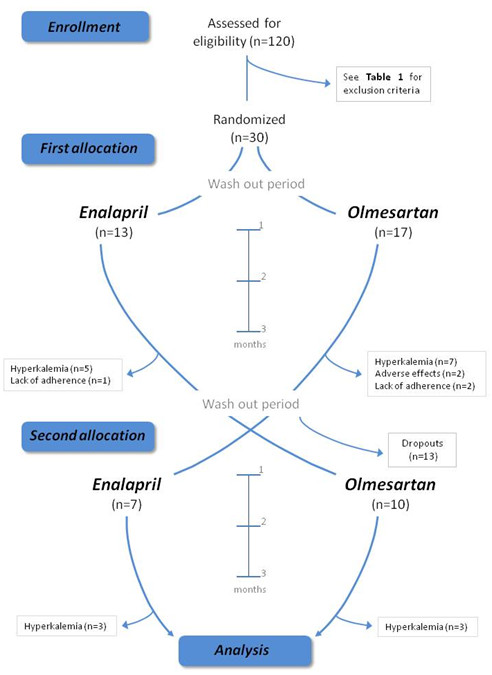
In a randomized, double-blind, phase IV, controlled, crossover study we recruited 30 patients with stage 3 CKD under restrictive eligibility criteria and strict dietary control. With the exception of withdrawals, each patient was treated with olmesartan and enalapril separately for 3 months each, with a 1-week wash-out period between treatments. Patients were clinically assessed on 10 occasions via measurements of serum and urine samples. We used the Cochran-Mantel-Haenszel statistics for comparison of categorical data between groups. Comparisons were also made using independent two-sample t-tests and Welch's t-test. Analysis of variance (ANOVA) was performed when necessary. We used either a Mann-Whitney or Kruskal-Wallis test if the distribution was not normal or the variance not homogeneous.
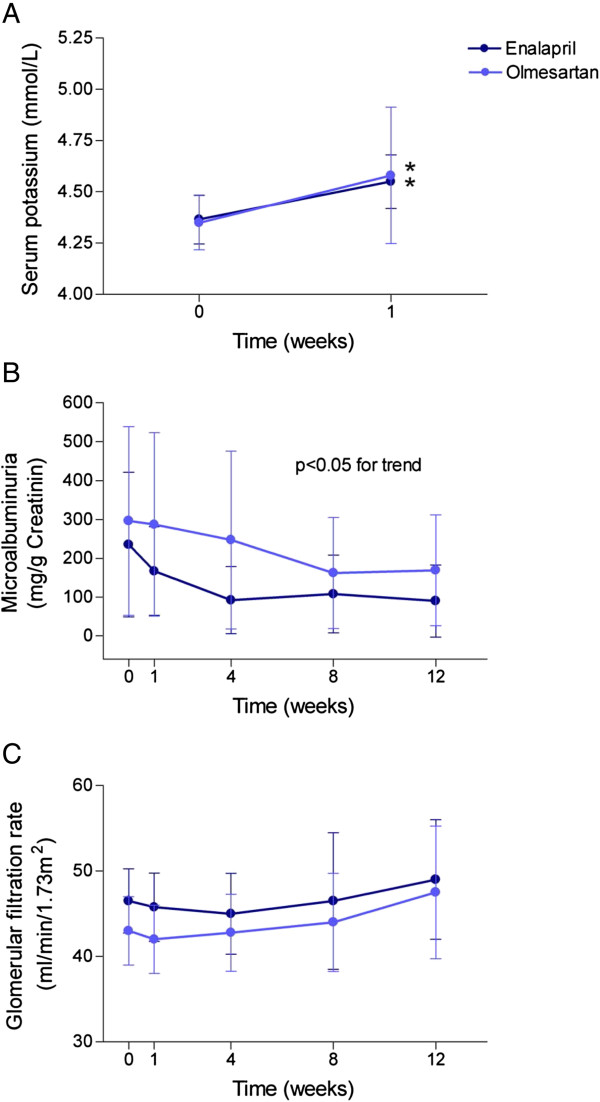
Enalapril and olmesartan increased serum potassium levels similarly (0.3 mmol/L and 0.24 mmol/L respectively). The percentage of patients presenting hyperkalemia higher than 5 mmol/L did not differ between treatments: 37% for olmesartan and 40% for enalapril. The mean e-GFR ranged 46.3 to 48.59 ml/mint/1.73 m2 in those treated with olmesartan and 46.8 to 48.3 ml/mint/1.73 m2 in those with enalapril and remained unchanged at the end of the study. The decreases in microalbuminuria were also similar (23% in olmesartan and 29% in enalapril patients) in the 4 weeks time point. The percentage of patients presenting hyperkalemia, even after a two month period, did not differ between treatments. There were no appreciable changes in sodium and potassium urinary excretion.
Disturbances in potassium balance upon treatment with either olmesartan or enalapril are frequent and without differences between groups. The follow-up of these patients should include control of potassium levels, at least after the first week and the first and second month after initiating treatment.
The trial EudraCT "2008-002191-98".
血管紧张素转换酶抑制剂和血管紧张素II受体阻滞剂具有肾脏保护作用,但两者都可能使慢性肾脏病(CKD)患者的血清钾浓度升高。受影响患者的比例、最佳随访期以及药物在这种并发症发生过程中是否存在差异仍有待确定。
在一项随机、双盲、IV期、对照、交叉研究中,我们根据严格的入选标准和严格的饮食控制招募了30例3期CKD患者。除退出研究的患者外,每位患者分别接受奥美沙坦和依那普利治疗,各治疗3个月,治疗期间有1周的洗脱期。通过检测血清和尿液样本,对患者进行了10次临床评估。我们使用 Cochr an-Mantel-Haenszel统计量比较组间分类数据。还使用独立样本t检验和韦尔奇t检验进行比较。必要时进行方差分析(ANOVA)。如果分布不正常或方差不齐,则使用Mann-Whitney检验或Kruskal-Wallis检验。
依那普利和奥美沙坦升高血清钾水平的情况相似(分别为0.3 mmol/L和0.24 mmol/L)。治疗组中血钾高于5 mmol/L的患者百分比无差异:奥美沙坦组为37%,依那普利组为40%。接受奥美沙坦治疗的患者平均估算肾小球滤过率(e-GFR)在46.3至48.59 ml/min/1.73 m²之间,接受依那普利治疗的患者平均e-GFR在46.8至48.3 ml/min/1.73 m²之间,研究结束时保持不变。在4周时间点,微量白蛋白尿的下降情况也相似(奥美沙坦组为23%,依那普利组为29%)。即使在两个月后,治疗组中血钾过高的患者百分比也无差异。尿钠和尿钾排泄没有明显变化。
使用奥美沙坦或依那普利治疗时钾平衡紊乱很常见,且组间无差异。对这些患者的随访应包括控制血钾水平,至少在开始治疗后的第一周以及第一个月和第二个月之后。
该试验在欧洲药品管理局临床试验数据库(EudraCT)中的注册号为“2008-002191-98”。