Luz Fiusa Maiara Marx, Costa-Lima Carolina, de Souza Gleice Regina, Vigorito Afonso Celso, Penteado Aranha Francisco Jose, Lorand-Metze Irene, Annichino-Bizzacchi Joyce M, de Souza Carmino Antonio, De Paula Erich V
Crit Care. 2013 Aug 5;17(4):R169. doi: 10.1186/cc12848.
Endothelial barrier breakdown is a hallmark of septic shock, and proteins that physiologically regulate endothelial barrier integrity are emerging as promising biomarkers of septic shock development. Patients with cancer and febrile neutropenia (FN) present a higher risk of sepsis complications, such as septic shock. Nonetheless, these patients are normally excluded or under-represented in sepsis biomarker studies. The aim of our study was to validate the measurement of a panel of microvascular permeability modulators as biomarkers of septic shock development in cancer patients with chemotherapy-associated FN.
This was a prospective study of diagnostic accuracy, performed in two distinct in-patient units of a university hospital. Levels of vascular endothelial growth factor A (VEGF-A), soluble fms-like tyrosine kinase-1 (sFlt-1) and angiopoietin (Ang) 1 and 2 were measured after the onset of neutropenic fever, in conditions designed to mimic the real-world use of a sepsis biomarker, based on our local practice. Patients were categorized based on the development of septic shock by 28 days as an outcome.
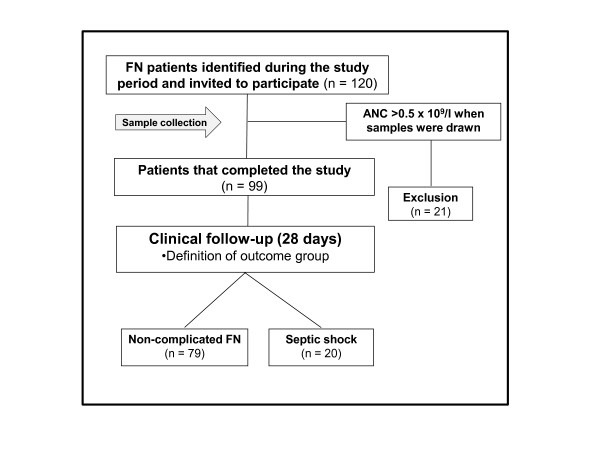
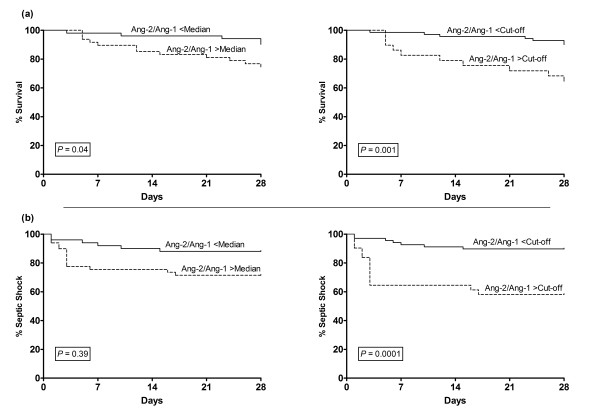
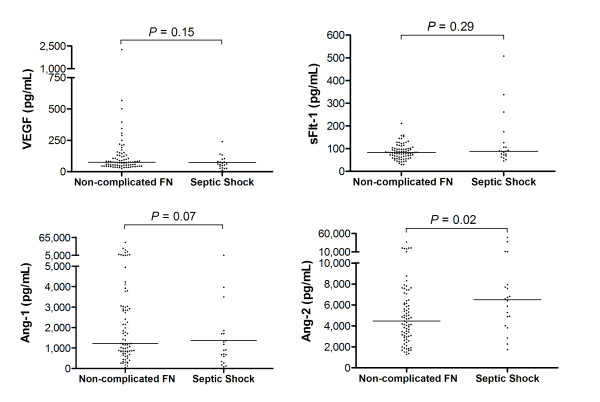
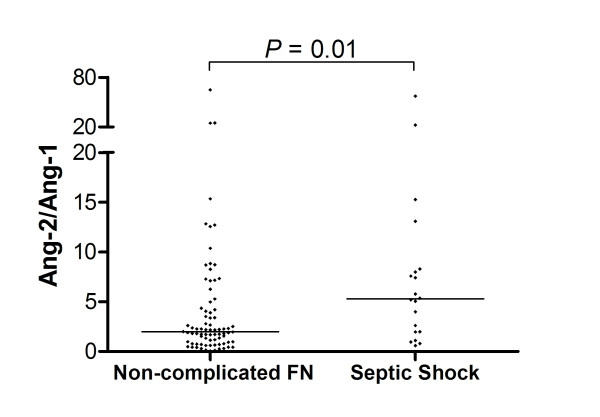
A total of 99 consecutive patients were evaluated in the study, of which 20 developed septic shock and 79 were classified as non-complicated FN. VEGF-A and sFlt-1 levels were similar between both outcome groups. In contrast, Ang-2 concentrations were increased in patients with septic shock, whereas an inverse finding was observed for Ang-1, resulting in a higher Ang-2/Ang-1 ratio in patients with septic shock (5.29, range 0.58 to 57.14) compared to non-complicated FN (1.99, range 0.06 to 64.62; P = 0.01). After multivariate analysis, the Ang-2/Ang-1 ratio remained an independent factor for septic shock development and 28-day mortality.
A high Ang-2/Ang-1 ratio can predict the development of septic shock in cancer patients with febrile neutropenia.
内皮屏障破坏是脓毒性休克的一个标志,生理上调节内皮屏障完整性的蛋白质正成为脓毒性休克发展的有前景的生物标志物。癌症和发热性中性粒细胞减少症(FN)患者发生脓毒症并发症(如脓毒性休克)的风险更高。尽管如此,这些患者在脓毒症生物标志物研究中通常被排除或代表性不足。我们研究的目的是验证一组微血管通透性调节剂的测量作为化疗相关FN癌症患者脓毒性休克发展的生物标志物。
这是一项诊断准确性的前瞻性研究,在一家大学医院的两个不同住院科室进行。根据我们当地的实践,在中性粒细胞减少性发热发作后,在旨在模拟脓毒症生物标志物实际应用的条件下,测量血管内皮生长因子A(VEGF-A)、可溶性fms样酪氨酸激酶-1(sFlt-1)以及血管生成素(Ang)1和2的水平。以28天内脓毒性休克的发生作为结果对患者进行分类。
该研究共评估了99例连续患者,其中20例发生脓毒性休克,79例被归类为非复杂性FN。两个结果组之间的VEGF-A和sFlt-1水平相似。相比之下,脓毒性休克患者的Ang-2浓度升高,而Ang-1则相反,导致脓毒性休克患者的Ang-2/Ang-1比值(5.29,范围0.58至57.14)高于非复杂性FN患者(1.99,范围0.06至64.62;P = 0.01)。多变量分析后,Ang-2/Ang-1比值仍然是脓毒性休克发展和28天死亡率的独立因素。
高Ang-2/Ang-1比值可预测发热性中性粒细胞减少症癌症患者脓毒性休克的发展。