Department of Animal & Plant Sciences, University of Sheffield Sheffield, S10 2TN, UK.
Ecol Evol. 2013 Jul;3(7):1864-77. doi: 10.1002/ece3.558. Epub 2013 May 21.
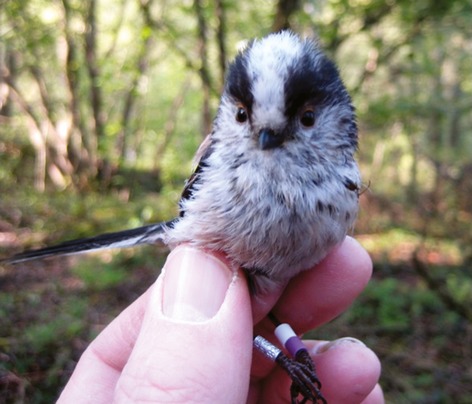
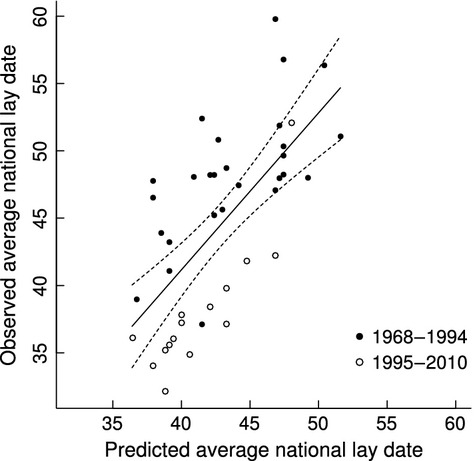
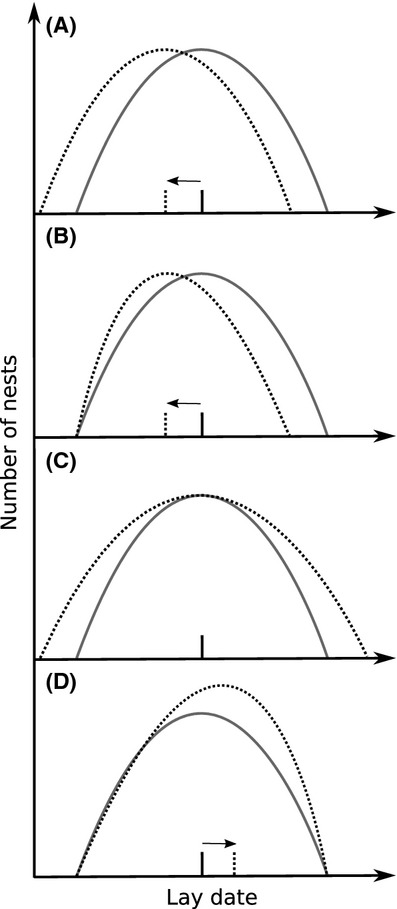
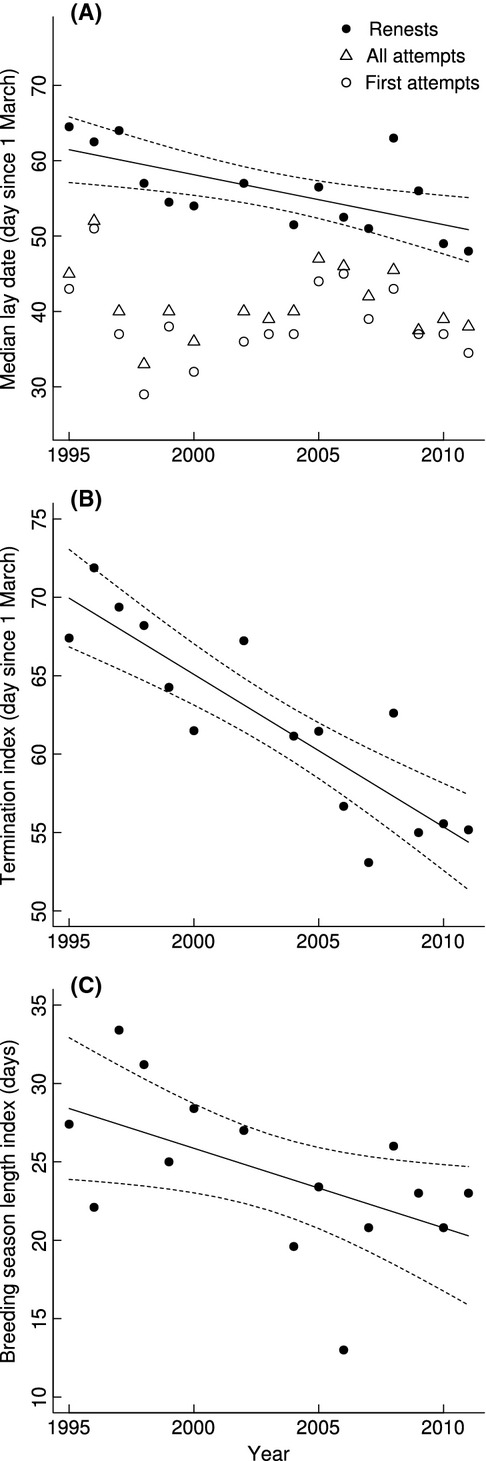
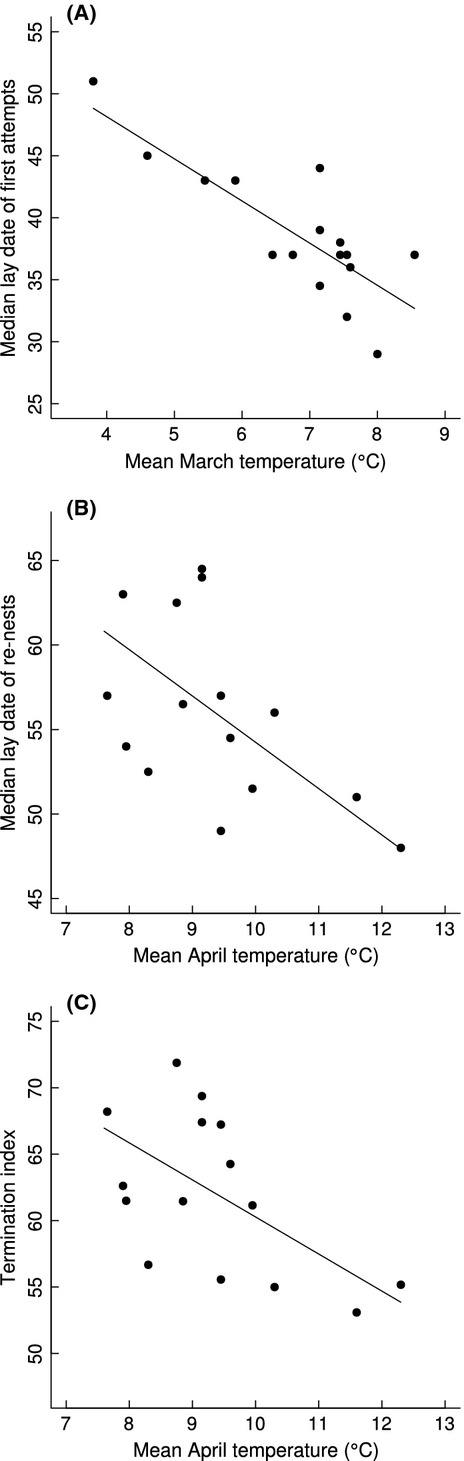
Climate change-induced shifts in phenology have important demographic consequences, and are frequently used to assess species' sensitivity to climate change. Therefore, developing accurate phenological predictions is an important step in modeling species' responses to climate change. The ability of such phenological models to predict effects at larger spatial and temporal scales has rarely been assessed. It is also not clear whether the most frequently used phenological index, namely the average date of a phenological event across a population, adequately captures phenological shifts in the distribution of events across the season. We use the long-tailed tit Aegithalos caudatus (Fig. 1) as a case study to explore these issues. We use an intensive 17-year local study to model mean breeding date and test the capacity of this local model to predict phenology at larger spatial and temporal scales. We assess whether local models of breeding initiation, termination, and renesting reveal phenological shifts and responses to climate not detected by a standard phenological index, that is, population average lay date. These models take predation timing/intensity into account. The locally-derived model performs well at predicting phenology at the national scale over several decades, at both high and low temperatures. In the local model, a trend toward warmer Aprils is associated with a significant advance in termination dates, probably in response to phenological shifts in food supply. This results in a 33% reduction in breeding season length over 17 years - a substantial loss of reproductive opportunity that is not detected by the index of population average lay date. We show that standard phenological indices can fail to detect patterns indicative of negative climatic effects, potentially biasing assessments of species' vulnerability to climate change. More positively, we demonstrate the potential of detailed local studies for developing broader-scale predictive models of future phenological shifts.
气候变化引起的物候变化对人口有重要的影响,并且经常被用于评估物种对气候变化的敏感性。因此,准确预测物候是模拟物种对气候变化反应的重要步骤。这些物候模型在更大的空间和时间尺度上预测影响的能力很少被评估。也不清楚最常用的物候指数,即一个物候事件在一个种群中的平均日期,是否能充分捕捉到事件在整个季节分布上的物候变化。我们使用长尾山雀(Aegithalos caudatus)(图 1)作为案例研究来探讨这些问题。我们使用了一项长达 17 年的密集本地研究来模拟平均繁殖日期,并测试了该本地模型预测更大空间和时间尺度上物候的能力。我们评估了繁殖起始、终止和再筑巢的本地模型是否揭示了标准物候指数(即种群平均产卵日期)未检测到的物候变化和对气候的反应。这些模型考虑了捕食时间/强度的影响。在几十年的时间里,在高、低温度下,该本地衍生模型在预测全国范围的物候方面表现良好。在本地模型中,4 月变暖的趋势与终止日期的显著提前有关,这可能是对食物供应物候变化的反应。这导致繁殖季节长度在 17 年内减少了 33%——这是一个实质性的繁殖机会损失,而标准的种群平均产卵日期指数并没有检测到这一点。我们表明,标准的物候指数可能无法检测到表明负面气候影响的模式,这可能会对物种对气候变化的脆弱性评估产生偏差。更积极的是,我们展示了详细的本地研究在开发未来物候变化的更广泛预测模型方面的潜力。