Forest Ecology and Conservation Group, Department of Plant Sciences, Downing Street, University of Cambridge Cambridge, CB2 3EA, UK.
Ecol Evol. 2013 Jul;3(7):1890-901. doi: 10.1002/ece3.548. Epub 2013 May 22.
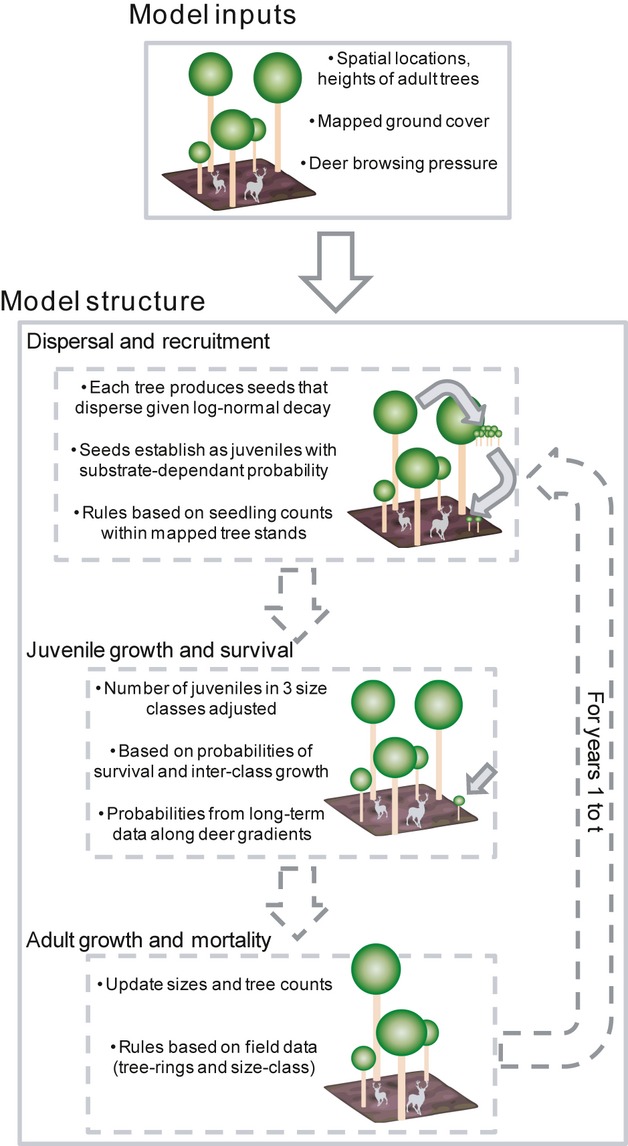
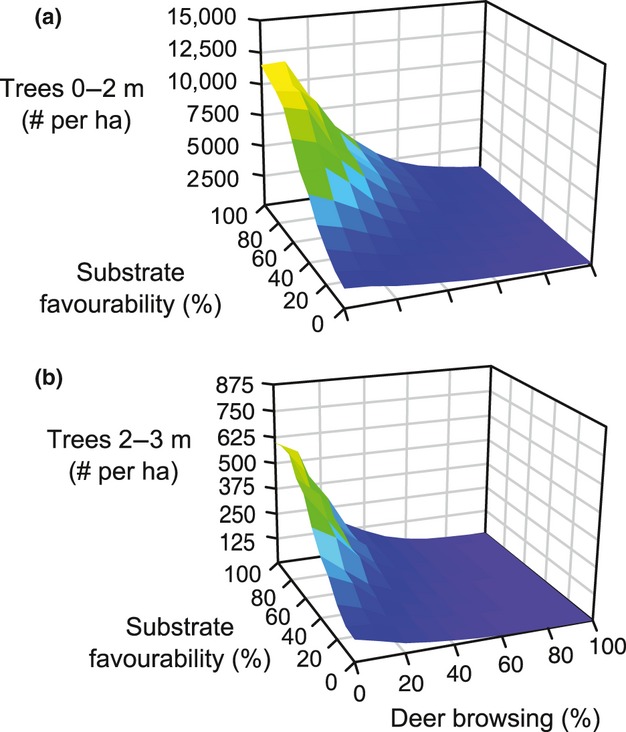
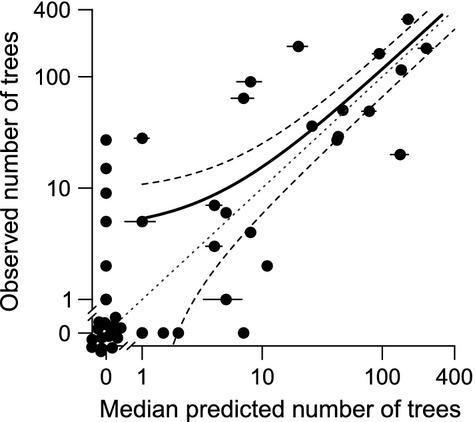
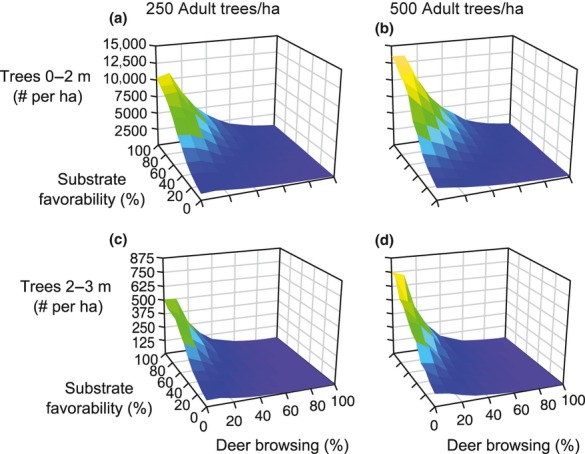
High deer populations threaten the conservation value of woodlands and grasslands, but predicting the success of deer culling, in terms of allowing vegetation to recover, is difficult. Numerical simulation modeling is one approach to gain insight into the outcomes of management scenarios. We develop a spatially explicit model to predict the responses of Betula spp. to red deer (Cervus elaphus) and land management in the Scottish Highlands. Our model integrates a Bayesian stochastic stage-based matrix model within the framework of a widely used individual-based forest simulation model, using data collected along spatial and temporal gradients in deer browsing. By initializing our model with the historical spatial locations of trees, we find that densities of juvenile trees (<3 m tall) predicted after 9-13 years closely match counts observed in the field. This is among the first tests of the accuracy of a dynamical simulation model for predicting the responses of tree regeneration to herbivores. We then test the relative importance of deer browsing, ground cover vegetation, and seed availability in facilitating landscape-level birch regeneration using simulations in which we varied these three variables. We find that deer primarily control transitions of birch to taller (>3 m) height tiers over 30 years, but regeneration also requires suitable ground cover for seedling establishment. Densities of adult seed sources did not influence regeneration, nor did an active management scenario where we altered the spatial configuration of adults by creating "woodland islets". Our results show that managers interested in maximizing tree regeneration cannot simply reduce deer densities but must also improve ground cover for seedling establishment, and the model we develop now enables managers to quantify explicitly how much both these factors need to be altered. More broadly, our findings emphasize the need for land managers to consider the impacts of large herbivores rather than their densities.
高的鹿种群数量威胁到林地和草原的保护价值,但预测鹿捕杀的成功,就植被恢复而言,是困难的。数值模拟建模是一种深入了解管理情景结果的方法。我们开发了一种空间显式模型,以预测苏格兰高地的桦树(Betula spp.)对红鹿(Cervus elaphus)和土地管理的反应。我们的模型在一个广泛使用的基于个体的森林模拟模型的框架内,将贝叶斯随机阶段矩阵模型集成在一起,使用沿鹿捕食的时空梯度收集的数据。通过用树木的历史空间位置初始化我们的模型,我们发现,在 9-13 年后预测的幼树(<3 米高)的密度与实地观察到的计数非常吻合。这是首次测试动态模拟模型预测树木再生对食草动物反应的准确性。然后,我们通过模拟改变这三个变量,测试了鹿捕食、地被植被和种子可用性在促进桦树再生方面的相对重要性。我们发现,鹿主要控制桦树在 30 年内向更高(>3 米)高度层的转变,但再生还需要适合幼苗建立的地被植被。成年种子源的密度不会影响再生,也不会影响通过创建“林地小岛”改变成年树木空间配置的主动管理情景。我们的结果表明,有兴趣最大限度地提高树木再生的管理者不能简单地降低鹿的密度,还必须改善幼苗建立的地被植被,我们开发的模型现在使管理者能够明确量化这两个因素需要改变多少。更广泛地说,我们的发现强调了土地管理者需要考虑大型食草动物的影响,而不仅仅是它们的密度。