National Institute of Agrobiological Sciences 2-1-2 Kannondai, Tsukuba, Ibaraki, 305-8602, Japan.
Ecol Evol. 2013 Jul;3(7):2150-68. doi: 10.1002/ece3.606. Epub 2013 Jun 5.
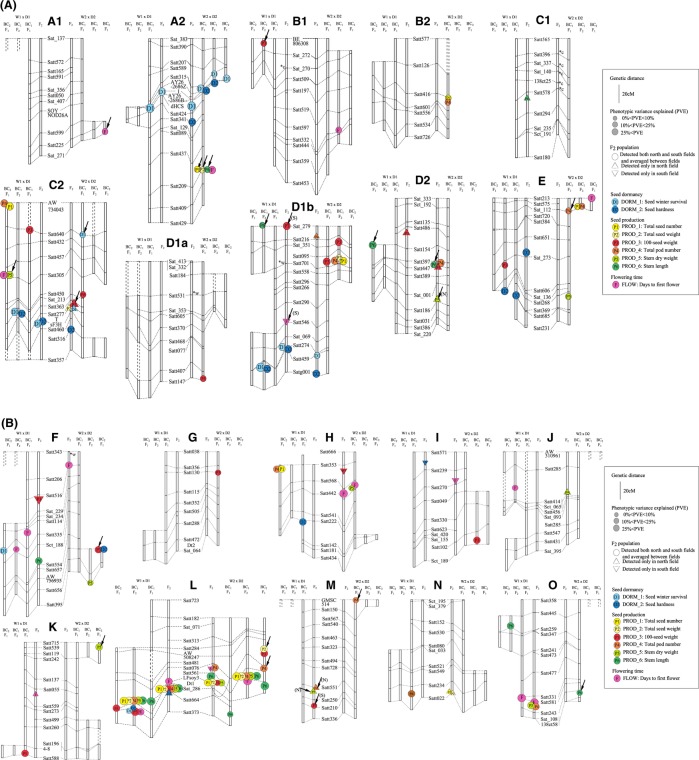
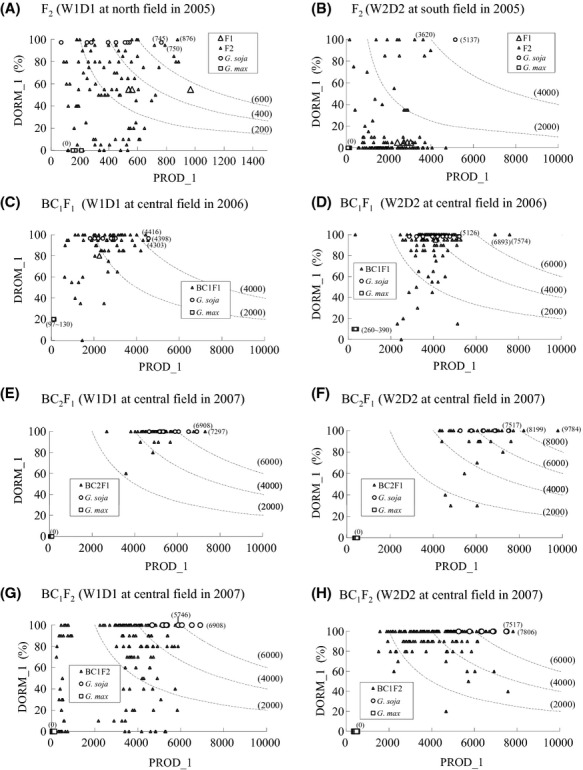
The objective of this study was to identify quantitative trait loci (QTL) affecting fitness of hybrids between wild soybean (Glycine soja) and cultivated soybean (Glycine max). Seed dormancy and seed number, both of which are important for fitness, were evaluated by testing artificial hybrids of G. soja × G. max in a multiple-site field trial. Generally, the fitness of the F1 hybrids and hybrid derivatives from self-pollination was lower than that of G. soja due to loss of seed dormancy, whereas the fitness of hybrid derivatives with higher proportions of G. soja genetic background was comparable with that of G. soja. These differences were genetically dissected into QTL for each population. Three QTLs for seed dormancy and one QTL for total seed number were detected in the F2 progenies of two diverse cross combinations. At those four QTLs, the G. max alleles reduced seed number and severely reduced seed survival during the winter, suggesting that major genes acquired during soybean adaptation to cultivation have a selective disadvantage in natural habitats. In progenies with a higher proportion of G. soja genetic background, the genetic effects of the G. max alleles were not expressed as phenotypes because the G. soja alleles were dominant over the G. max alleles. Considering the highly inbreeding nature of these species, most hybrid derivatives would disappear quickly in early self-pollinating generations in natural habitats because of the low fitness of plants carrying G. max alleles.
本研究旨在鉴定影响野生大豆(Glycine soja)与栽培大豆(Glycine max)杂种适应性的数量性状位点(QTL)。通过在多地点田间试验中对 G. soja × G. max 的人工杂种进行测试,评估了休眠和种子数量这两个对适应性很重要的性状。一般来说,由于休眠性丧失,F1 杂种及其自交产生的杂种后代的适应性低于 G. soja,而具有较高 G. soja 遗传背景的杂种后代的适应性与 G. soja 相当。这些差异在遗传上被分解为每个群体的 QTL。在两个不同杂交组合的 F2 后代中检测到了 3 个休眠 QTL 和 1 个总种子数 QTL。在这四个 QTL 中,G. max 等位基因减少了种子数量,并严重降低了种子在冬季的存活率,这表明在大豆适应栽培的过程中获得的主要基因在自然栖息地中具有选择劣势。在具有较高 G. soja 遗传背景的后代中,G. max 等位基因的遗传效应不会表现为表型,因为 G. soja 等位基因对 G. max 等位基因是显性的。考虑到这些物种的高度自交性质,由于携带 G. max 等位基因的植物适应性较低,大多数杂种后代在自然栖息地的早期自交世代中会迅速消失。