Division of Cardiovascular Medicine, Department of Internal Medicine, University of Michigan, Ann Arbor, MI 48106, USA.
Inhal Toxicol. 2013 Aug;25(10):587-92. doi: 10.3109/08958378.2013.814733. Epub 2013 Aug 6.
Fine particulate matter (PM) air pollution has been associated with alterations in circulating endothelial progenitor cell (EPC) levels, which may be one mechanism whereby exposures promote cardiovascular diseases. However, the impact of coarse PM on EPCs is unknown.
We aimed to determine the effect of acute exposure to coarse concentrated ambient particles (CAP) on circulating EPC levels.
Thirty-two adults (25.9 ± 6.6 years) were exposed to coarse CAP (76.2 ± 51.5 μg m(-3)) in a rural location and filtered air (FA) for 2 h in a randomized double-blind crossover study. Peripheral venous blood was collected 2 and 20 h post-exposures for circulating EPC (n = 21), white blood cell (n = 24) and vascular endothelial growth factor (VEGF) (n = 16-19) levels. The changes between exposures were compared by matched Wilcoxon signed-rank tests.
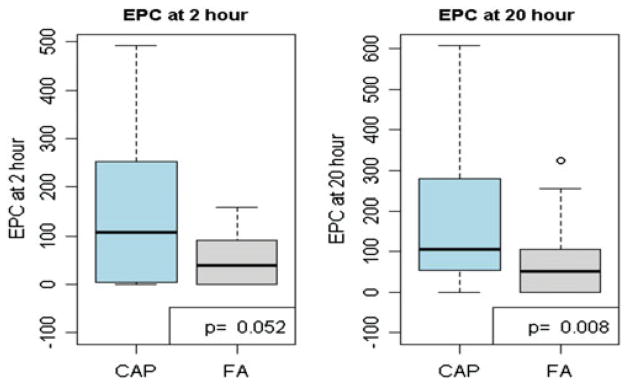
Circulating EPC levels were elevated 2 [108.29 (6.24-249.71) EPC mL(-1); median (25th-75th percentiles), p = 0.052] and 20 h [106.86 (52.91-278.35) EPC mL(-1), p = 0.008] post-CAP exposure compared to the same time points following FA [38.47 (0.00-84.83) and 50.16 (0.00-104.79) EPC mL(-1)]. VEGF and white blood cell (WBC) levels did not differ between exposures.
Brief inhalation of coarse PM from a rural location elicited an increase in EPCs that persisted for at least 20 h. The underlying mechanism responsible may reflect a systemic reaction to an acute "endothelial injury" and/or a circulating EPC response to sympathetic nervous system activation.
细颗粒物(PM)空气污染与循环内皮祖细胞(EPC)水平的改变有关,这可能是暴露促进心血管疾病的一种机制。然而,粗颗粒 PM 对 EPC 的影响尚不清楚。
我们旨在确定急性暴露于农村地区的粗集中环境颗粒(CAP)对循环 EPC 水平的影响。
32 名成年人(25.9±6.6 岁)在农村地区接受了 2 小时的粗 CAP(76.2±51.5μg/m3)和过滤空气(FA)的随机双盲交叉研究。暴露后 2 和 20 小时采集外周静脉血,用于循环 EPC(n=21)、白细胞(n=24)和血管内皮生长因子(VEGF)(n=16-19)水平。通过配对 Wilcoxon 符号秩检验比较暴露之间的变化。
与 FA 后相同时间点相比,CAP 暴露后 2 小时[108.29(6.24-249.71)EPC/mL(中位数(25%至 75%),p=0.052]和 20 小时[106.86(52.91-278.35)EPC/mL(p=0.008)升高。暴露后 VEGF 和白细胞(WBC)水平没有差异。
从农村地区短暂吸入粗颗粒 PM 会引起 EPC 增加,至少持续 20 小时。负责的潜在机制可能反映了对急性“内皮损伤”的全身反应和/或循环 EPC 对交感神经系统激活的反应。