Department of Oncology, The Sidney Kimmel Comprehensive Cancer Center at Johns Hopkins, Baltimore, MD 21287, USA.
Mol Cancer. 2013 Aug 6;12:90. doi: 10.1186/1476-4598-12-90.
Recent epidemiological studies demonstrate that both active and involuntary exposure to tobacco smoke increase the risk of breast cancer. Little is known, however, about the molecular mechanisms by which continuous, long term exposure to tobacco smoke contributes to breast carcinogenesis because most previous studies have focused on short term treatment models. In this work we have set out to investigate the progressive transforming effects of tobacco smoke on non-tumorigenic mammary epithelial cells and breast cancer cells using in vitro and in vivo models of chronic cigarette smoke exposure.
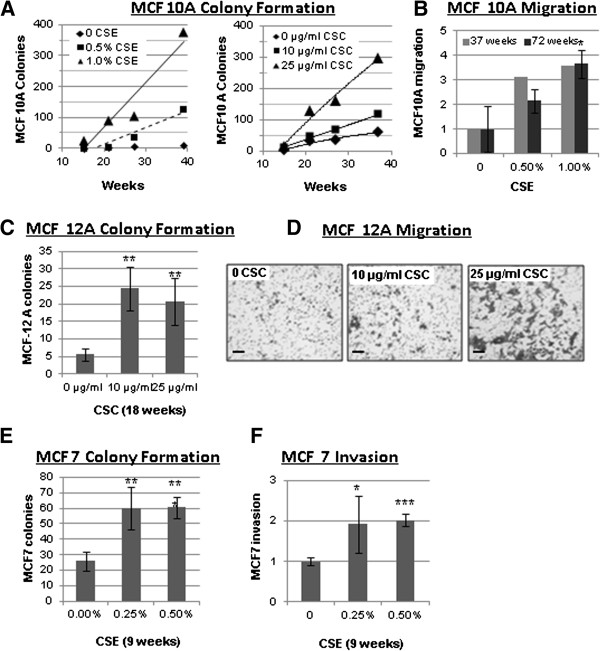
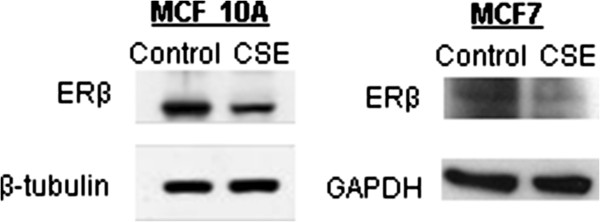
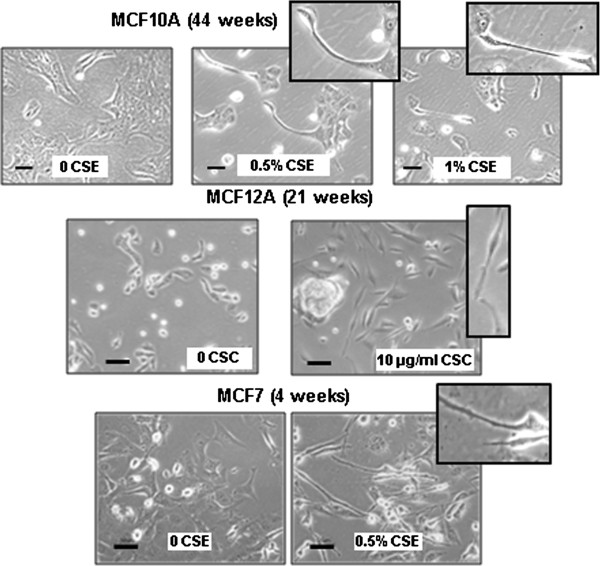
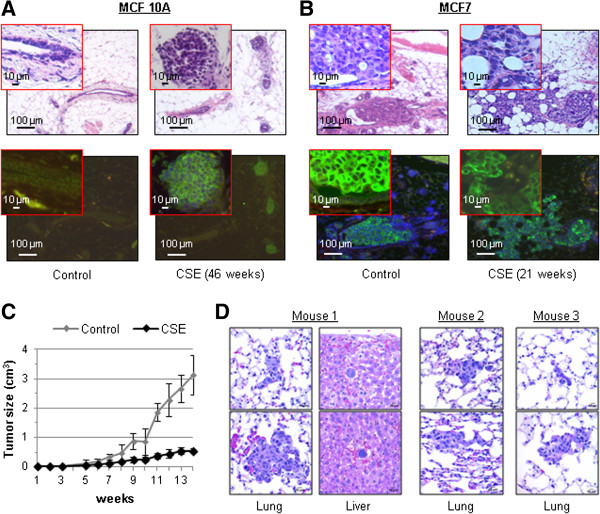
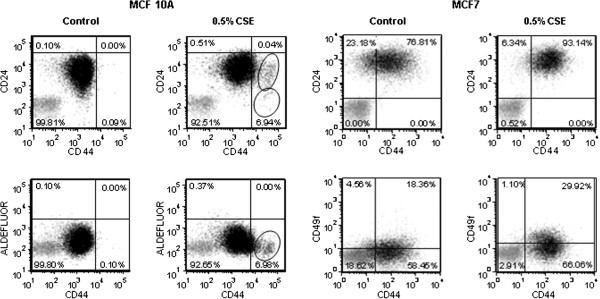
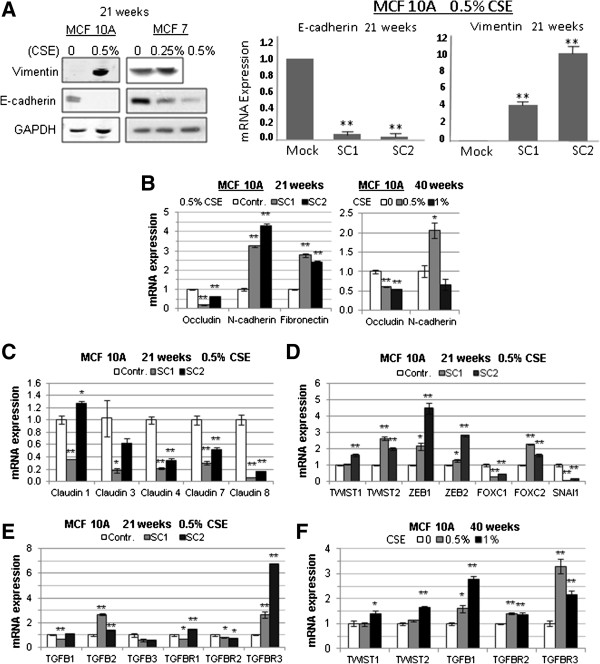
We show that both non-tumorigenic (MCF 10A, MCF-12A) and tumorigenic (MCF7) breast epithelial cells exposed to cigarette smoke acquire mesenchymal properties such as fibroblastoid morphology, increased anchorage-independent growth, and increased motility and invasiveness. Moreover, transplantation experiments in mice demonstrate that treatment with cigarette smoke extract renders MCF 10A cells more capable to survive and colonize the mammary ducts and MCF7 cells more prone to metastasize from a subcutaneous injection site, independent of cigarette smoke effects on the host and stromal environment. The extent of transformation and the resulting phenotype thus appear to be associated with the differentiation state of the cells at the time of exposure. Analysis by flow cytometry showed that treatment with CSE leads to the emergence of a CD44(hi)/CD24(low) population in MCF 10A cells and of CD44+ and CD49f + MCF7 cells, indicating that cigarette smoke causes the emergence of cell populations bearing markers of self-renewing stem-like cells. The phenotypical alterations induced by cigarette smoke are accompanied by numerous changes in gene expression that are associated with epithelial to mesenchymal transition and tumorigenesis.
Our results indicate that exposure to cigarette smoke leads to a more aggressive and transformed phenotype in human mammary epithelial cells and that the differentiation state of the cell at the time of exposure may be an important determinant in the phenotype of the final transformed state.
最近的流行病学研究表明,主动和被动接触烟草烟雾都会增加患乳腺癌的风险。然而,人们对烟草烟雾持续、长期暴露导致乳腺癌发生的分子机制知之甚少,因为大多数先前的研究都集中在短期治疗模型上。在这项工作中,我们使用体外和体内慢性香烟烟雾暴露模型,研究了烟草烟雾对非致瘤性乳腺上皮细胞和乳腺癌细胞的渐进转化作用。
我们表明,暴露于香烟烟雾的非致瘤性(MCF10A、MCF-12A)和致瘤性(MCF7)乳腺上皮细胞获得间充质特性,如成纤维细胞样形态、增加的无锚定依赖性生长以及增加的运动性和侵袭性。此外,在小鼠中的移植实验表明,用香烟烟雾提取物处理使 MCF10A 细胞更有能力在乳腺导管中存活和定植,使 MCF7 细胞更倾向于从皮下注射部位转移,而与香烟烟雾对宿主和基质环境的影响无关。转化的程度和由此产生的表型似乎与细胞在暴露时的分化状态有关。流式细胞术分析表明,CSE 处理导致 MCF10A 细胞中出现 CD44(hi)/CD24(low)群体,以及 CD44+和 CD49f+ MCF7 细胞,表明香烟烟雾导致具有自我更新干细胞样细胞标志物的细胞群体出现。香烟烟雾引起的表型改变伴随着大量基因表达的变化,这些变化与上皮间质转化和肿瘤发生有关。
我们的结果表明,暴露于香烟烟雾会导致人乳腺上皮细胞更具侵袭性和转化表型,而细胞在暴露时的分化状态可能是最终转化状态表型的重要决定因素。