Holmes Valerie A, Young Ian S, Patterson Christopher C, Maresh Michael J A, Pearson Donald W M, Walker James D, McCance David R
Corresponding author: Valerie A. Holmes,
Diabetes Care. 2013 Nov;36(11):3671-7. doi: 10.2337/dc13-0944. Epub 2013 Aug 6.
To assess the association between circulating angiogenic and antiangiogenic factors in the second trimester and risk of preeclampsia in women with type 1 diabetes.
Maternal plasma concentrations of placental growth factor (PlGF), soluble fms-like tyrosine kinase 1 (sFlt-1), and soluble endoglin (sEng) were available at 26 weeks of gestation in 540 women with type 1 diabetes enrolled in the Diabetes and Preeclampsia Intervention Trial.
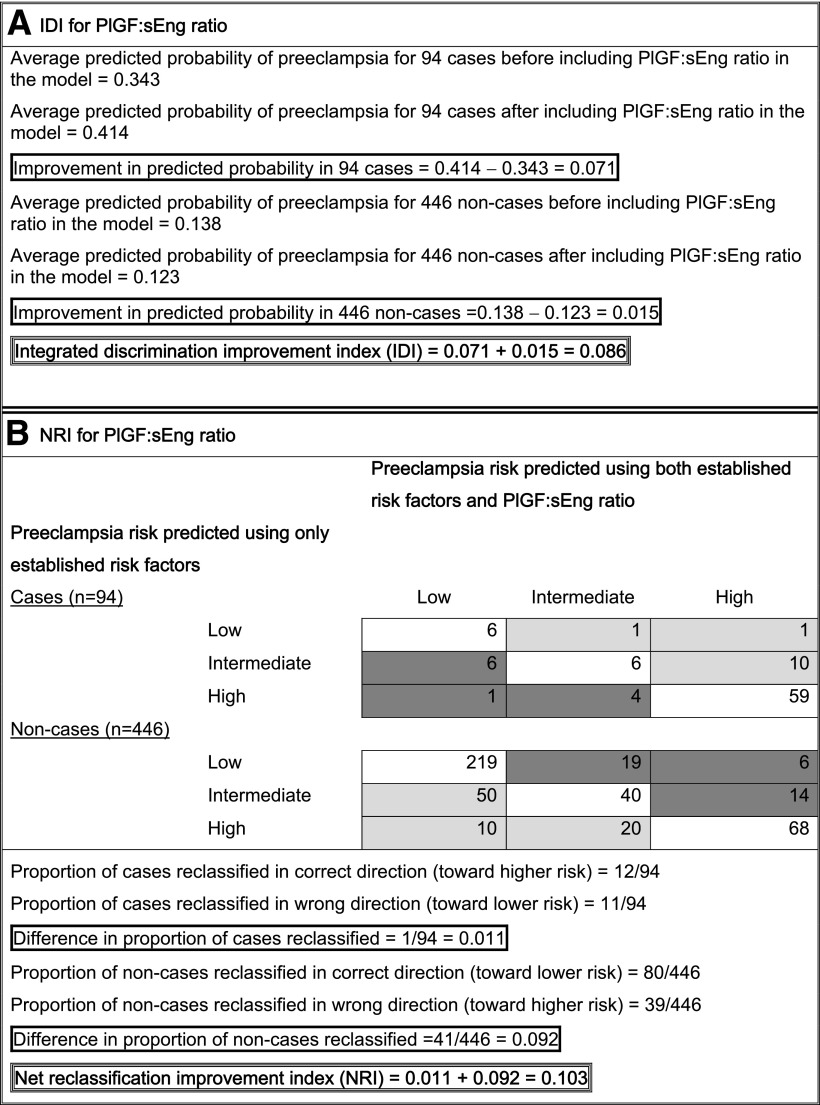
Preeclampsia developed in 17% of pregnancies (n = 94). At 26 weeks of gestation, women in whom preeclampsia developed later had significantly lower PlGF (median [interquartile range]: 231 pg/mL [120-423] vs. 365 pg/mL [237-582]; P < 0.001), higher sFlt-1 (1,522 pg/mL [1,108-3,393] vs. 1,193 pg/mL [844-1,630] P < 0.001), and higher sEng (6.2 ng/mL [4.9-7.9] vs. 5.1 ng/mL[(4.3-6.2]; P < 0.001) compared with women who did not have preeclampsia. In addition, the ratio of PlGF to sEng was significantly lower (40 [17-71] vs. 71 [44-114]; P < 0.001) and the ratio of sFlt-1 to PlGF was significantly higher (6.3 [3.4-15.7] vs. 3.1 [1.8-5.8]; P < 0.001) in women who later developed preeclampsia. The addition of the ratio of PlGF to sEng or the ratio of sFlt-1 to PlGF to a logistic model containing established risk factors (area under the curve [AUC], 0.813) significantly improved the predictive value (AUC, 0.850 and 0.846, respectively; P < 0.01) and significantly improved reclassification according to the integrated discrimination improvement index (IDI) (IDI scores 0.086 and 0.065, respectively; P < 0.001).
These data suggest that angiogenic and antiangiogenic factors measured during the second trimester are predictive of preeclampsia in women with type 1 diabetes. The addition of the ratio of PlGF to sEng or the ratio of sFlt-1 to PlGF to established clinical risk factors significantly improves the prediction of preeclampsia in women with type 1 diabetes.
评估孕中期循环血管生成因子和抗血管生成因子与1型糖尿病女性先兆子痫风险之间的关联。
在参与糖尿病与先兆子痫干预试验的540例1型糖尿病女性中,于妊娠26周时获取了母体血浆中胎盘生长因子(PlGF)、可溶性fms样酪氨酸激酶1(sFlt-1)和可溶性内皮糖蛋白(sEng)的浓度。
17%的妊娠(n = 94)发生了先兆子痫。在妊娠26周时,后来发生先兆子痫的女性的PlGF显著降低(中位数[四分位间距]:231 pg/mL [120 - 423] 对比 365 pg/mL [237 - 582];P < 0.001),sFlt-1更高(1,522 pg/mL [1,108 - 3,393] 对比 1,193 pg/mL [844 - 1,630];P < 0.001),sEng也更高(6.2 ng/mL [4.9 - 7.9] 对比 5.1 ng/mL [4.3 - 6.2];P < 0.001),与未发生先兆子痫的女性相比。此外,后来发生先兆子痫的女性中PlGF与sEng的比值显著更低(40 [17 - 71] 对比 71 [44 - 114];P < 0.001),sFlt-1与PlGF的比值显著更高(6.3 [3.4 - 15.7] 对比 3.1 [1.8 - 5.8];P < 0.001)。将PlGF与sEng的比值或sFlt-1与PlGF的比值添加到包含既定风险因素的逻辑模型中(曲线下面积[AUC],0.813),显著提高了预测价值(AUC分别为0.850和0.846;P < 0.01),并根据综合判别改善指数(IDI)显著改善了重新分类(IDI分数分别为0.086和0.065;P < 0.001)。
这些数据表明,孕中期测量的血管生成因子和抗血管生成因子可预测1型糖尿病女性的先兆子痫。将PlGF与sEng的比值或sFlt-1与PlGF的比值添加到既定的临床风险因素中,可显著改善1型糖尿病女性先兆子痫的预测。