Department of Ecology, Swedish University of Agricultural Sciences, Uppsala, Sweden.
PLoS One. 2013 Jul 29;8(7):e69431. doi: 10.1371/journal.pone.0069431. Print 2013.
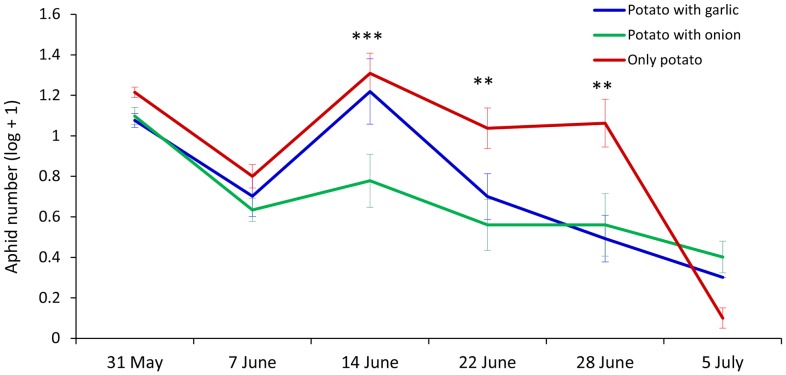
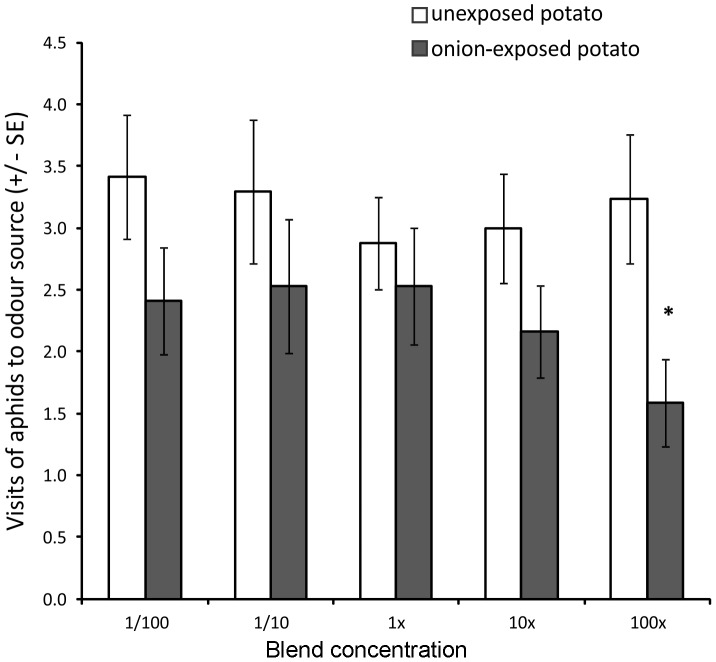
Changes in plant volatile emission can be induced by exposure to volatiles from neighbouring insect-attacked plants. However, plants are also exposed to volatiles from unattacked neighbours, and the consequences of this have not been explored. We investigated whether volatile exchange between undamaged plants affects volatile emission and plant-insect interaction. Consistently greater quantities of two terpenoids were found in the headspace of potato previously exposed to volatiles from undamaged onion plants identified by mass spectrometry. Using live plants and synthetic blends mimicking exposed and unexposed potato, we tested the olfactory response of winged aphids, Myzus persicae. The altered potato volatile profile deterred aphids in laboratory experiments. Further, we show that growing potato together with onion in the field reduces the abundance of winged, host-seeking aphids. Our study broadens the ecological significance of the phenomenon; volatiles carry not only information on whether or not neighbouring plants are under attack, but also information on the emitter plants themselves. In this way responding plants could obtain information on whether the neighbouring plant is a competitive threat and can accordingly adjust their growth towards it. We interpret this as a response in the process of adaptation towards neighbouring plants. Furthermore, these physiological changes in the responding plants have significant ecological impact, as behaviour of aphids was affected. Since herbivore host plants are potentially under constant exposure to these volatiles, our study has major implications for the understanding of how mechanisms within plant communities affect insects. This knowledge could be used to improve plant protection and increase scientific understanding of communication between plants and its impact on other organisms.
植物挥发物的排放变化可以通过暴露于邻近受昆虫攻击的植物挥发物而引起。然而,植物也会暴露于未受攻击的邻近植物的挥发物中,而这种情况的后果尚未得到探索。我们研究了未受损植物之间的挥发性物质交换是否会影响挥发性物质的排放和植物与昆虫的相互作用。通过质谱鉴定,我们发现先前暴露于未受损洋葱植物挥发物的马铃薯植株的气室中,两种萜烯的含量明显更高。使用活体植物和模拟暴露和未暴露的马铃薯的合成混合物,我们测试了有翼蚜虫,桃蚜的嗅觉反应。在实验室实验中,改变后的马铃薯挥发性特征阻止了蚜虫的出现。此外,我们表明,在田间与洋葱一起种植马铃薯可减少有翼、寻找宿主的蚜虫的丰度。我们的研究拓宽了这一现象的生态意义;挥发物不仅传递了邻近植物是否受到攻击的信息,还传递了发射器植物本身的信息。通过这种方式,反应植物可以获得有关邻近植物是否是竞争威胁的信息,并相应地调整其对该植物的生长。我们将其解释为对邻近植物的适应过程中的一种反应。此外,由于蚜虫的行为受到影响,响应植物的这些生理变化对具有重大的生态影响。由于食草性宿主植物可能会不断受到这些挥发物的影响,因此我们的研究对了解植物群落内部的机制如何影响昆虫具有重要意义。这一知识可用于改善植物保护并增加对植物与其他生物之间的交流的科学理解。