Neurosciences Unit, Great Ormond Street Hospital for Children NHS Trust and UCL-Institute of Child Health, London, UK.
Dev Med Child Neurol. 2013 Sep;55(9):846-56. doi: 10.1111/dmcn.12171.
Recently, we reported a previously unrecognized symptom constellation comprising epilepsy, ataxia, sensorineural deafness, and tubulopathy (EAST syndrome) associated with recessive mutations in the KCNJ10 gene. Here, we provide a detailed characterization of the clinical features of the syndrome to aid patient management with respect to diagnosis, prognostic counselling, and identification of best treatment modalities.
We conducted a retrospective review of the detailed neurological and neuroradiological features of nine children (four females, five males; age range at last examination 6-20y) with genetically proven EAST syndrome.
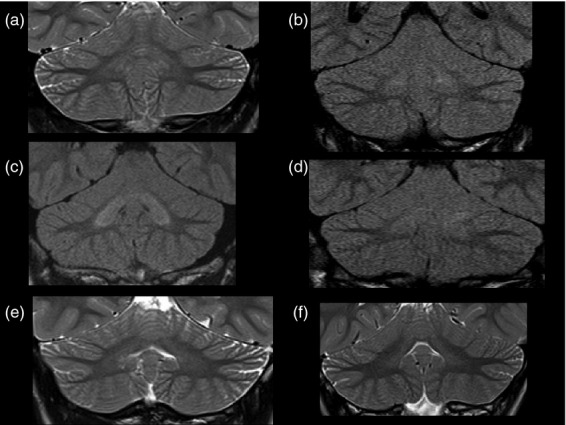
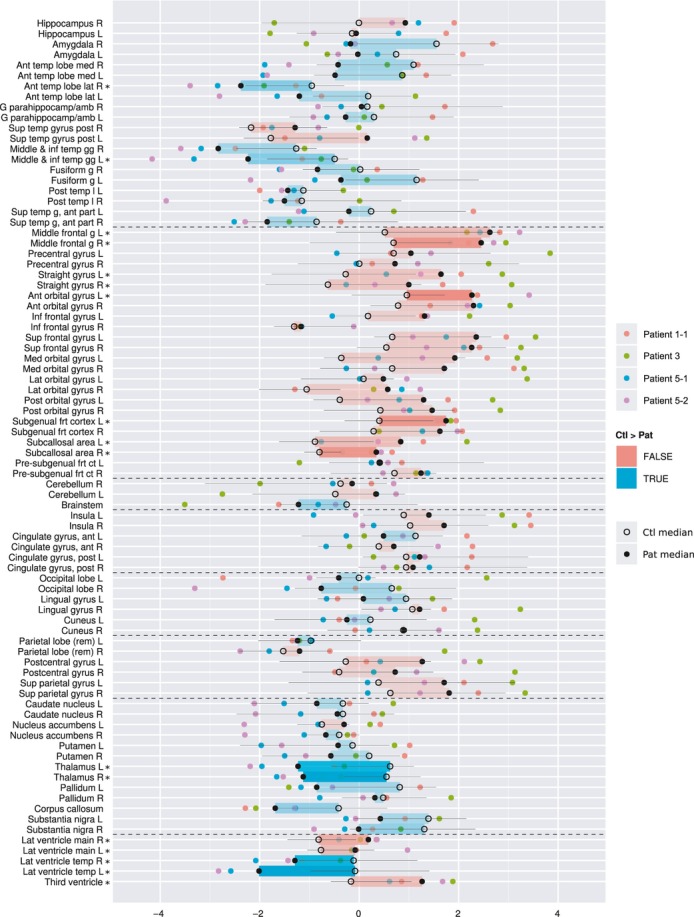
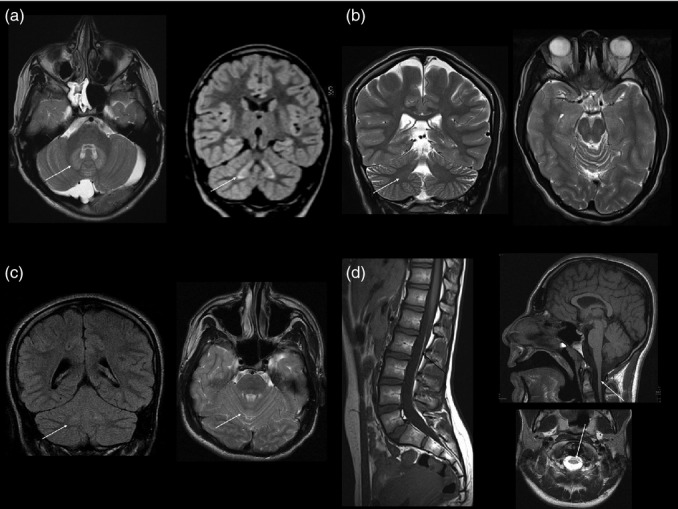
All children presented with tonic-clonic seizures in infancy. Later, non-progressive, cerebellar ataxia and hearing loss were noted. Whilst seizures mostly responded well to treatment, ataxia proved to be the most debilitating feature, with three patients non-ambulant. All available magnetic resonance imaging (MRI) revealed subtle symmetrical signal changes in the cerebellar dentate nuclei. Moreover, four patients had a small corpus callosum and brainstem hypoplasia, and three had a small spinal cord. Regional quantitative volumetric analysis of the images confirmed the corpus callosum and brainstem hypoplasia and showed further patterns of variation from the norm.
The neurological features of EAST syndrome appear to be non-progressive, which is important for prognostic counselling. The spectrum of EAST syndrome includes consistent abnormalities on brain MRI, which may aid diagnosis. Further longitudinal documentation is required to determine the true natural history of the disorder.
最近,我们报道了一组以前未被识别的症状,包括癫痫、共济失调、感觉神经性耳聋和肾小管病(EAST 综合征),与 KCNJ10 基因的隐性突变有关。在这里,我们详细描述了该综合征的临床特征,以帮助患者管理诊断、预后咨询和确定最佳治疗方式。
我们对 9 名经基因证实的 EAST 综合征儿童(4 名女性,5 名男性;最后一次检查时年龄范围 6-20 岁)的详细神经学和神经影像学特征进行了回顾性分析。
所有儿童在婴儿期均出现强直阵挛性癫痫发作。随后,出现进行性小脑共济失调和听力损失。虽然癫痫发作大多对治疗反应良好,但共济失调是最致残的特征,有 3 名患者无法行走。所有可获得的磁共振成像(MRI)均显示小脑齿状核有轻微对称信号改变。此外,4 名患者存在胼胝体小和脑干发育不良,3 名患者存在脊髓小。对图像进行区域性定量容积分析证实了胼胝体和脑干发育不良,并显示了与正常情况进一步的变异模式。
EAST 综合征的神经学特征似乎是进行性的,这对预后咨询很重要。EAST 综合征的频谱包括脑 MRI 上一致的异常,这可能有助于诊断。需要进一步的纵向记录来确定该疾病的真实自然史。