German Center for Neurodegenerative Diseases (DZNE); Bonn, Germany.
Prion. 2013 Jul-Aug;7(4):291-3. doi: 10.4161/pri.26019. Epub 2013 Aug 7.
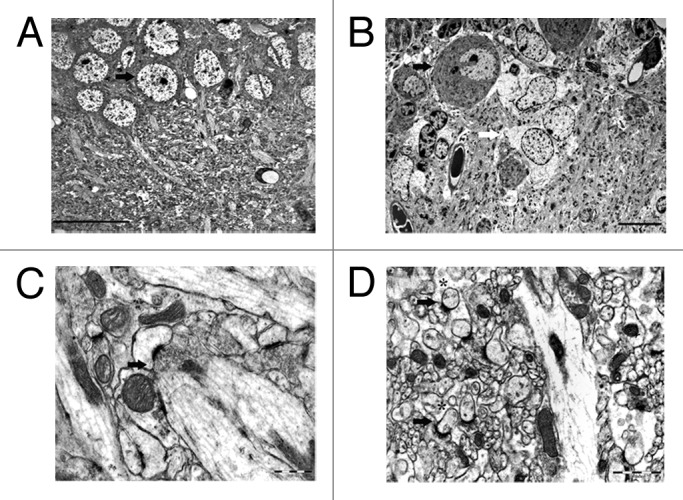
Structure is a key determinant of function, with the nervous system being no exception. For example, in the nervous system the physiological properties of different synapses may be understood by comparing their structures. However, it is not clear whether specific structural properties of some neurons might play a role in driving their selective removal during chronic neurodegeneration or whether the structural properties might underpin why particular types of synapses or other neuronal compartments are more susceptible to degeneration (i.e., become dysfunctional) in certain brain regions than in others. Our recent study of the ultrastructure of the hippocampus and the cerebellum revealed that early synaptic loss is not a ubiquitous event in a brain undergoing chronic neurodegeneration. The prominent structural differences in proximity of the synaptic environment that are brought about by a degree of synaptic ensheathment by glial cells may help explain why Purkinje cell synapses remain intact, while pyramidal cell synapses progressively degenerate. The intrinsic structural organization of the hippocampal neuropil could contribute to the susceptibility of synapses to extracellular protein misfolding by a relatively higher degree of synaptic exposure to the extracellular environment. We suggest that neuronal structure may determine more than function; it might also predict dysfunction.
结构是功能的关键决定因素,神经系统也不例外。例如,在神经系统中,可以通过比较不同突触的结构来理解它们的生理特性。然而,目前尚不清楚某些神经元的特定结构特性是否会在慢性神经退行性变过程中导致其选择性清除,或者这些结构特性是否可以解释为什么某些类型的突触或其他神经元区室在某些脑区比在其他脑区更容易发生退行性变(即功能失调)。我们最近对海马体和小脑的超微结构的研究表明,在慢性神经退行性变的大脑中,早期突触丢失并不是普遍发生的事件。由于胶质细胞对突触的一定程度的包裹,突触环境的接近度会产生显著的结构差异,这可能有助于解释为什么浦肯野细胞突触保持完整,而锥体神经元突触逐渐退化。海马神经胶的固有结构组织可能会导致突触更容易受到细胞外蛋白质错误折叠的影响,因为突触相对更多地暴露于细胞外环境中。我们认为,神经元结构可能不仅决定功能,还可能预测功能障碍。