Rockwood Kenneth, Richard Matthew, Leibman Chris, Mucha Lisa, Mitnitski Arnold
Dalhousie University, Department of Medicine, Dalhousie University, Halifax, NS, Canada.
J Med Internet Res. 2013 Aug 7;15(8):e145. doi: 10.2196/jmir.2461.
The World Wide Web allows access to patient/care partner perspectives on the lived experience of dementia. We were interested in how symptoms that care partners target for tracking relate to dementia stage, and whether dementia could be staged using only these online profiles of targeted symptoms.
To use clinical data where the dementia stage is known to develop a model that classifies an individual's stage of dementia based on their symptom profile and to apply this model to classify dementia stages for subjects from a Web-based dataset.
An Artificial Neural Network (ANN) was used to identify the relationships between the dementia stages and individualized profiles of people with dementia obtained from the 60-item SymptomGuide (SG). The clinic-based training dataset (n=320), with known dementia stages, was used to create an ANN model for classifying stages in Web-based users (n=1930).
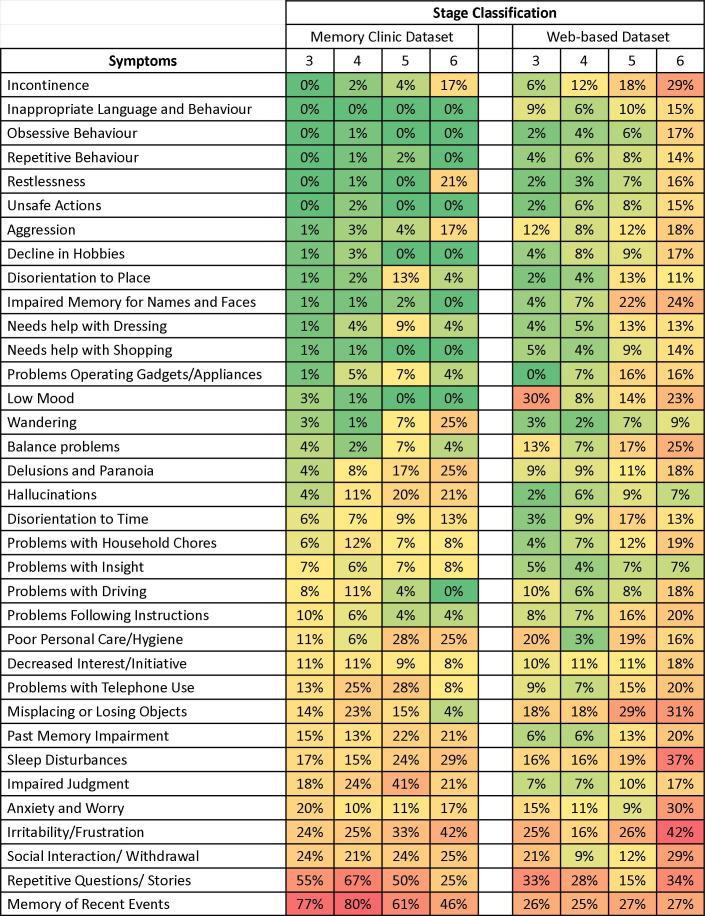
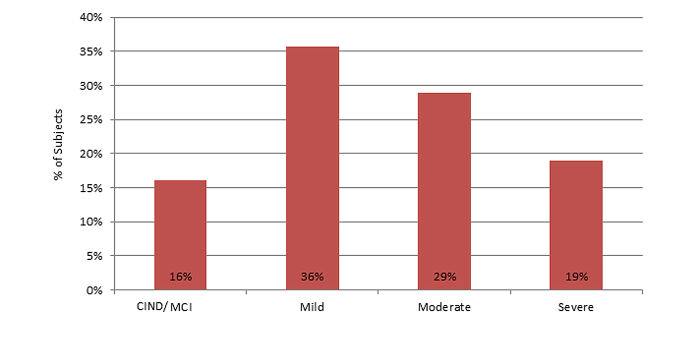
The ANN model was trained in 66% of the 320 Memory Clinic patients, with the remaining 34% used to test its accuracy in classification. Training and testing staging distributions were not significantly different. In the 1930 Web-based profiles, 309 people (16%) were classified as having mild cognitive impairment, 36% as mild dementia, 29% as moderate, and 19% as severe. In both the clinical and Web-based symptom profiles, most symptoms became more common as the stage of dementia worsened (eg, mean 5.6 SD 5.9 symptoms in the MCI group versus 11.9 SD 11.3 in the severe). Overall, Web profiles recorded more symptoms (mean 7.1 SD 8.0) than did clinic ones (mean 5.5 SD 1.8). Even so, symptom profiles were relatively similar between the Web-based and clinical datasets.
Symptoms targeted for online tracking by care partners of people with dementia can be used to stage dementia. Even so, caution is needed to assure the validity of data collected online as the current staging algorithm should be seen as an initial step.
万维网使人们能够获取患者/护理伙伴对痴呆症生活体验的看法。我们感兴趣的是护理伙伴所关注追踪的症状与痴呆症阶段之间的关系,以及是否仅使用这些针对性症状的在线档案就能对痴呆症进行分期。
利用已知痴呆症阶段的临床数据开发一个模型,该模型可根据个体的症状特征对其痴呆症阶段进行分类,并将此模型应用于对基于网络的数据集中的受试者的痴呆症阶段进行分类。
使用人工神经网络(ANN)来确定痴呆症阶段与从60项症状指南(SG)中获得的痴呆症患者个体特征之间的关系。基于临床的训练数据集(n = 320),其痴呆症阶段已知,用于创建一个ANN模型,以对基于网络的用户(n = 1930)的阶段进行分类。
ANN模型在320名记忆诊所患者中的66%进行了训练,其余34%用于测试其分类准确性。训练和测试分期分布无显著差异。在1930个基于网络的档案中,309人(16%)被分类为轻度认知障碍,36%为轻度痴呆,29%为中度,19%为重度。在临床和基于网络的症状特征中,随着痴呆症阶段的恶化,大多数症状变得更加常见(例如,轻度认知障碍组平均有5.6±5.9个症状,而重度组为11.9±11.3个)。总体而言,网络档案记录的症状(平均7.1±8.0个)比临床档案(平均5.5±1.8个)更多。即便如此,基于网络的数据集和临床数据集之间的症状特征相对相似。
痴呆症患者的护理伙伴在线追踪所针对的症状可用于对痴呆症进行分期。即便如此,仍需谨慎确保在线收集数据的有效性,因为当前的分期算法应被视为第一步。