• 文献检索
  • 文档翻译
  • 深度研究
  • 学术资讯
  • Suppr Zotero 插件Zotero 插件
  • 邀请有礼
  • 套餐&价格
  • 历史记录
应用&插件
Suppr Zotero 插件Zotero 插件浏览器插件Mac 客户端Windows 客户端微信小程序
定价
高级版会员购买积分包购买API积分包
服务
文献检索文档翻译深度研究API 文档MCP 服务
关于我们
关于 Suppr公司介绍联系我们用户协议隐私条款
关注我们

Suppr 超能文献

核心技术专利:CN118964589B侵权必究
粤ICP备2023148730 号-1Suppr @ 2026

文献检索

告别复杂PubMed语法,用中文像聊天一样搜索,搜遍4000万医学文献。AI智能推荐,让科研检索更轻松。

立即免费搜索

文件翻译

保留排版,准确专业,支持PDF/Word/PPT等文件格式,支持 12+语言互译。

免费翻译文档

深度研究

AI帮你快速写综述,25分钟生成高质量综述,智能提取关键信息,辅助科研写作。

立即免费体验

伊朗原发性不孕的流行病学概述。

An overview of the epidemiology of primary infertility in iran.

作者信息

Kazem Mohammad, Ali Ardalan

机构信息

Department of Epidemiology and Biostatistics, School of Public Health, Tehran University of Medical Sciences, Tehran, Iran.

出版信息

J Reprod Infertil. 2009 Oct;10(3):213-6.

PMID:23926471
原文链接:https://pmc.ncbi.nlm.nih.gov/articles/PMC3719328/
Abstract

INTRODUCTION

This article compares the prevalence of primary infertility in Iran estimates provided by different studies. No other study had provided a review about the researches related to epidemiology of infertility in the country.

MATERIALS AND METHODS

A literature review was undertaken using the scientific resources on the internet and the list of national projects obtained from Deputy of Research and Technology, of Iran Ministry of Health and Medical Education (MOH & ME) and relevant research centers. These resources were attentively reviewed to find about national studies on the epidemiology of primary infertility in Iran during the last decade. Based on their design quality, the National Infertility Study (NIS) (2004-2005), National Health Survey (NHS) (2001) and Tehran Study (1997) were considered for the research.

RESULTS

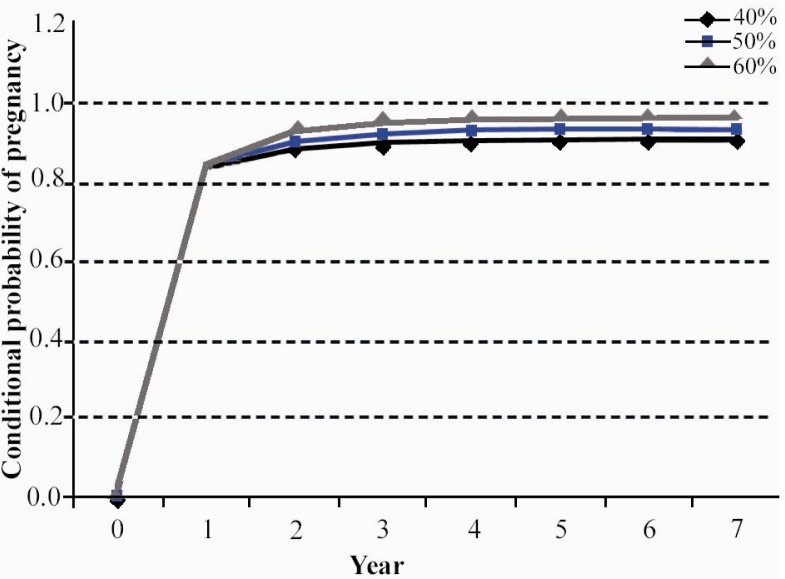
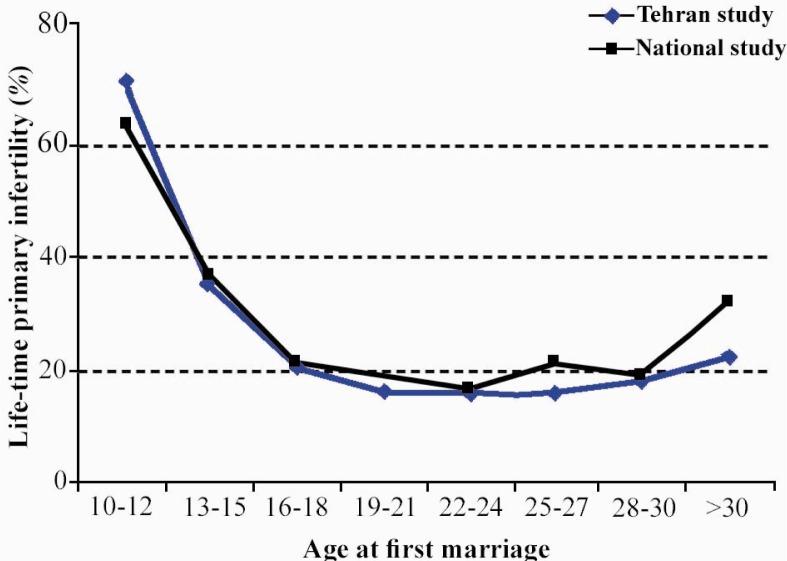
Current primary infertility estimated by National Health Survey (NHS) was 2.8% and by National Infertility Survey (NIS) 3.4%. Tehran study and NIS estimated the prevalence of lifetime primary infertility to be 21.9% and 24.9%, respectively. The minimum prevalence of lifetime primary infertility was found to be 15.8% for the marriage age of 19-27 by Tehran study and 17.2% for the marriage age of 21-26 by NIS.

CONCLUSION

On the average, 21-22% of women experience primary infertility during their marital life. The best age of marriage for women in Iran seems to be 20-27 years. At this age group, the lowest number of women (16-18%) would experience primary infertility.

摘要

引言

本文比较了不同研究对伊朗原发性不孕患病率的估计。此前没有其他研究对该国不孕不育流行病学相关研究进行过综述。

材料与方法

利用互联网上的科学资源以及从伊朗卫生和医学教育部(MOH&ME)研究与技术司及相关研究中心获取的国家项目清单进行文献综述。仔细查阅这些资源,以查找过去十年间伊朗原发性不孕不育流行病学的全国性研究。基于设计质量,研究考虑了全国不孕不育研究(NIS)(2004 - 2005年)、全国健康调查(NHS)(2001年)和德黑兰研究(1997年)。

结果

全国健康调查(NHS)估计当前原发性不孕率为2.8%,全国不孕不育调查(NIS)估计为3.4%。德黑兰研究和NIS估计终生原发性不孕率分别为21.9%和24.9%。德黑兰研究发现,结婚年龄在19 - 27岁时,终生原发性不孕的最低患病率为15.8%,NIS则为结婚年龄在21 - 26岁时的17.2%。

结论

平均而言,21 - 22%的女性在婚姻生活中经历原发性不孕。伊朗女性的最佳结婚年龄似乎是20 - 27岁。在这个年龄组,经历原发性不孕的女性数量最少(16 - 18%)。
https://cdn.ncbi.nlm.nih.gov/pmc/blobs/d89c/3719328/c70d94fd34a0/JRI-10-213-g002.jpg
https://cdn.ncbi.nlm.nih.gov/pmc/blobs/d89c/3719328/e466bf83c7fa/JRI-10-213-g001.jpg
https://cdn.ncbi.nlm.nih.gov/pmc/blobs/d89c/3719328/c70d94fd34a0/JRI-10-213-g002.jpg
https://cdn.ncbi.nlm.nih.gov/pmc/blobs/d89c/3719328/e466bf83c7fa/JRI-10-213-g001.jpg
https://cdn.ncbi.nlm.nih.gov/pmc/blobs/d89c/3719328/c70d94fd34a0/JRI-10-213-g002.jpg

相似文献

1
An overview of the epidemiology of primary infertility in iran.伊朗原发性不孕的流行病学概述。
J Reprod Infertil. 2009 Oct;10(3):213-6.
2
Prevalence of primary infertility in the Islamic Republic of Iran in 2004-2005.2004 - 2005年伊朗伊斯兰共和国原发性不孕的患病率。
Asia Pac J Public Health. 2009 Jul;21(3):287-93. doi: 10.1177/1010539509336009. Epub 2009 May 14.
3
Prevalence of Primary Infertility in Iran in 2010.2010年伊朗原发性不孕的患病率。
Iran J Public Health. 2013 Dec;42(12):1398-404.
4
Infertility and assisted reproduction in Denmark. Epidemiology and psychosocial consequences.丹麦的不孕症与辅助生殖。流行病学及心理社会后果。
Dan Med Bull. 2006 Nov;53(4):390-417.
5
The Prevalence and Causes of Primary Infertility in Iran: A Population-Based Study.伊朗原发性不孕的患病率及原因:一项基于人群的研究。
Glob J Health Sci. 2015 Apr 19;7(6):226-32. doi: 10.5539/gjhs.v7n6p226.
6
Infertility among couples in a population-based study in Iran: prevalence and associated risk factors.伊朗一项基于人群的研究中夫妻的不孕症:患病率及相关危险因素
Int J Androl. 2008 Jun;31(3):303-14. doi: 10.1111/j.1365-2605.2007.00764.x. Epub 2007 May 7.
7
A Meta-Analysis of The Prevalence and Etiology of Infertility in Iran.伊朗不孕症患病率与病因的荟萃分析。
Int J Fertil Steril. 2023 Apr 1;17(3):160-173. doi: 10.22074/ijfs.2023.541991.1215.
8
Practical Difficulties in Estimating The Prevalence of Primary Infertility in Iran.估算伊朗原发性不孕患病率的实际困难
Int J Fertil Steril. 2019 Jul;13(2):113-117. doi: 10.22074/ijfs.2019.5583. Epub 2019 Apr 27.
9
A population-based study on infertility and its influencing factors in four selected provinces in Iran (2008-2010).一项关于伊朗四个选定省份不孕症及其影响因素的基于人群的研究(2008 - 2010年)。
Iran J Reprod Med. 2014 Aug;12(8):561-6.
10
Differential mortality in Iran.伊朗的死亡率差异。
Popul Health Metr. 2007 Jul 28;5:7. doi: 10.1186/1478-7954-5-7.

引用本文的文献

1
Traumatic Ovarian Artery Pseudoaneurysm Post-ovum Pickup: A Rare Complication.取卵术后创伤性卵巢动脉假性动脉瘤:一种罕见的并发症。
Cureus. 2021 Dec 30;13(12):e20825. doi: 10.7759/cureus.20825. eCollection 2021 Dec.
2
The effect of counseling based on acceptance and commitment therapy on mental health and quality of life among infertile couples: A randomized controlled trial.基于接纳与承诺疗法的咨询对不孕夫妇心理健康和生活质量的影响:一项随机对照试验。
J Educ Health Promot. 2020 Sep 28;9:251. doi: 10.4103/jehp.jehp_512_20. eCollection 2020.
3
The Need for A Training Software among Iranian Infertile Couples: A Qualitative Study.

本文引用的文献

1
Prevalence of primary infertility in the Islamic Republic of Iran in 2004-2005.2004 - 2005年伊朗伊斯兰共和国原发性不孕的患病率。
Asia Pac J Public Health. 2009 Jul;21(3):287-93. doi: 10.1177/1010539509336009. Epub 2009 May 14.
2
Research on infertility: which definition should we use?不孕症研究:我们应该采用哪种定义?
Fertil Steril. 2005 Apr;83(4):846-52. doi: 10.1016/j.fertnstert.2004.11.033.
3
Towards less confusing terminology in reproductive medicine: a proposal.关于生殖医学中减少混淆术语的提议。
伊朗不孕夫妇对培训软件的需求:一项定性研究。
Int J Fertil Steril. 2019 Jul;13(2):118-126. doi: 10.22074/ijfs.2019.5727. Epub 2019 Apr 27.
4
Association between the Religious Coping of Infertile People with their Own Quality of Life and Their Spouses': A Correlation Study in Iranian Infertile Couples.不孕不育者的宗教应对方式与其自身及配偶生活质量之间的关联:伊朗不孕不育夫妇的相关性研究
Iran J Nurs Midwifery Res. 2018 May-Jun;23(3):198-204. doi: 10.4103/ijnmr.IJNMR_32_17.
5
Congenital Malformations in Infants of Mothers Undergoing Assisted Reproductive Technologies: A Systematic Review and Meta-analysis Study.接受辅助生殖技术的母亲所生婴儿的先天性畸形:一项系统评价和荟萃分析研究
J Prev Med Public Health. 2017 Nov;50(6):347-360. doi: 10.3961/jpmph.16.122.
6
Comparison of In Vitro Fertilization/Intracytoplasmic Sperm Injection Cycle Outcome in Patients with and without Polycystic Ovary Syndrome: A Modified Poisson Regression Model.多囊卵巢综合征患者与非多囊卵巢综合征患者体外受精/卵胞浆内单精子注射周期结局的比较:改良泊松回归模型
Int J Fertil Steril. 2018 Jan;11(4):309-313. doi: 10.22074/ijfs.2018.5117. Epub 2017 Oct 12.
7
Tehran Survey of Potential Risk Factors for Multiple Births.德黑兰多胎妊娠潜在风险因素调查。
Int J Fertil Steril. 2017 Oct;11(3):220-225. doi: 10.22074/ijfs.2017.4700. Epub 2017 Aug 27.
8
Leptin as a Predictive Marker in Unexplained Infertility in North Indian Population.瘦素作为印度北部人群不明原因不孕症的预测标志物
J Clin Diagn Res. 2017 Mar;11(3):QC28-QC31. doi: 10.7860/JCDR/2017/22444.9567. Epub 2017 Mar 1.
9
The Relationship between the Amount of Saturated Fat Intake and Semen Quality in Men.男性饱和脂肪摄入量与精液质量之间的关系。
Iran J Nurs Midwifery Res. 2017 Jan-Feb;22(1):46-50. doi: 10.4103/1735-9066.202067.
10
Prevalence of Infertility Problems among Iranian Infertile Patients Referred to Royan Institute.转诊至罗扬研究所的伊朗不孕患者中不孕问题的患病率
Int J Fertil Steril. 2016 Oct-Dec;10(3):278-282. doi: 10.22074/ijfs.2016.5043. Epub 2016 Sep 5.
Hum Reprod. 2004 Jul;19(7):1497-501. doi: 10.1093/humrep/deh303.
4
Infertility in Shanghai: prevalence, treatment seeking and impact.上海的不孕症:患病率、治疗寻求情况及影响
J Obstet Gynaecol. 2002 Nov;22(6):643-8. doi: 10.1080/0144361021000020457.
5
Infertility and the seeking of infertility treatment in a representative population.具有代表性人群中的不孕不育及寻求不孕不育治疗的情况。
Br J Obstet Gynaecol. 1995 Dec;102(12):978-84. doi: 10.1111/j.1471-0528.1995.tb10905.x.
6
Prevalence of infertility: international data and problems of measurement.
Eur J Obstet Gynecol Reprod Biol. 1991 Jan 4;38(1):43-52. doi: 10.1016/0028-2243(91)90206-z.