Department of Otolaryngology Head and Neck Surgery, Beijing Tongren Hospital, Capital Medical University, 17 HouGouHuTong, DongCheng District, Beijing, 100005, China.
BMC Pediatr. 2013 Aug 8;13:116. doi: 10.1186/1471-2431-13-116.
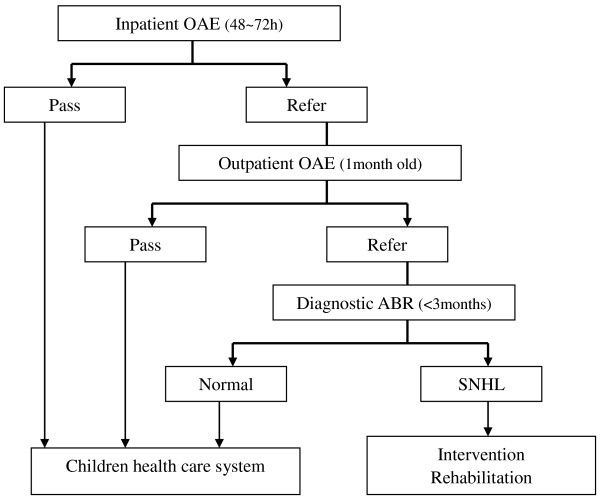
Although migrant workers account for the majority of newborns in Beijing, their children are less likely to undergo appropriate universal newborn hearing screening/rescreening (UNHS) than newborns of local non-migrant residents. We hypothesised that this was at least in part due to the inadequacy of the UNHS protocol currently employed for newborn babies, and therefore aimed to modify the protocol to specifically reflect the needs of the migrant population.
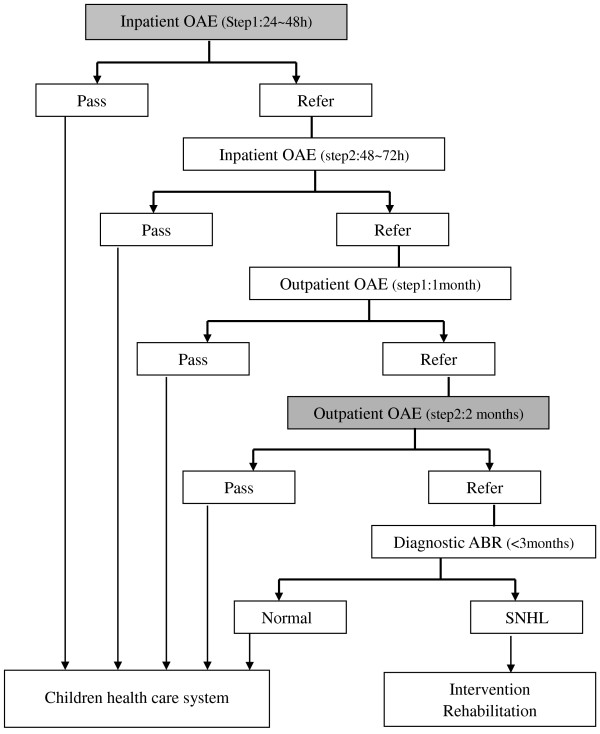
A total of 10,983 healthy babies born to migrant mothers between January 2007 and December 2009 at a Beijing public hospital were investigated for hearing abnormalities according to a modified UNHS protocol. This incorporated two additional/optional otoacoustic emissions (OAE) tests at 24-48 hours and 2 months after birth. Infants not passing a screening test were referred to the next test, until any hearing loss was confirmed by the auditory brainstem response (ABR) test.
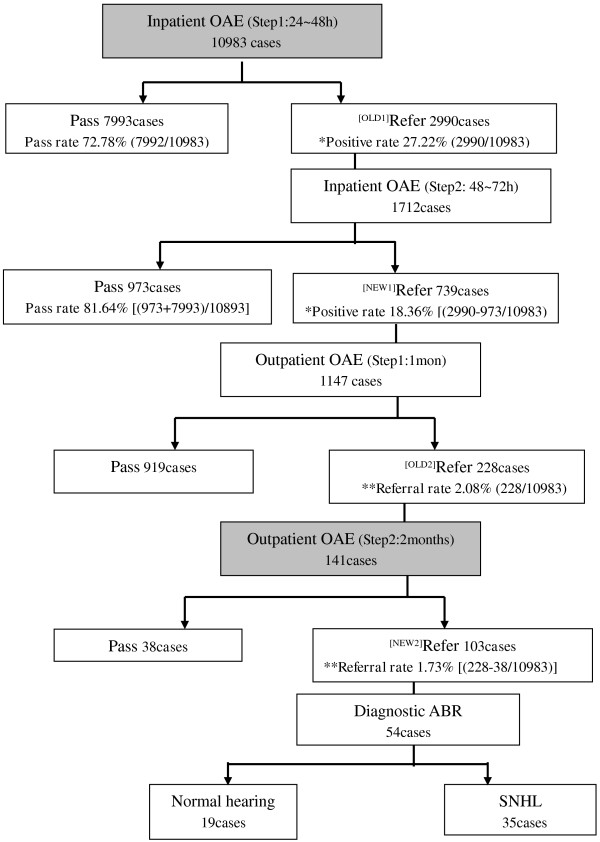
A total of 98.91% (10983/11104) of all newborn children underwent the initial OAE test, of which 27.22% (2990/10983) failed the test. 1712 of the failed babies underwent the second inpatient OAE test, with739 failing again; thus significantly decreasing the overall positive rate for abnormal hearing from 27.22% to 18.36% ([2990-973 /10983)]; p = 0). Overall, 1147(56.87%) babies underwent the outpatient OAE test again after1-month, of whom 228 failed and were referred for the second outpatient OAE test (i.e. 2.08% (228/10983) referral rate at 1month of age). 141 of these infants underwent the referral test, of whom 103 (73.05%) tested positive again and were referred for a final ABR test for hearing loss (i.e. final referral rate of 1.73% ([228-38/10983] at 2 months of age). Only 54 infants attended the ABR test and 35 (0.32% of the original cohort tested) were diagnosed with abnormal hearing.
Our study shows that it is feasible and practical to achieve high coverage rates for screening hearing loss and decrease the referral rates in newborn babies of migrant workers, using a modification of the currently employed UNHS protocol.
尽管外来务工人员在北京市的新生儿中占大多数,但他们的孩子接受适当的普遍新生儿听力筛查/复筛(UNHS)的比例低于当地非外来务工居民的新生儿。我们假设,这至少部分是由于目前用于新生儿的 UNHS 方案不够完善,因此,我们旨在修改该方案,以专门反映流动人口的需求。
2007 年 1 月至 2009 年 12 月,北京一家公立医院共对 10983 名外来务工母亲所生的健康婴儿进行了听力异常调查,根据修改后的 UNHS 方案进行检查。该方案增加了两次可选的耳声发射(OAE)测试,分别在出生后 24-48 小时和 2 个月进行。未通过筛查测试的婴儿将被转诊至下一次测试,直到通过听觉脑干反应(ABR)测试确认任何听力损失。
共有 98.91%(10983/11104)的新生儿接受了初始 OAE 测试,其中 27.22%(2990/10983)未通过测试。1712 名未通过测试的婴儿接受了第二次住院 OAE 测试,其中 739 名再次未通过;这使得整体异常听力阳性率从 27.22%下降到 18.36%([2990-973/10983]);p=0)。总体而言,1147 名(56.87%)婴儿在 1 个月后再次接受门诊 OAE 测试,其中 228 名未通过并被转诊进行第二次门诊 OAE 测试(即 1 个月时转诊率为 2.08%(228/10983))。其中 141 名婴儿接受了转诊测试,其中 103 名(73.05%)再次测试阳性,并被转诊进行最终的 ABR 听力损失测试(即 2 个月时的最终转诊率为 1.73%([228-38/10983]))。只有 54 名婴儿接受了 ABR 测试,其中 35 名(原始队列测试的 0.32%)被诊断为听力异常。
我们的研究表明,通过修改目前使用的 UNHS 方案,对于外来务工人员的新生儿来说,筛查听力损失和降低转诊率是可行且实际的。