BMC Biotechnol. 2013 Aug 8;13:65. doi: 10.1186/1472-6750-13-65.
Common cell based strategies for the treatment of osseous defects require the isolation and expansion of autologous cells. Since this makes such approaches time-consuming and expensive, we developed a novel expedited technology creating gene activated muscle grafts. We have previously shown that large segmental bone defects in rats can be regenerated by implantation of muscle tissue fragments activated by BMP-2 gene transfer.
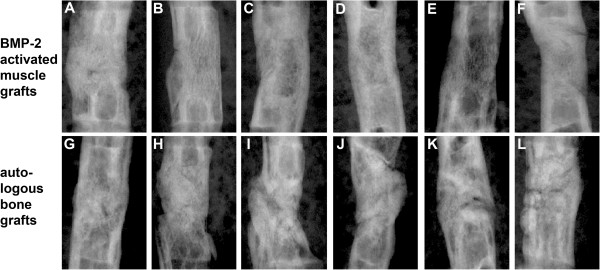
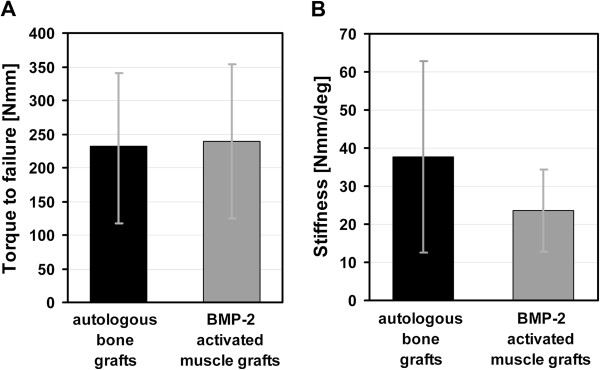
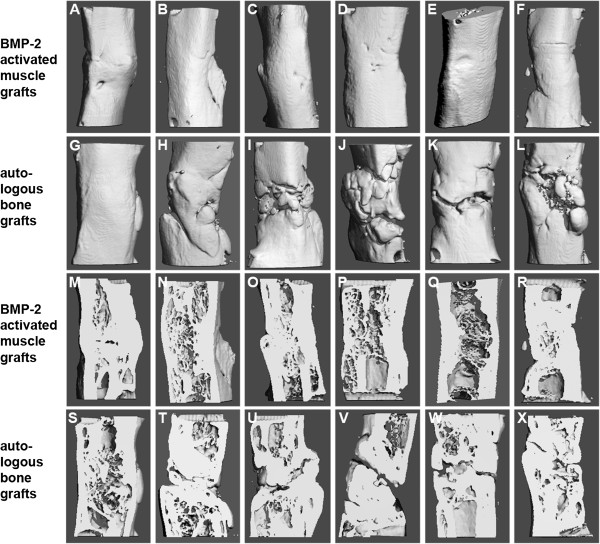
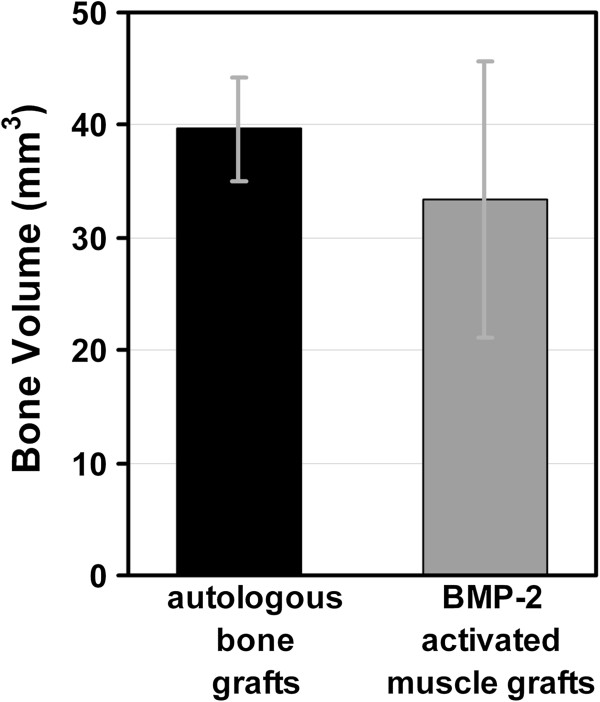
In the present study, we compared the bone healing capacities of such gene activated muscle grafts with bone isografts, mimicking autologous bone grafting, the clinical gold standard for treatment of bone defects in patients. Two of 14 male, syngeneic Fischer 344 rats used for this experiment served as donors for muscle and bone. Muscle tissue was harvested from both hind limbs and incubated with an adenoviral vector carrying the cDNA encoding BMP-2. Bone was harvested from the iliac crest and long bone epiphyses. Bone defects (5 mm) were created in the right femora of 12 rats and were filled with either BMP-2 activated muscle tissue or bone grafts. After eight weeks, femora were evaluated by radiographs, micro-computed tomography (μCT), and biomechanical testing. In the group receiving BMP-2 activated muscle grafts as well as in the bone-grafting group, 100% of the bone defects were healed, as documented by radiographs and μCT-imaging. Bone volume was similar in both groups and biomechanical stability of the two groups was statistically indistinguishable.
This study demonstrates that treatment of large bone defects by implantation of BMP-2 gene activated muscle tissue leads to similar bone volume and stability as bone isografts, mimicking autologous bone grafting.
治疗骨缺损的常见细胞策略需要分离和扩增自体细胞。由于这使得这些方法既耗时又昂贵,我们开发了一种新的加速技术,创建基因激活的肌肉移植物。我们之前已经表明,通过植入经 BMP-2 基因转染激活的肌肉组织片段,可以再生大鼠的大节段骨缺损。
在本研究中,我们比较了这种基因激活的肌肉移植物与骨同种移植物的骨愈合能力,骨同种移植物模仿自体骨移植,是治疗患者骨缺损的临床金标准。该实验使用的 14 只雄性同源 Fischer 344 大鼠中有 2 只为肌肉和骨骼供体。从后肢采集肌肉组织,并在携带编码 BMP-2 的 cDNA 的腺病毒载体中孵育。从髂嵴和长骨骨骺采集骨。在 12 只大鼠的右侧股骨中创建 5mm 的骨缺损,并填充 BMP-2 激活的肌肉组织或骨移植物。8 周后,通过 X 射线、微计算机断层扫描(μCT)和生物力学测试评估股骨。在接受 BMP-2 激活的肌肉移植物和骨移植物的组中,100%的骨缺损被治愈,这在 X 射线和 μCT 成像中得到了证明。两组的骨体积相似,两组的生物力学稳定性在统计学上无差异。
这项研究表明,通过植入 BMP-2 基因激活的肌肉组织治疗大骨缺损可导致与骨同种移植物相似的骨体积和稳定性,模仿自体骨移植。