Centers for Disease Control and Prevention, Comprehensive Cancer Control Branch, Division of Cancer Prevention and Control, National Center for Chronic Disease Prevention and Public Health Promotion, 4770 Buford Hwy, MS K-57, Atlanta, GA 30341, USA.
Prev Chronic Dis. 2013 Aug 8;10:E132. doi: 10.5888/pcd10.120337.
Radon is the second leading cause of lung cancer among smokers and the leading cause among nonsmokers. The US Environmental Protection Agency recommends that every home be tested for radon. Comprehensive Cancer Control (CCC) programs develop cancer coalitions that coordinate funding and resources to focus on cancer activities that are recorded in cancer plans. Radon tests, remediation, and radon mitigation techniques are relatively inexpensive, but it is unclear whether coalitions recognize radon as an important carcinogen.
We reviewed 65 cancer plans created from 2005 through 2011 for the terms "radon," "radiation," or "lung." Plan activities were categorized as radon awareness, home testing, remediation, supporting radon policy activities, or policy evaluation. We also reviewed each CCC program's most recent progress report. Cancer plan content was reviewed to assess alignment with existing radon-specific policies in each state.
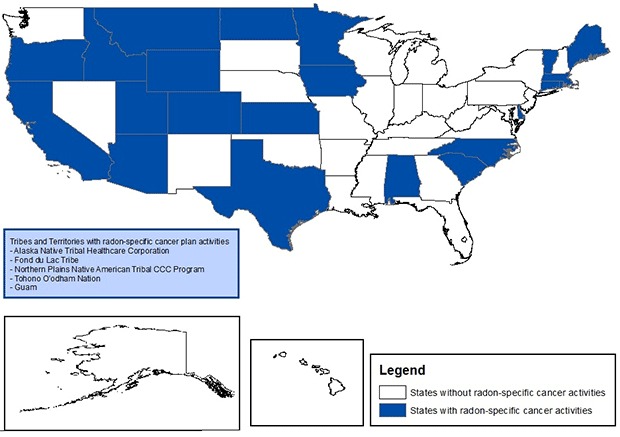
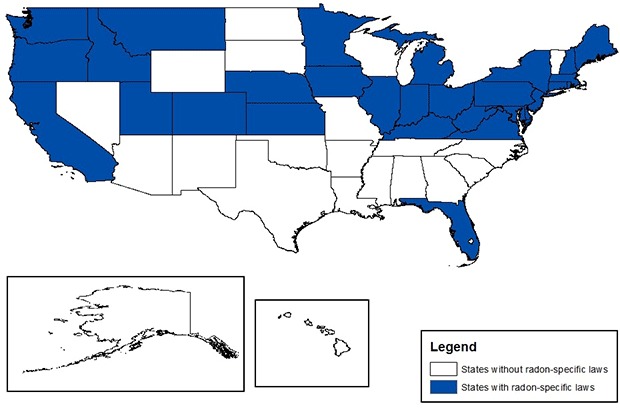
Twenty-seven of the plans reviewed (42%) had radon-specific terminology. Improving awareness of radon was included in all 27 plans; also included were home testing (n=21), remediation (n=11), support radon policy activities (n=13), and policy evaluation (n=1). Three plans noted current engagement in radon activities. Thirty states had radon-specific laws; most (n=21) were related to radon professional licensure. Eleven states had cancer plan activities that aligned with existing state radon laws.
Although several states have radon-specific policies, approximately half of cancer coalitions may not be aware of radon as a public health issue. CCC-developed cancer coalitions and plans should prioritize tobacco control to address lung cancer but should consider addressing radon through partnership with existing radon control programs.
氡是吸烟者肺癌的第二大主要病因,也是不吸烟者肺癌的主要病因。美国环境保护署建议对每个家庭进行氡测试。综合癌症控制(CCC)计划成立癌症联盟,协调资金和资源,专注于癌症计划中记录的癌症活动。氡测试、修复和氡缓解技术相对便宜,但尚不清楚联盟是否将氡视为重要的致癌物质。
我们回顾了 2005 年至 2011 年期间制定的 65 项癌症计划中关于“氡”、“辐射”或“肺”的条款。计划活动分为氡意识、家庭测试、修复、支持氡政策活动或政策评估。我们还审查了每个 CCC 计划的最新进展报告。审查癌症计划的内容,以评估其与每个州现有的氡特定政策的一致性。
在审查的 27 项计划中(42%)有氡特定术语。提高对氡的认识包含在所有 27 项计划中;还包括家庭测试(n=21)、修复(n=11)、支持氡政策活动(n=13)和政策评估(n=1)。三项计划指出目前正在开展氡活动。30 个州有氡特定法律;大多数(n=21)与氡专业许可证有关。11 个州的癌症计划活动与现有的州氡法律一致。
尽管一些州有氡特定政策,但大约一半的癌症联盟可能不知道氡是一个公共卫生问题。CCC 制定的癌症联盟和计划应优先考虑烟草控制,以解决肺癌问题,但应考虑通过与现有氡控制计划合作来解决氡问题。