Interdisciplinary Centre for Plant Genomics and Department of Plant Molecular Biology, University of Delhi South Campus, Benito Juarez Road, New Delhi 110021, India.
J Exp Bot. 2013 Nov;64(14):4239-53. doi: 10.1093/jxb/ert231. Epub 2013 Aug 8.
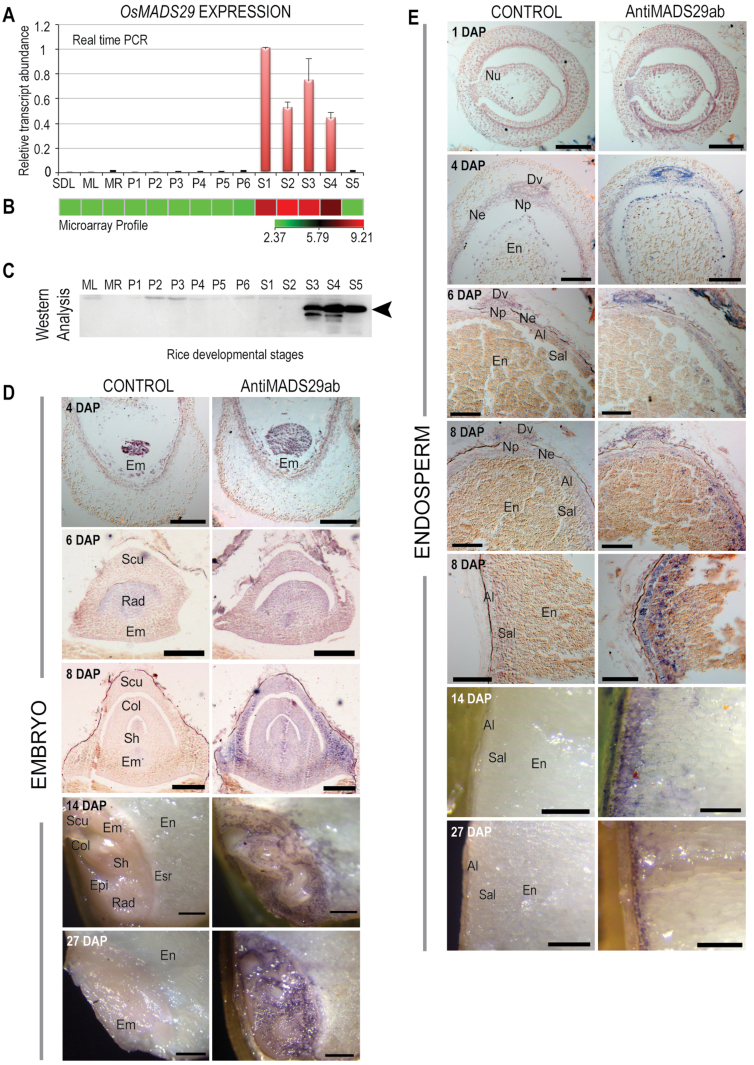
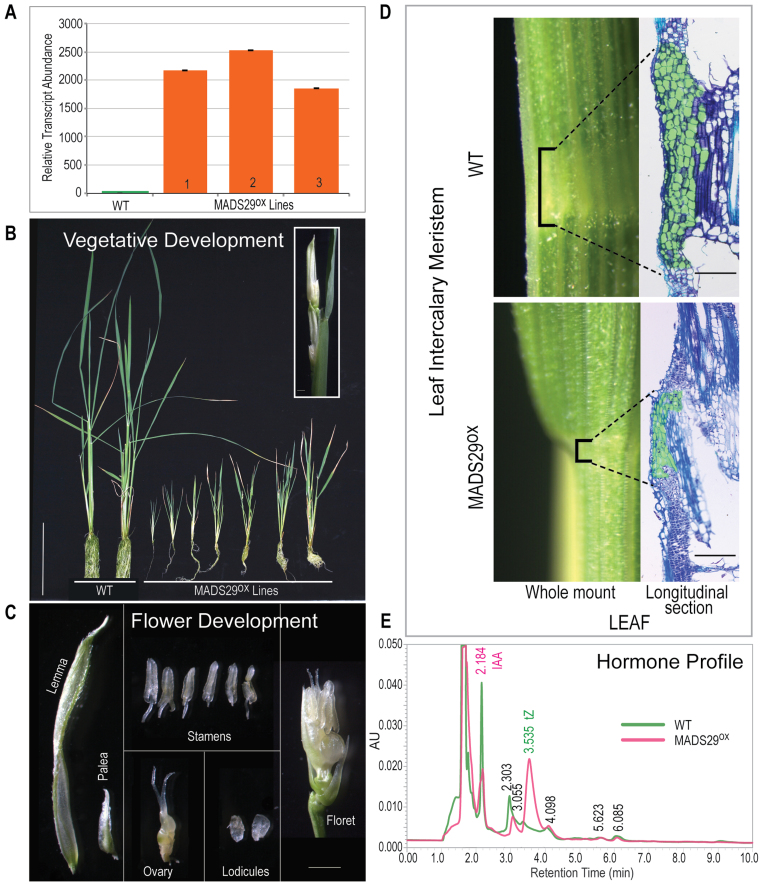
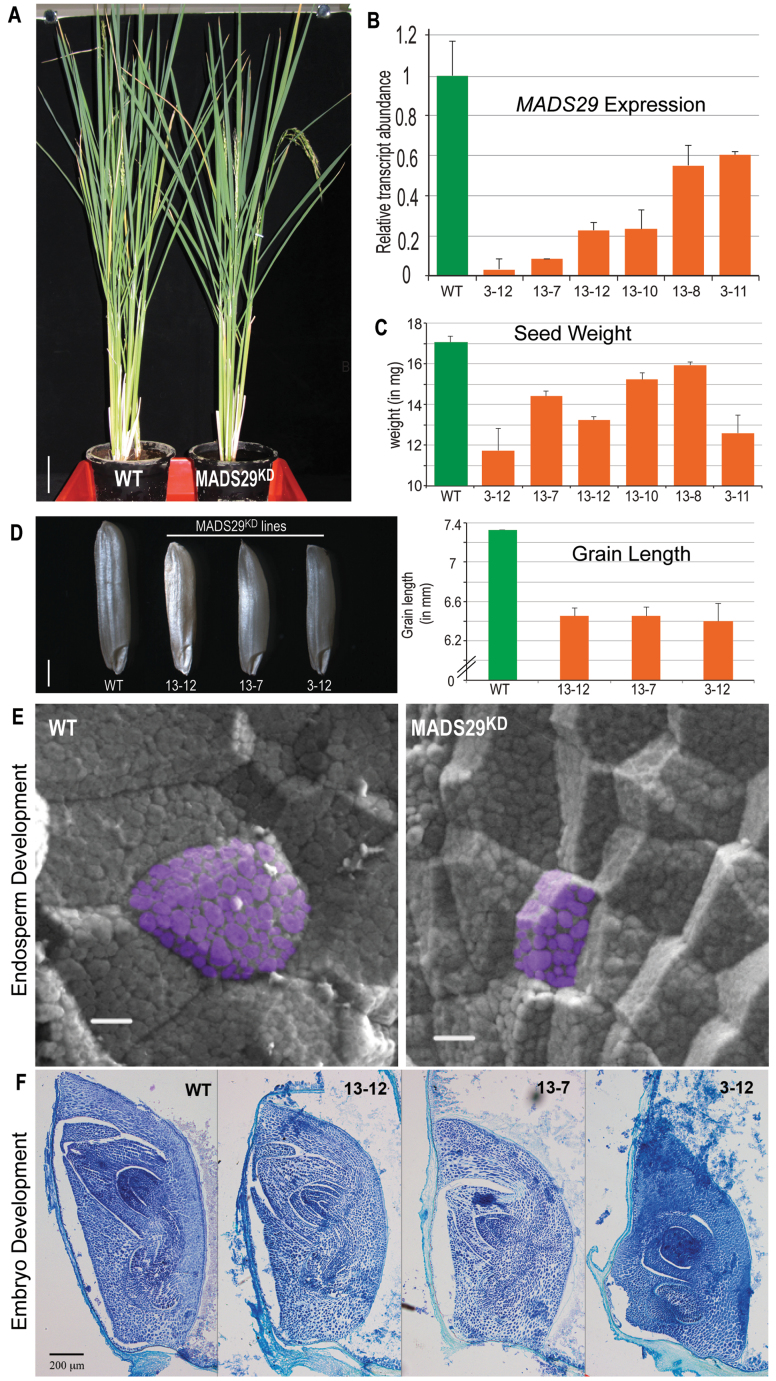
Rice MADS29 has recently been reported to cause programmed cell death of maternal tissues, the nucellus, and the nucellar projection during early stages of seed development. However, analyses involving OsMADS29 protein expression domains and characterization of OsMADS29 gain-of-function and knockdown phenotypes revealed novel aspects of its function in maintaining hormone homeostasis, which may have a role in the development of embryo and plastid differentiation and starch filling in endosperm cells. The MADS29 transcripts accumulated to high levels soon after fertilization; however, protein accumulation was found to be delayed by at least 4 days. Immunolocalization studies revealed that the protein accumulated initially in the dorsal-vascular trace and the outer layers of endosperm, and subsequently in the embryo and aleurone and subaleurone layers of the endosperm. Ectopic expression of MADS29 resulted in a severely dwarfed phenotype, exhibiting elevated levels of cytokinin, thereby suggesting that cytokinin biosynthesis pathway could be one of the major targets of OsMADS29. Overexpression of OsMADS29 in heterologous BY2 cells was found to mimic the effects of exogenous application of cytokinins that causes differentiation of proplastids to starch-containing amyloplasts and activation of genes involved in the starch biosynthesis pathway. Suppression of MADS29 expression by RNAi severely affected seed set. The surviving seeds were smaller in size, with developmental abnormalities in the embryo and reduced size of endosperm cells, which also contained loosely packed starch granules. Microarray analysis of overexpression and knockdown lines exhibited altered expression of genes involved in plastid biogenesis, starch biosynthesis, cytokinin signalling and biosynthesis.
水稻 MADS29 最近被报道在种子发育的早期阶段导致母体组织、珠心和珠心突起的程序性细胞死亡。然而,涉及 OsMADS29 蛋白表达域的分析以及 OsMADS29 功能获得和敲低表型的特征表明,其在维持激素平衡方面具有新的功能,这可能在胚胎和质体分化以及胚乳细胞中淀粉填充的发育中发挥作用。MADS29 转录本在受精后很快积累到高水平;然而,发现蛋白质的积累至少延迟了 4 天。免疫定位研究表明,该蛋白最初在背血管迹和胚乳外层积累,随后在胚胎和糊粉层和亚糊粉层中积累。MADS29 的异位表达导致严重的矮化表型,细胞分裂素水平升高,这表明细胞分裂素生物合成途径可能是 OsMADS29 的主要靶标之一。在异源 BY2 细胞中过表达 OsMADS29 被发现模拟了外源细胞分裂素应用的效果,导致前质体分化为含有淀粉的淀粉体,并激活参与淀粉生物合成途径的基因。MADS29 表达的 RNAi 抑制严重影响种子结实。存活的种子较小,胚胎发育异常,胚乳细胞变小,其中还含有松散堆积的淀粉颗粒。过表达和敲低系的微阵列分析显示,参与质体生物发生、淀粉生物合成、细胞分裂素信号转导和生物合成的基因表达发生改变。