Unit 4D, Genetic Alliance UK, London, UK.
BMJ Open. 2013 Aug 7;3(8):e003056. doi: 10.1136/bmjopen-2013-003056.
A mixed methods study exploring the UK general public's willingness to donate human biosamples (HBSs) for biomedical research.
Cross-sectional focus groups followed by an online survey.
Twelve focus groups (81 participants) selectively sampled to reflect a range of demographic groups; 1110 survey responders recruited through a stratified sampling method with quotas set on sex, age, geographical location, socioeconomic group and ethnicity.
(1) Identify participants' willingness to donate HBSs for biomedical research, (2) explore acceptability towards donating different types of HBSs in various settings and (3) explore preferences regarding use and access to HBSs.
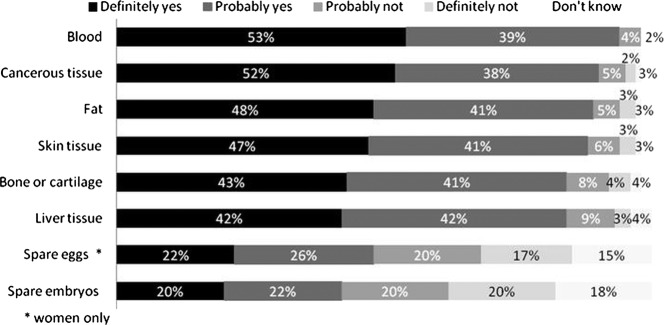
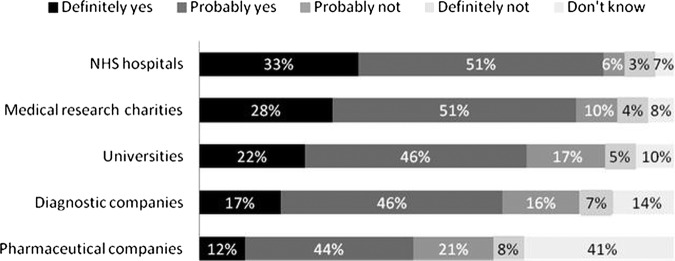
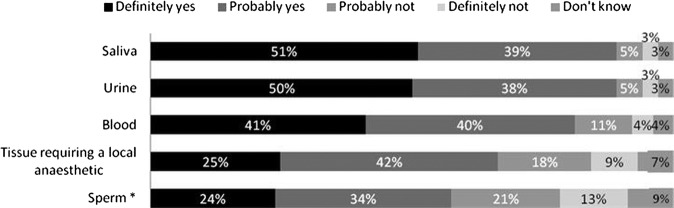
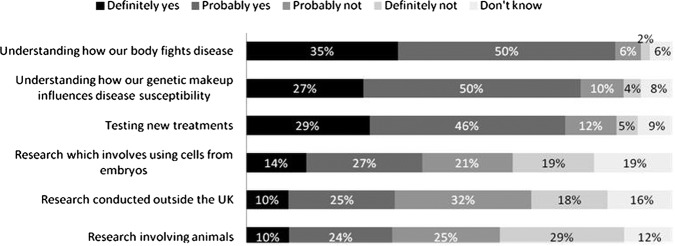
87% of survey participants thought donation of HBSs was important and 75% wanted to be asked to donate in general. Responders who self-reported having some or good knowledge of the medical research process were significantly more likely to want to donate (p<0.001). Reasons why focus group participants saw donation as important included: it was a good way of reciprocating for the medical treatment received; it was an important way of developing drugs and treatments; residual tissue would otherwise go to waste and they or their family members might benefit. The most controversial types of HBSs to donate included: brain post mortem (29% would donate), eyes post mortem (35%), embryos (44%), spare eggs (48%) and sperm (58%). Regarding the use of samples, there were concerns over animal research (34%), research conducted outside the UK (35%), and research conducted by pharmaceutical companies (56%), although education and discussion were found to alleviate such concerns.
There is a high level of public support and willingness to donate HBSs for biomedical research. Underlying concerns exist regarding the use of certain types of HBSs and conditions under which they are used. Improved education and more controlled forms of consent for sensitive samples may mitigate such concerns.
一项混合方法研究,旨在探讨英国公众对捐赠人类生物样本(HBS)用于生物医学研究的意愿。
横断面焦点小组,随后进行在线调查。
12 个焦点小组(81 名参与者)进行有针对性的抽样,以反映各种人群的范围;通过分层抽样方法招募了 1110 名调查响应者,并对性别、年龄、地理位置、社会经济群体和种族设定了配额。
(1)确定参与者捐赠 HBS 用于生物医学研究的意愿,(2)探讨在不同环境下捐赠不同类型 HBS 的可接受性,(3)探讨对 HBS 使用和获取的偏好。
75%的调查参与者认为捐赠 HBS 很重要,75%的人希望被要求普遍捐赠。自我报告对医疗研究过程有一定或良好了解的应答者更有可能愿意捐赠(p<0.001)。焦点小组参与者认为捐赠重要的原因包括:这是对所接受医疗的一种回报方式;这是开发药物和治疗方法的重要途径;否则,残留组织将被浪费,他们或他们的家庭成员可能会受益。最具争议性的捐赠 HBS 类型包括:死后脑组织(29%会捐赠)、死后眼睛(35%)、胚胎(44%)、备用卵子(48%)和精子(58%)。关于样本的使用,有人担心动物研究(34%)、在英国境外进行的研究(35%)和制药公司进行的研究(56%),尽管教育和讨论被发现可以减轻这些担忧。
公众对捐赠 HBS 用于生物医学研究有很高的支持度和意愿。对某些类型的 HBS 的使用以及使用条件存在潜在的担忧。通过改进教育和对敏感样本进行更受控制的同意形式,可能会减轻这些担忧。