Department of Radiology, University of Washington School of Medicine, 825 Eastlake Avenue East, G3-200, Seattle, WA 98109-1023, USA.
Breast Cancer Res Treat. 2012 Dec;136(3):899-906. doi: 10.1007/s10549-012-2324-x. Epub 2012 Nov 6.
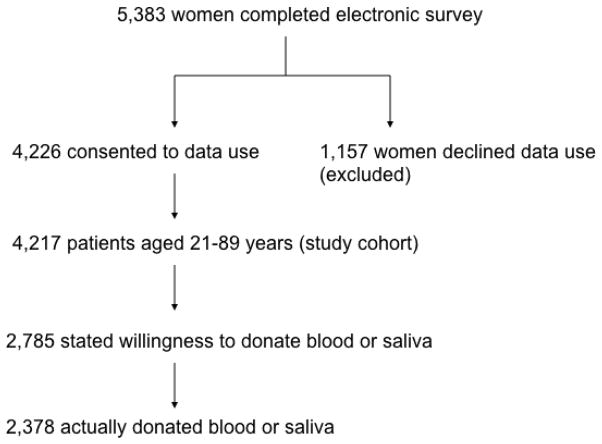
To characterize patients' willingness to donate a biospecimen for future research as part of a breast cancer-related biobank involving a general screening population. We performed a prospective cross-sectional study of 4,217 women aged 21-89 years presenting to our facilities for screening mammogram between December 2010 and October 2011. This HIPAA-compliant study was approved by our institutional review board. We collected data on patients' interest in and actual donation of a biospecimen, motivators and barriers to donating, demographic information, and personal breast cancer risk factors. A multivariate logistic regression analysis was performed to identify patient-level characteristics associated with an increased likelihood to donate. Mean patient age was 57.8 years (SD 11.1 years). While 66.0 % (2,785/4,217) of patients were willing to donate blood or saliva during their visit, only 56.4 % (2,378/4,217) actually donated. Women with a college education (OR = 1.27, p = 0.003), older age (OR = 1.02, p < 0.001), previous breast biopsy (OR = 1.23, p = 0.012), family history of breast cancer (OR = 1.23, p = 0.004), or a comorbidity (OR = 1.22, p = 0.014) were more likely to donate. Asian-American women were significantly less likely to donate (OR = 0.74, p = 0.005). The major reason for donating was to help all future patients (42.3 %) and the major reason for declining donation was privacy concerns (22.3 %). A large proportion of women participating in a breast cancer screening registry are willing to donate blood or saliva to a biobank. Among minority participants, Asian-American women are less likely to donate and further qualitative research is required to identify novel active recruitment strategies to insure their involvement.
为了描述参与涉及一般筛查人群的乳腺癌相关生物库的患者对未来研究中捐赠生物样本的意愿,我们对 2010 年 12 月至 2011 年 10 月期间在我们机构进行筛查乳房 X 光检查的 4,217 名年龄在 21-89 岁的女性进行了一项前瞻性横断面研究。这项符合 HIPAA 标准的研究得到了我们机构审查委员会的批准。我们收集了患者对捐赠生物样本的兴趣和实际捐赠情况、捐赠的动机和障碍、人口统计学信息以及个人乳腺癌风险因素的数据。我们进行了多变量逻辑回归分析,以确定与增加捐赠可能性相关的患者特征。患者的平均年龄为 57.8 岁(标准差 11.1 岁)。虽然 66.0%(2785/4217)的患者愿意在就诊期间捐赠血液或唾液,但只有 56.4%(2378/4217)的患者实际捐赠。具有大学学历的女性(OR=1.27,p=0.003)、年龄较大(OR=1.02,p<0.001)、有过乳房活检史(OR=1.23,p=0.012)、有乳腺癌家族史(OR=1.23,p=0.004)或合并症(OR=1.22,p=0.014)的女性更有可能捐赠。亚裔美国女性明显不太愿意捐赠(OR=0.74,p=0.005)。捐赠的主要原因是帮助所有未来的患者(42.3%),拒绝捐赠的主要原因是隐私问题(22.3%)。参与乳腺癌筛查登记的女性中,有很大一部分愿意向生物库捐赠血液或唾液。在少数族裔参与者中,亚裔美国女性不太愿意捐赠,需要进一步进行定性研究,以确定新颖的积极招募策略,以确保她们的参与。