Peiris Pubudu M, Tam Morgan, Vicente Peter, Abramowski Aaron, Toy Randall, Bauer Lisa, Mayer Aaron, Pansky Jenna, Doolittle Elizabeth, Tucci Samantha, Schmidt Erik, Shoup Christopher, Rao Swetha, Murray Kaitlyn, Gopalakrishnan Ramamurthy, Keri Ruth A, Basilion James P, Griswold Mark A, Karathanasis Efstathios
Department of Biomedical Engineering, Case Western Reserve University, Cleveland, Ohio, USA.
Pharm Res. 2014 Jun;31(6):1460-8. doi: 10.1007/s11095-013-1102-8. Epub 2013 Aug 9.
To evaluate the ability of radiofrequency (RF)-triggered drug release from a multicomponent chain-shaped nanoparticle to inhibit the growth of an aggressive breast tumor.
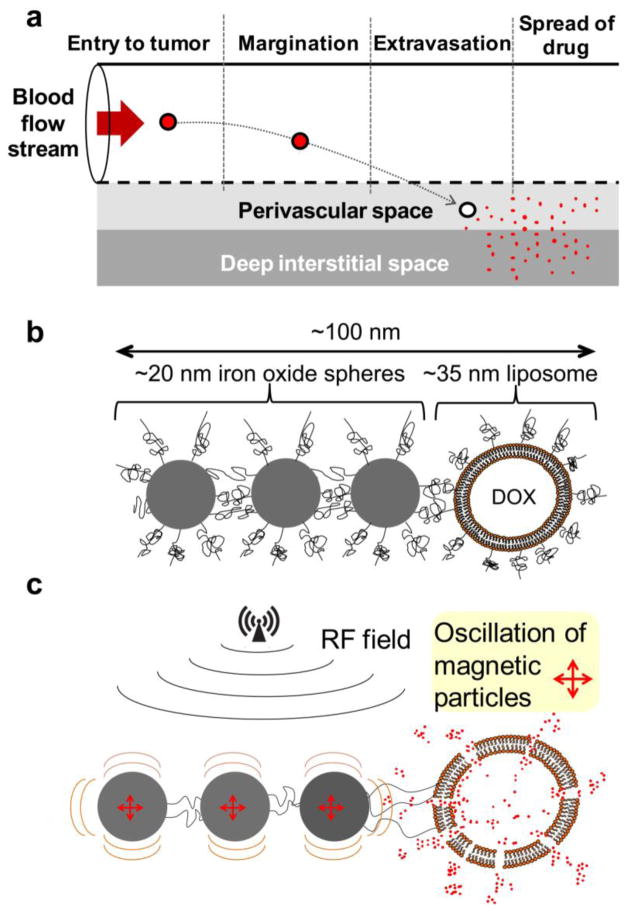
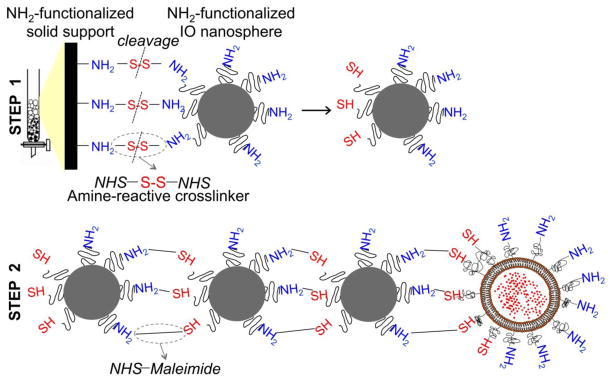
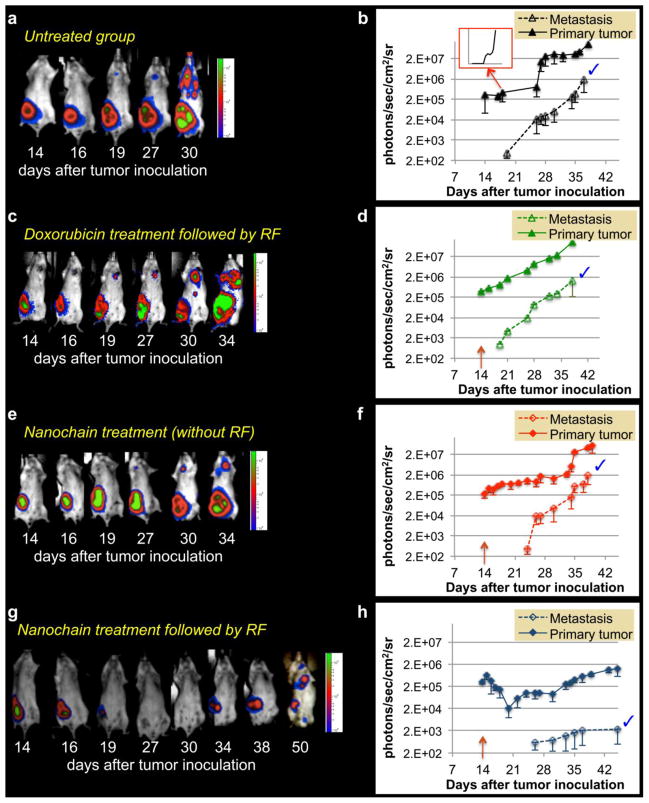
A two-step solid phase chemistry was employed to synthesize doxorubicin-loaded nanochains, which were composed of three iron oxide nanospheres and one doxorubicin-loaded liposome assembled in a 100-nm-long linear nanochain. The nanochains were tested in the 4T1-LUC-GFP orthotopic mouse model, which is a highly aggressive breast cancer model. The 4T1-LUC-GFP cell line stably expresses firefly luciferase, which allowed the non-invasive in vivo imaging of tumor response to the treatment using bioluminescence imaging (BLI).
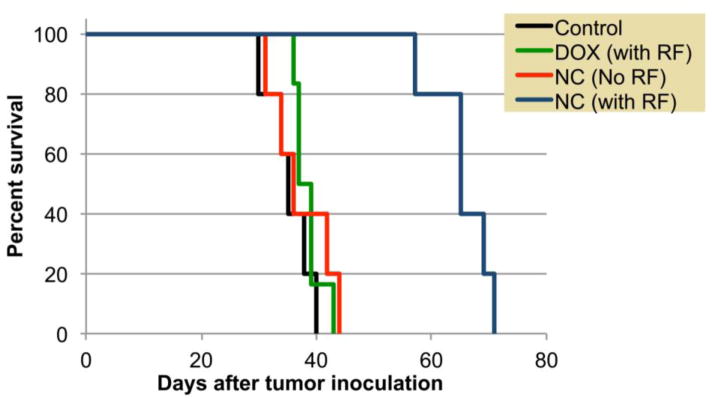
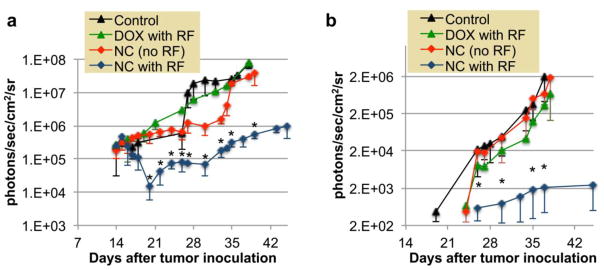
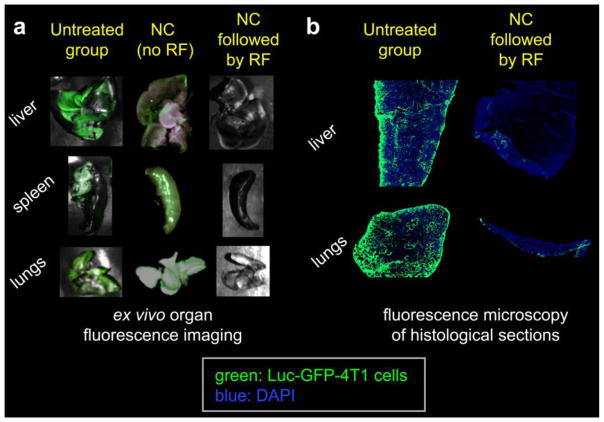
Longitudinal BLI imaging showed that a single nanochain treatment followed by application of RF resulted in an at least 100-fold lower BLI signal compared to the groups treated with nanochains (without RF) or free doxorubicin followed by RF. A statistically significant increase in survival time of the nanochain-treated animals followed by RF (64.3 days) was observed when compared to the nanochain-treated group without RF (35.7 days), free doxorubicin-treated group followed by RF (38.5 days), and the untreated group (30.5 days; n=5 animals per group).
These studies showed that the combination of RF and nanochains has the potential to effectively treat highly aggressive cancers and prolong survival.
评估射频(RF)触发多组分链状纳米颗粒释放药物以抑制侵袭性乳腺肿瘤生长的能力。
采用两步固相化学法合成负载阿霉素的纳米链,其由三个氧化铁纳米球和一个负载阿霉素的脂质体组装成100纳米长的线性纳米链。在4T1-LUC-GFP原位小鼠模型中对纳米链进行测试,该模型是一种高度侵袭性乳腺癌模型。4T1-LUC-GFP细胞系稳定表达萤火虫荧光素酶,这使得能够使用生物发光成像(BLI)对肿瘤对治疗的反应进行非侵入性体内成像。
纵向BLI成像显示,与纳米链(无RF)或游离阿霉素后接RF处理的组相比,单次纳米链处理后施加RF导致BLI信号至少低100倍。与无RF的纳米链处理组(35.7天)、游离阿霉素处理后接RF的组(38.5天)和未处理组(30.5天;每组n = 5只动物)相比,观察到纳米链处理后接RF的动物存活时间有统计学显著增加(64.3天)。
这些研究表明,RF与纳米链的组合有潜力有效治疗高度侵袭性癌症并延长生存期。