Ke Xiao, Chen Jingtuan, Zhang Xin, Fang Wenyi, Yang Chunbo, Peng Jun, Chen Youqin, Sferra Thomas J
Department of Gastroenterology, Second Affiliated Hospital of Fujian University of Traditional Chinese Medicine, Fuzhou, Fujian 350003;
Exp Ther Med. 2013 Jul;6(1):189-193. doi: 10.3892/etm.2013.1071. Epub 2013 Apr 22.
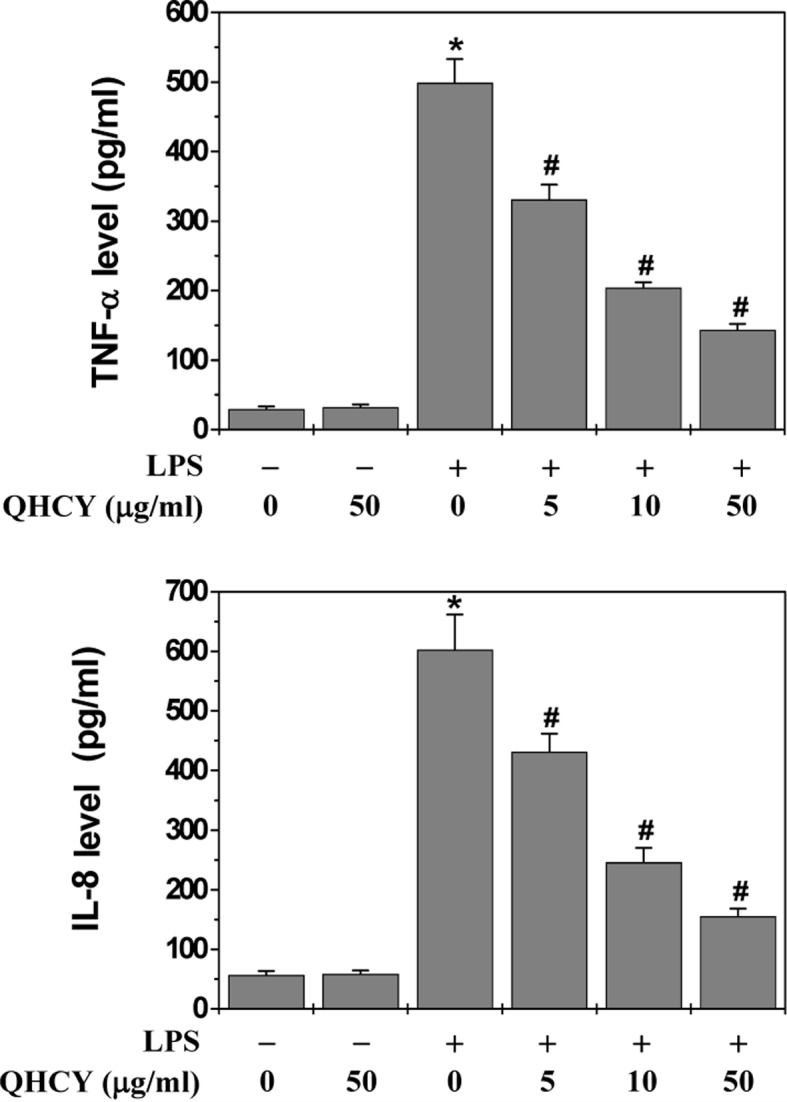
Ulcerative colitis (UC) is a major form of inflammatory bowel disease (IBD), which is tightly regulated by the nuclear factor κB (NF-κB) pathway. Thus, the suppression of NF-κB signaling may provide a promising strategy for the treatment of UC. Qing Hua Chang Yin (QHCY) is a traditional Chinese formulation, which has been used for a number of years to clinically treat UC. However, little is known with regard to its anti-inflammatory properties. In the present study, lipopolysaccharide (LPS)-stimulated Caco-2 cells were used as an inflammatory model of the human intestinal epithelium to evaluate the anti-inflammatory effects of QHCY and its underlying molecular mechanisms. We observed that QHCY inhibited the inflammatory response in intestinal epithelial cells as it significantly and concentration-dependently reduced the LPS-induced secretion of pro-inflammatory TNF-α and IL-8 in Caco-2 cells. Furthermore, QHCY treatment inhibited the phosphorylation of IκB and the nuclear translocation of NF-κB in Caco-2 cells in a concentration-dependent manner, indicating that QHCY suppressed the activation of the NF-κB signaling pathway. Collectively, our results suggest that the inhibition of NF-κB-mediated inflammation may constitute a potential mechanism by which QHCY treats UC.
溃疡性结肠炎(UC)是炎症性肠病(IBD)的一种主要形式,其受到核因子κB(NF-κB)信号通路的严格调控。因此,抑制NF-κB信号传导可能为UC的治疗提供一种有前景的策略。清化畅饮(QHCY)是一种中药配方,多年来一直用于临床治疗UC。然而,其抗炎特性鲜为人知。在本研究中,脂多糖(LPS)刺激的Caco-2细胞被用作人类肠上皮细胞的炎症模型,以评估QHCY的抗炎作用及其潜在的分子机制。我们观察到,QHCY抑制肠上皮细胞中的炎症反应,因为它显著且浓度依赖性地降低了LPS诱导的Caco-2细胞中促炎细胞因子TNF-α和IL-8的分泌。此外,QHCY处理以浓度依赖性方式抑制Caco-2细胞中IκB的磷酸化和NF-κB的核转位,表明QHCY抑制了NF-κB信号通路的激活。总体而言,我们的结果表明,抑制NF-κB介导的炎症可能是QHCY治疗UC的潜在机制。