Institute of Urology and Nephrology, First Affiliated Hospital of Guangxi Medical University, Nanning, Guangxi Zhuang Autonomous Region, China.
PLoS One. 2013 Jul 23;8(7):e67152. doi: 10.1371/journal.pone.0067152. Print 2013.
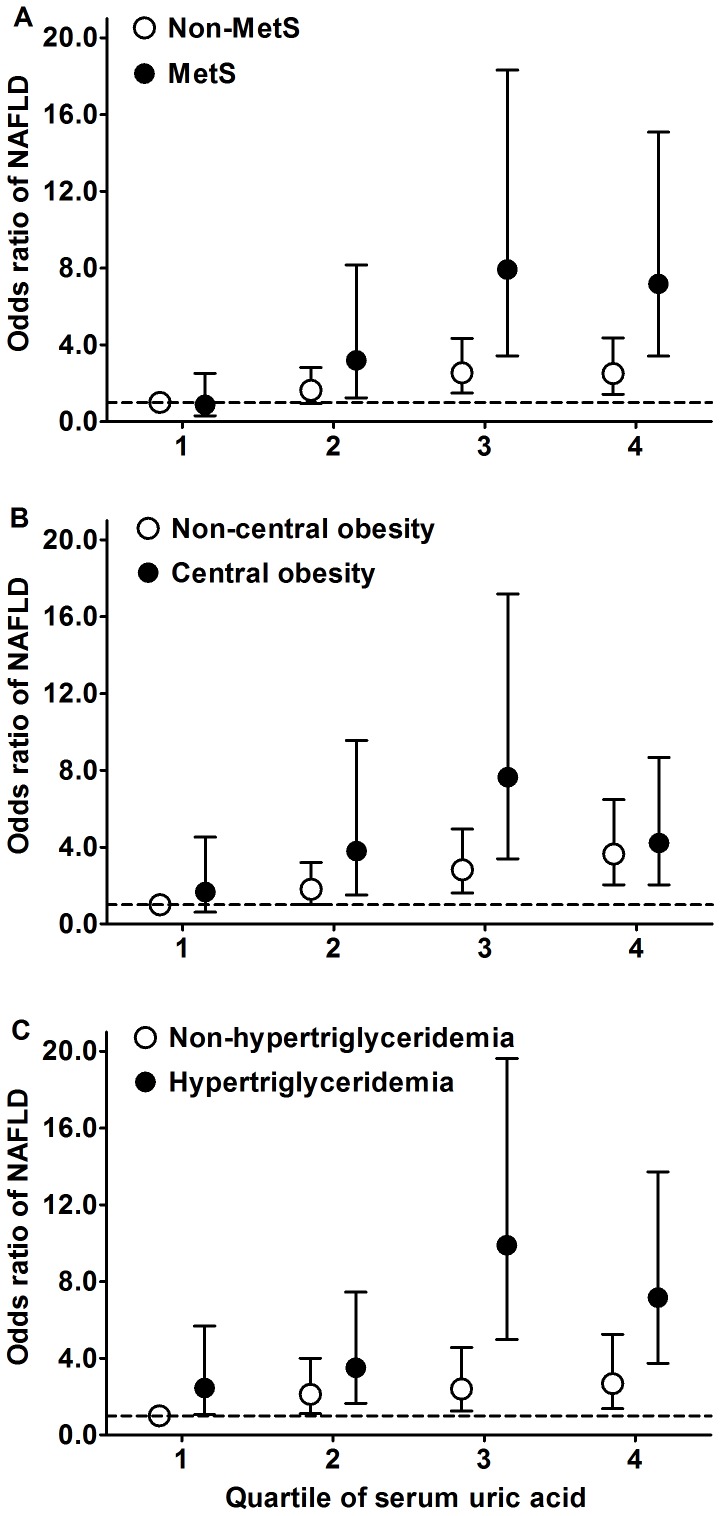
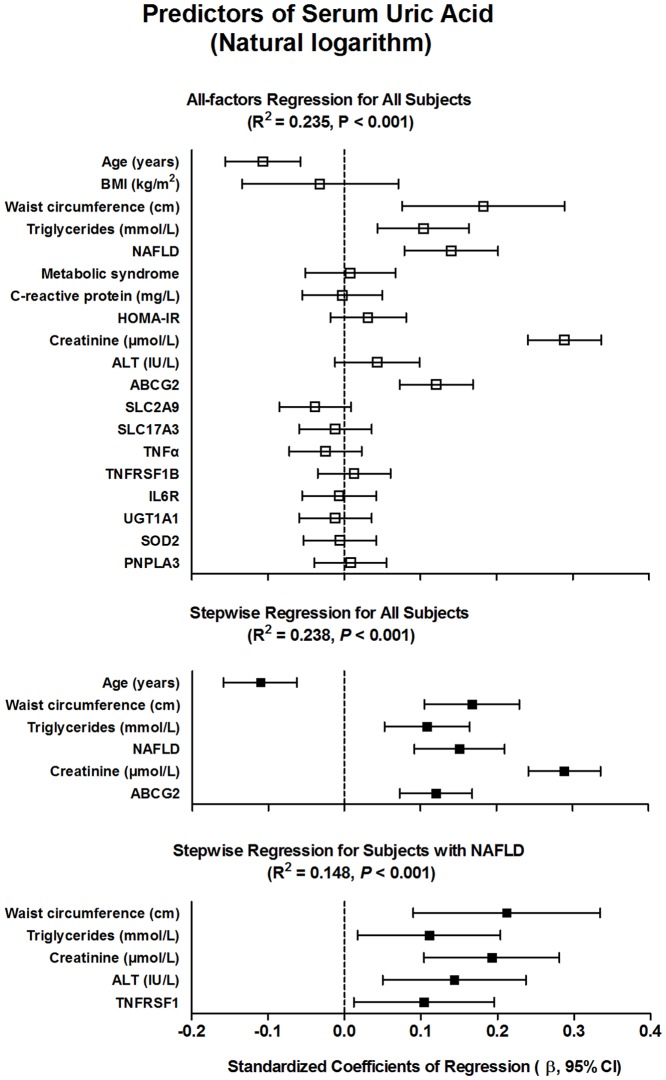
Increased serum uric acid (SUA) levels may be involved in the development of non-alcoholic fatty liver disease (NAFLD) in men presenting with metabolic syndrome (MetS) and/or insulin resistance. We aimed to determine the independent relationship between SUA and NAFLD in non-diabetic Chinese male population, and to explore the determinants of SUA levels among indexes of adiposity, lipid, and genotypes pertaining to triglycerides metabolism, inflammation, oxidative stress, and SUA concentrations. A total of 1440 men, classified depending on the presence of ultrasonographically detected NAFLD, underwent a complete healthy checkup program. Genotypes were extracted from our previously established genome-wide association study database. After adjusting for age, smoking, drinking, body mass index, homeostasis model assessment of insulin resistance, C-reactive protein, creatinine, alanine aminotransferase (ALT) and components of metabolic syndrome, the odds ratio for NAFLD, comparing the highest with the lowest SUA quartile, was 2.81 (95% confidence interval 1.66-4.76). A stepwise multivariate linear regression analysis (R(2) = 0.238, P<0.001) retained age, waist circumference, serum creatinine, triglycerides, the Q141K variant in ABCG2 (rs2231142) and NAFLD as significant predictors of SUA levels (all P<0.001). Besides, ALT and Met196Arg variant in TNFRSF1B (rs1061622) additionally associated with SUA among individuls with NAFLD. Our data suggest that in Chinese men, elevated SUA is significantly associated with NAFLD, independent of insulin resistance and other metabolic disorders, such as central obesity or hypertriglyceridemia. Meanwhile, among subjects with NAFLD, index of liver damage, such as elevated ALT combined with genetic susceptibility to inflammation associated with increased SUA levels.
血清尿酸(SUA)水平升高可能与代谢综合征(MetS)和/或胰岛素抵抗男性中非酒精性脂肪性肝病(NAFLD)的发展有关。我们旨在确定非糖尿病中国男性人群中 SUA 与 NAFLD 之间的独立关系,并探讨与肥胖、血脂和与甘油三酯代谢、炎症、氧化应激和 SUA 浓度有关的基因型相关的 SUA 水平的决定因素。共有 1440 名男性根据超声检测到的 NAFLD 的存在进行了全面的健康检查计划。从我们之前建立的全基因组关联研究数据库中提取了基因型。在调整年龄、吸烟、饮酒、体重指数、胰岛素抵抗的稳态模型评估、C 反应蛋白、肌酐、丙氨酸氨基转移酶(ALT)和代谢综合征的成分后,NAFLD 的比值比,与 SUA 四分位最低相比,最高四分位为 2.81(95%置信区间 1.66-4.76)。逐步多元线性回归分析(R²=0.238,P<0.001)保留了年龄、腰围、血清肌酐、甘油三酯、ABCG2 中的 Q141K 变体(rs2231142)和 NAFLD 是 SUA 水平的重要预测因子(均 P<0.001)。此外,在患有 NAFLD 的个体中,TNFRSF1B 中的 ALT 和 Met196Arg 变体(rs1061622)也与 SUA 相关。我们的数据表明,在中国男性中,SUA 升高与 NAFLD 显著相关,与胰岛素抵抗和其他代谢紊乱无关,如中心性肥胖或高甘油三酯血症。同时,在患有 NAFLD 的患者中,肝损伤指标,如升高的 ALT 与炎症相关的遗传易感性相结合,导致 SUA 水平升高。