Department of Applied Statistics, Faculty of Economics and Administration, University of Malaya, Kuala Lumpur, Malaysia.
PLoS One. 2013 Jul 30;8(7):e68728. doi: 10.1371/journal.pone.0068728. Print 2013.
Tobacco smoking (TS) and illicit drug use (IDU) are of public health concerns especially in developing countries, including Bangladesh. This paper aims to (i) identify the determinants of TS and IDU, and (ii) examine the association of TS with IDU among young slum dwellers in Bangladesh.
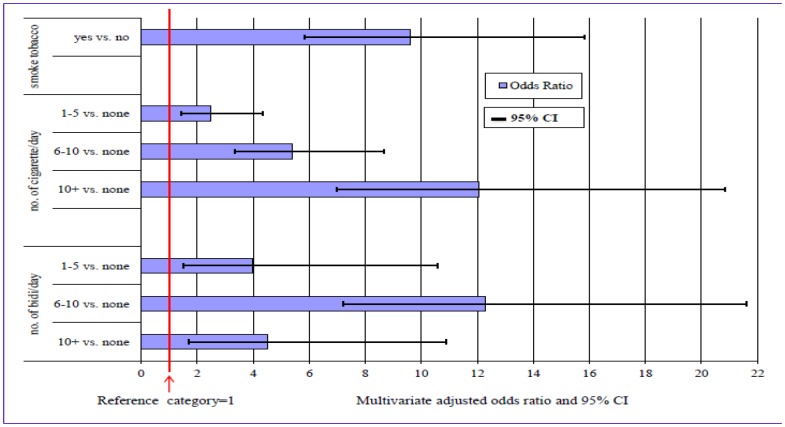
METHODOLOGY/PRINCIPAL FINDINGS: Data on a total of 1,576 young slum dwellers aged 15-24 years were extracted for analysis from the 2006 Urban Health Survey (UHS), which covered a nationally representative sample of 13,819 adult men aged 15-59 years from slums, non-slums and district municipalities of six administrative regions in Bangladesh. Methods used include frequency run, Chi-square test of association and multivariable logistic regression. The overall prevalence of TS in the target group was 42.3%, of which 41.4% smoked cigarettes and 3.1% smoked bidis. The regression model for TS showed that age, marital status, education, duration of living in slums, and those with sexually transmitted infections were significantly (p<0.001 to p<0.05) associated with TS. The overall prevalence of IDU was 9.1%, dominated by those who had drug injections (3.2%), and smoked ganja (2.8%) and tari (1.6%). In the regression model for IDU, the significant (p<0.01 to p<0.10) predictors were education, duration of living in slums, and whether infected by sexually transmitted diseases. The multivariable logistic regression (controlling for other variables) revealed significantly (p<0.001) higher likelihood of IDU (OR = 9.59, 95% CI = 5.81-15.82) among users of any form of TS. The likelihood of IDU increased significantly (p<0.001) with increased use of cigarettes.
CONCLUSIONS/SIGNIFICANCE: Certain groups of youth are more vulnerable to TS and IDU. Therefore, tobacco and drug control efforts should target these groups to reduce the consequences of risky lifestyles through information, education and communication (IEC) programs.
吸烟(TS)和非法药物使用(IDU)是公共卫生关注的问题,尤其是在发展中国家,包括孟加拉国。本文旨在:(i)确定 TS 和 IDU 的决定因素,以及(ii)检验孟加拉国贫民窟青年中 TS 与 IDU 的关联。
方法/主要发现:从 2006 年城市健康调查(UHS)中提取了总共 1576 名年龄在 15-24 岁的贫民窟青年的数据进行分析,该调查覆盖了孟加拉国六个行政区的 13819 名年龄在 15-59 岁的成年男性,包括贫民窟、非贫民窟和地区市。使用的方法包括频率运行、关联的卡方检验和多变量逻辑回归。目标人群中 TS 的总体患病率为 42.3%,其中 41.4%吸烟,3.1%吸比迪烟。TS 的回归模型显示,年龄、婚姻状况、教育程度、在贫民窟居住的时间长短,以及患有性传播感染的人,与 TS 显著相关(p<0.001 至 p<0.05)。IDU 的总体患病率为 9.1%,主要由注射吸毒者(3.2%)、吸食大麻(2.8%)和吸食大麻叶(1.6%)者组成。在 IDU 的回归模型中,教育程度、在贫民窟居住的时间长短,以及是否感染性传播疾病,这些显著的预测因素(p<0.01 至 p<0.10)。多变量逻辑回归(控制其他变量)显示,任何形式的 TS 使用者 IDU 的可能性显著增加(OR=9.59,95%CI=5.81-15.82)。随着吸烟量的增加,IDU 的可能性显著增加(p<0.001)。
结论/意义:某些青年群体更容易受到 TS 和 IDU 的影响。因此,应该通过信息、教育和宣传(IEC)方案,针对这些群体开展烟草和药物控制工作,减少危险生活方式的后果。