Department of Public Health and Informatics, Jahangirnagar University, Savar, Dhaka, Bangladesh.
CHINTA Research Bangladesh, Savar, Dhaka, Bangladesh.
PLoS One. 2021 Jul 21;16(7):e0254926. doi: 10.1371/journal.pone.0254926. eCollection 2021.
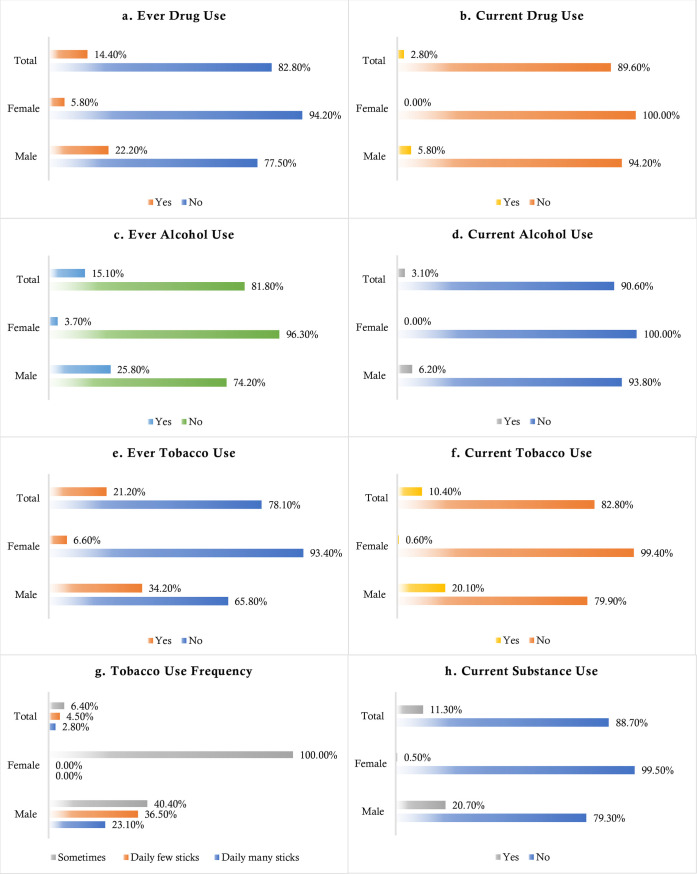
Substance abuse is a major concern worldwide and is increasing rapidly in Bangladesh. However, there are no prior studies concerning lifestyle-related factors that influence adolescents' substance use behavior. Therefore, the present study investigated the prevalence of substance use and its associated sociodemographic and lifestyle-related risk factors among a total of 424 Bangladeshi high school-going adolescents through a structured questionnaire interview study. The survey questionnaire consisted of socio-demographics, lifestyle-related information, and substance use-related questions. For data analysis, descriptive and inferential statistics were performed using SPSS (Statistical Package for Social Science) version 22.0, and a p-value of <0.05 determined statistical significance. Results showed that 21.2%, 14.4%, and 15.1% of the participants reported smoking, using a drug, and consuming alcohol, respectively, at least once during their lifespan; whereas the current (i.e., past-month) rates were reported to be 10.4%, 2.8%, and 3.1%, respectively. Overall, the current substance use risk factors were identified as being male, not being from science academic background, having less family influence on personal life, irregular teeth brushing, being smartphone users, using a smartphone for a longer time, and being late-night sleepers. From the list of identified risk factors of substance use, those that are modifiable may be targeted to evolve a prevention program to manage this problem in Bangladeshi adolescents.
物质滥用是一个全球性的主要关注点,在孟加拉国迅速增加。然而,目前还没有关于影响青少年物质使用行为的与生活方式相关因素的研究。因此,本研究通过结构问卷调查研究调查了总共 424 名孟加拉国高中青少年的物质使用情况及其与社会人口统计学和生活方式相关的风险因素的流行情况。调查问卷包括社会人口统计学、与生活方式相关的信息和物质使用相关的问题。为了进行数据分析,使用 SPSS(社会科学统计软件包)版本 22.0 进行了描述性和推断性统计,p 值<0.05 表示具有统计学意义。结果表明,21.2%、14.4%和 15.1%的参与者报告在一生中至少有一次吸烟、使用药物和饮酒;而目前(即过去一个月)的报告率分别为 10.4%、2.8%和 3.1%。总体而言,目前的物质使用风险因素被确定为男性、非科学学术背景、个人生活中家庭影响较小、刷牙不规律、使用智能手机、使用智能手机时间较长和晚睡者。在确定的物质使用风险因素中,那些可以改变的因素可能会被用来制定预防计划,以管理孟加拉国青少年的这个问题。