Department of Immunology and Infectious Diseases, Harvard School of Public Health, Boston, Massachusetts, United States of America.
PLoS One. 2013 Jul 25;8(7):e68940. doi: 10.1371/journal.pone.0068940. Print 2013.
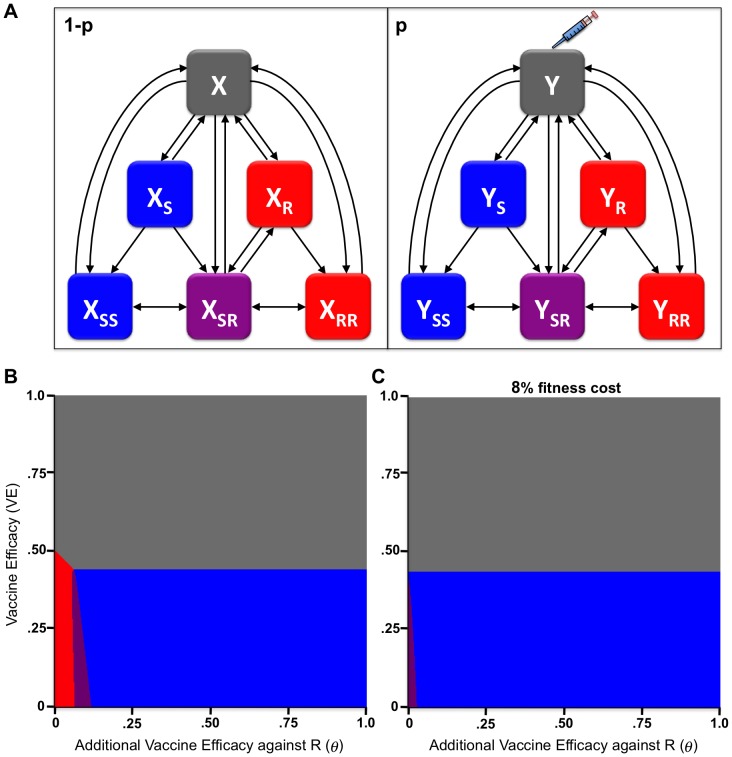
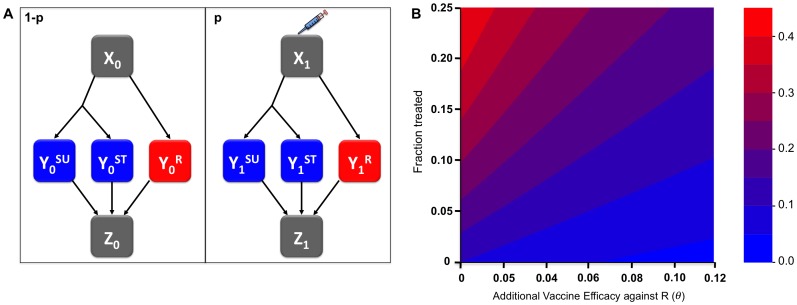
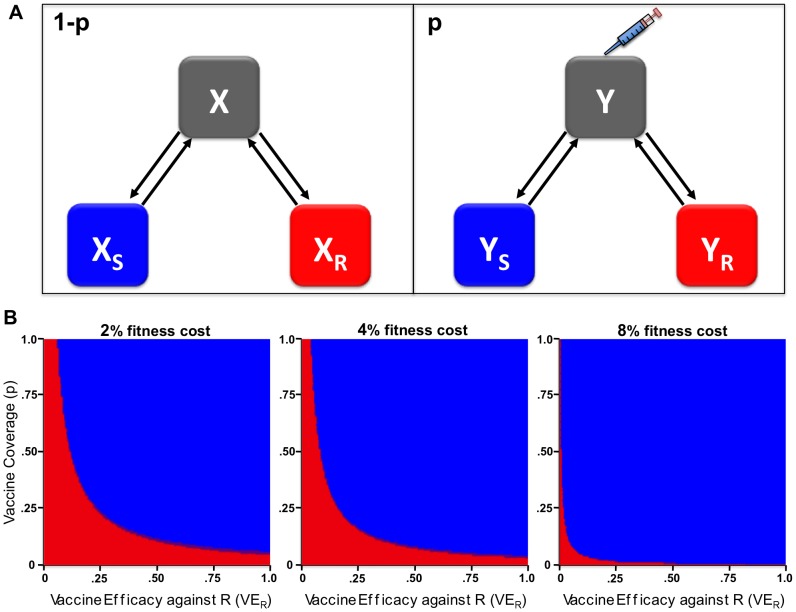
The growing prevalence of antimicrobial resistance in major pathogens is outpacing discovery of new antimicrobial classes. Vaccines mitigate the effect of antimicrobial resistance by reducing the need for treatment, but vaccines for many drug-resistant pathogens remain undiscovered or have limited efficacy, in part because some vaccines selectively favor pathogen strains that escape vaccine-induced immunity. A strain with even a modest advantage in vaccinated hosts can have high fitness in a population with high vaccine coverage, which can offset a strong selection pressure such as antimicrobial use that occurs in a small fraction of hosts. We propose a strategy to target vaccines against drug-resistant pathogens, by using resistance-conferring proteins as antigens in multicomponent vaccines. Resistance determinants may be weakly immunogenic, offering only modest specific protection against resistant strains. Therefore, we assess here how varying the specific efficacy of the vaccine against resistant strains would affect the proportion of drug-resistant vs. -sensitive strains population-wide for three pathogens--Streptococcus pneumoniae, Staphylococcus aureus, and influenza virus--in which drug resistance is a problem. Notably, if such vaccines confer even slightly higher protection (additional efficacy between 1% and 8%) against resistant variants than sensitive ones, they may be an effective tool in controlling the rise of resistant strains, given current levels of use for many antimicrobial agents. We show that the population-wide impact of such vaccines depends on the additional effect on resistant strains and on the overall effect (against all strains). Resistance-conferring accessory gene products or resistant alleles of essential genes could be valuable as components of vaccines even if their specific protective effect is weak.
主要病原体中抗菌药物耐药性的日益流行速度超过了新抗菌药物类别的发现速度。疫苗通过减少治疗的需求来减轻抗菌药物耐药性的影响,但针对许多耐药病原体的疫苗仍未被发现或疗效有限,部分原因是一些疫苗选择性地有利于逃避疫苗诱导免疫的病原体菌株。在接种宿主中即使具有适度优势的菌株,在疫苗接种率高的人群中也具有高适应性,这可以抵消在一小部分宿主中发生的强烈选择压力,如抗菌药物的使用。我们提出了一种针对耐药病原体疫苗的策略,即在多组分疫苗中使用赋予耐药性的蛋白作为抗原。耐药决定因素可能免疫原性较弱,仅对耐药菌株提供适度的特异性保护。因此,我们在这里评估了针对三种病原体(肺炎链球菌、金黄色葡萄球菌和流感病毒)中耐药性问题的疫苗对耐药菌株的特定功效的变化如何影响耐药与敏感菌株在人群中的比例,在这些病原体中,耐药性是一个问题。值得注意的是,如果这些疫苗对耐药变体的保护作用稍高(对敏感菌株的额外疗效在 1%至 8%之间),那么考虑到目前许多抗菌药物的使用水平,它们可能是控制耐药菌株上升的有效工具。我们表明,此类疫苗的人群影响取决于对耐药菌株的额外效果和总体效果(针对所有菌株)。即使它们的特定保护效果较弱,赋予耐药性的辅助基因产物或必需基因的耐药等位基因也可以作为疫苗的组成部分具有价值。